
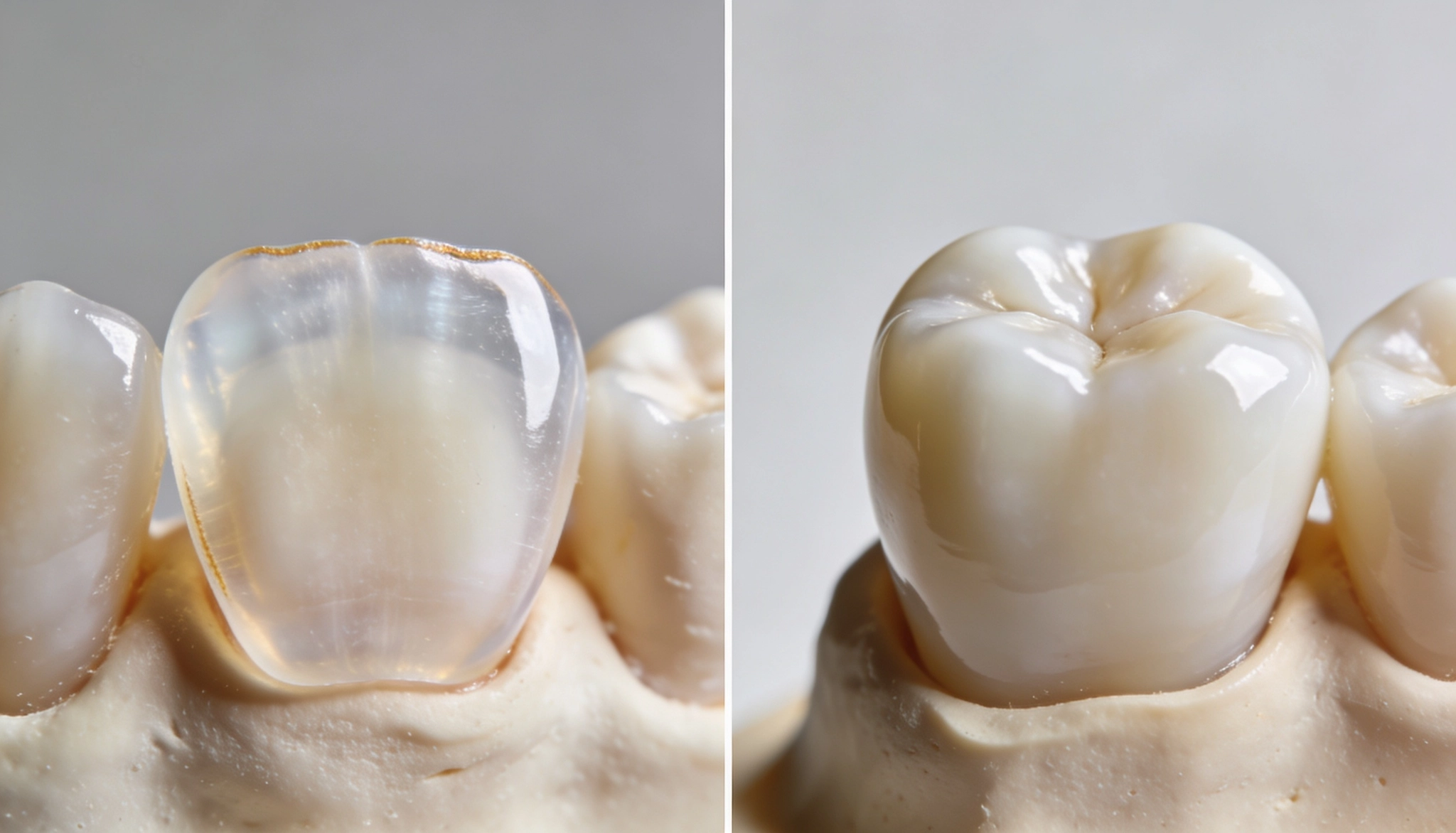
If you’ve narrowed your dental restoration choice down to two options — a crown or a veneer — you’re already most of the way there. The wrong call between these two can cost you a healthy tooth, hundreds of dollars, or years of redo work. The right call protects your tooth for 10 to 20+ years and looks indistinguishable from your natural smile.
This guide walks you through the decision the way a prosthodontist actually thinks about it: starting with your tooth’s condition, not your budget. We’ll cover the structural difference, the decision framework, the material breakdown, the pain and recovery, and what each costs in the US, UK, Australia, and Bangkok. By the end, you’ll know exactly which one fits your tooth — and why.
Quick answer: A veneer covers only the front of a structurally healthy tooth (about 0.5 mm of enamel removed). A crown covers the entire tooth (about 1.5–2 mm reduced) and is needed when the tooth is broken, decayed, post–root canal, or otherwise structurally compromised. Healthy tooth, cosmetic concern → veneer. Damaged tooth → crown.
Crown vs Veneer at a Glance
Here’s the entire comparison in one table. Bookmark this — every section below is just a deeper dive into one of these rows.
| Veneer | Crown | |
|---|---|---|
| Coverage | Front face only (thin shell) | Entire tooth (cap) |
| Thickness | 0.3–0.7 mm | 1.5–2.5 mm |
| Tooth removed | ~0.5 mm of enamel | ~1.5–2 mm all around |
| Primary use | Cosmetic on healthy teeth | Restorative on damaged teeth |
| Best for | Discoloration, minor chips, gaps, slight rotation | Cracks, large fillings, post–root canal, severe decay |
| Materials | Composite, porcelain, E-max, LiSi-press, zirconia | E-max, zirconia, PFM, gold |
| Longevity | 5–7 yrs (composite) / 10–15+ yrs (porcelain) | 10–15+ yrs (E-max) / 20+ yrs (zirconia) |
| Reversibility | Technically irreversible (some enamel removed) | Irreversible (significant tooth reduction) |
| Bangkok price | 4,000–14,000 THB (~$120–430) | 16,000–18,000 THB (~$490–550) |
| US price | $250–2,500 per tooth | $1,000–3,500 per tooth |
| Treatment time | 1 day (composite) / 10–12 days (porcelain) | 7 days |
| Warranty (DVB) | 1 year | 1 year |
TL;DR:
- Tooth is healthy, concern is cosmetic → Veneer
- Tooth is broken, decayed, or root-canal-treated → Crown
- Borderline case → keep reading
Skip to our veneer options in Bangkok or crown options in Bangkok if you already know which you need.
What Is a Dental Crown?
A dental crown — sometimes called a “cap” — is a custom-made covering that fits over the entire visible portion of a tooth, from the gum line up. Once cemented in place, it functions as the tooth: you bite, chew, and smile with it as if it were natural.
Crowns are placed when a tooth has lost too much structure to be restored with a filling, an inlay, or a veneer. Common scenarios include large existing fillings that have failed, fractured teeth, teeth that have undergone root canal therapy, and teeth worn down by grinding.
Crown materials
| Material | Strength | Aesthetics | Best for |
|---|---|---|---|
| E-max (lithium disilicate) | Strong (360–400 MPa) | Excellent translucency | Front and premolar teeth |
| Zirconia | Strongest (900–1,200 MPa) | Very good (modern multilayer) | Molars, grinders, posterior |
| PFM (porcelain-fused-to-metal) | Strong | Acceptable, may show metal at gum line | Budget option (not offered at our clinic) |
| Gold alloy | Durable | Visibly metallic | Rear molars, traditional choice |
Treatment timeline
At Dental Veneer Bangkok, crown placement is completed in 7 days across 2 visits using CAD/CAM digital impressions and an in-house lab — no shipping delays. Day 1: consultation, prep, temporary crown. Day 7: permanent bonding and bite adjustment.
Full pricing and process on our dental crowns Bangkok page.
What Is a Dental Veneer?
A dental veneer is a thin, custom-made shell that covers only the front surface of a tooth. Think of it as a sticker the thickness of a fingernail, bonded permanently to the visible side of the tooth. The back, sides, and biting edge of the tooth remain untouched.
Veneers are a cosmetic restoration. They exist to fix how a tooth looks — its colour, shape, length, alignment, or surface texture — without altering how it functions. Because they require minimal tooth preparation (about 0.5 mm of enamel removed, sometimes none with no-prep techniques), they’re considered the most conservative way to dramatically change a smile.
Veneer materials
| Material | Strength | Aesthetics | Best for |
|---|---|---|---|
| Composite resin | Moderate | Good | Single-tooth fixes, budget, same-day |
| Porcelain (feldspathic) | Good | Excellent | Multiple teeth, full smile makeover |
| E-max veneer | Strong | Excellent translucency | Single anterior teeth needing strength |
| LiSi-press | Strong | Excellent | Cosmetic restorations needing precision |
| Zirconia veneer | Strongest veneer option | Very good (less translucent) | Severely discoloured substrate needing full opacity |
Treatment timeline
- Composite veneer: 1 day (sculpted directly on the tooth, hardened with light)
- Composite veneer with digital design: 3 days
- Porcelain veneer: 10–12 days across 3 visits
Compare composite vs porcelain in detail on our veneers Bangkok page.
The Real Difference: Coverage, Thickness, and Tooth Removal
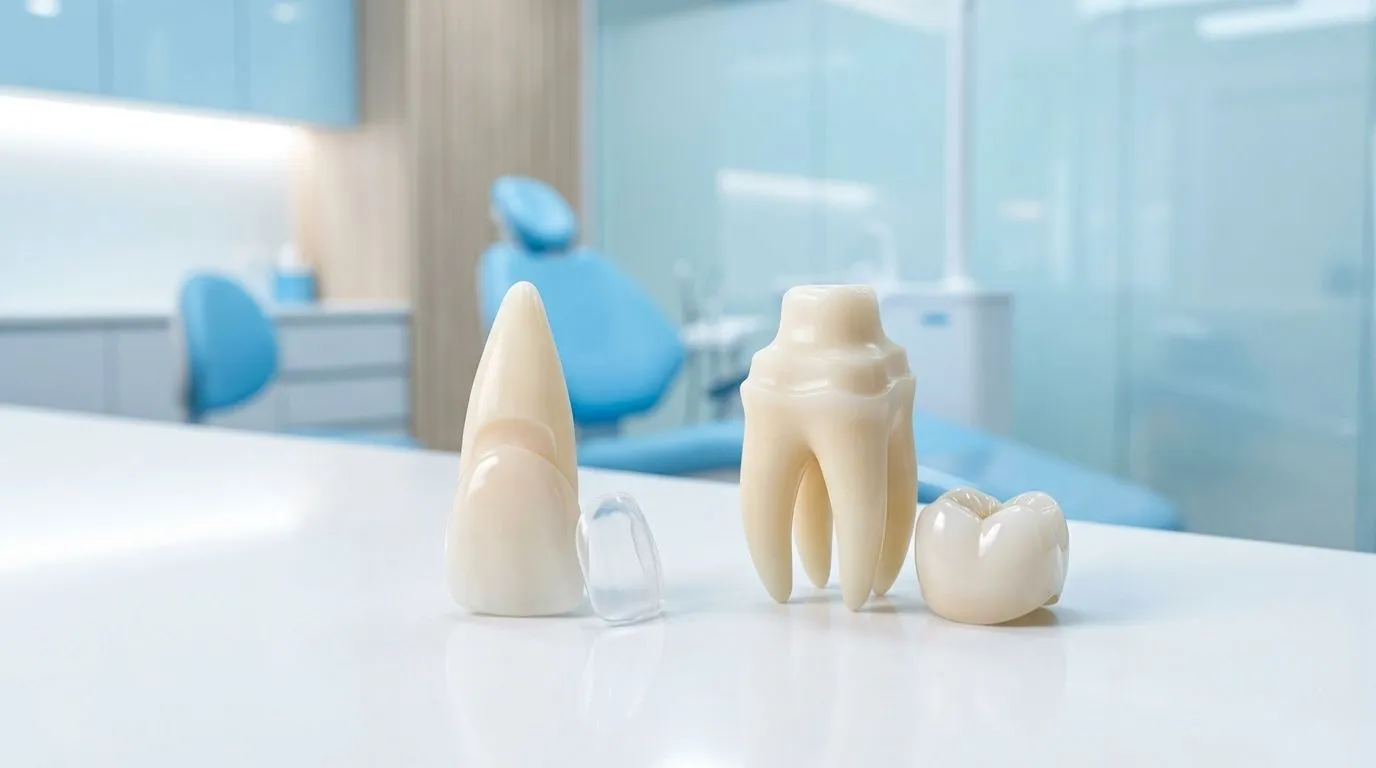
This is the single most important section to understand. The difference between a crown and a veneer is not about price, materials, or longevity — it’s about how much of your natural tooth has to be sacrificed to place each one.
The numbers
- Veneer prep: ~0.5 mm of enamel removed from the front face only
- Crown prep: ~1.5–2 mm reduced from all sides (front, back, sides, biting edge)
That means a crown removes 3 to 5 times more natural tooth structure than a veneer. Once gone, that enamel never grows back.
Why this matters long-term
Every millimeter of enamel removed is a permanent decision. The more you reduce the tooth, the more you compromise its long-term structure and the harder it becomes to redo treatment in 15–20 years if needed.
This is why a good cosmetic dentist chooses the least invasive option that solves the problem. If a veneer can do the job — meaning the underlying tooth is sound — then a crown is overtreatment. Conversely, placing a veneer over a structurally weak tooth is like wallpapering over a crumbling wall: it’ll fail.
The Decision Framework: Which Should You Choose?
Here’s the four-question decision tree a prosthodontist runs through with every patient.
Question 1: Is your tooth structurally damaged?
This means: a crack reaching the dentin layer, a large existing filling that’s failed, a chip larger than 2 mm, or any fracture extending into the pulp chamber.
- Yes → Crown. A veneer cannot reinforce a structurally compromised tooth.
- No → Continue to Q2.

Question 2: Has the tooth had a root canal?
A root-canal-treated tooth becomes brittle over time because it has no internal blood supply or living dentin.
- Yes (back tooth): Crown — required to prevent vertical fracture under chewing forces.
- Yes (front tooth): Often a veneer or even internal bleaching is enough — depends on remaining structure. Discuss with your dentist.
- No → Continue to Q3.
Question 3: Is the issue purely cosmetic — colour, shape, minor chip, gap, slight rotation?
- Yes → Veneer. Conservative, beautiful, minimum tooth removed.
- No → Continue to Q4.
Question 4: Is the tooth severely discoloured intrinsically (old tetracycline staining, trauma) AND you want maximum opacity?
- Yes → Could be either. Zirconia veneer or full crown both work. A prosthodontist will help you decide based on translucency requirements and how much enamel is left.
- No → Veneer (porcelain or E-max).
Reality check: About 70% of cosmetic restoration patients fall cleanly on one side or the other. The remaining 30% are borderline cases that benefit from a free consultation and a real-life intra-oral exam.
Book a free consultation — in person at our Siam clinic or via WhatsApp video call.
By Tooth Condition: When Each Wins
Most patients arrive knowing what’s wrong with their tooth, not which restoration to choose. Here’s the matrix.
Chipped tooth
- Small chip (under 2 mm, no exposed dentin): Direct composite bonding (cheapest) or composite veneer. Crown is overkill.
- Medium chip (2–4 mm, dentin exposed): Porcelain veneer.
- Large chip (more than half the tooth, or near the pulp): Crown.
Cracked or broken tooth
A crack that extends into the dentin or pulp will get worse under chewing forces — a veneer cannot stop crack propagation.
- Hairline surface crack only: Veneer can mask it cosmetically (with monitoring).
- Crack into dentin: Crown.
- Vertical root fracture: Usually unsalvageable — extraction + implant is the realistic plan.
Discoloured teeth
- Extrinsic staining (coffee, wine, tobacco): Whitening first. Veneer if whitening doesn’t work.
- Mild intrinsic discoloration (genetic, age-related): Porcelain veneer.
- Severe intrinsic staining (tetracycline, fluorosis, post-trauma “dead tooth”): Zirconia veneer or full crown for masking opacity. Internal bleaching can also work for non-vital teeth.
For dead-tooth discoloration, see our complete dead tooth treatment guide.
Gaps (diastema)
- Small to medium gap (1–3 mm): Veneer (composite or porcelain). Most common solution. Quick, conservative, no orthodontics needed.
- Large gap (over 3 mm): Veneer + careful planning, or orthodontic closure first.
- Multiple gaps: Veneer set + bite analysis.
After root canal therapy (RCT)
The classic question. The answer depends on tooth location:
- Front tooth, mostly intact: Veneer or even internal bleaching (especially for “dead tooth” cases).
- Premolar: Often crown, sometimes onlay.
- Molar: Crown — non-negotiable. Molars take 200+ PSI chewing forces; an unprotected RCT molar typically fractures within 5 years.
Large existing filling or extensive decay
When more than 50% of the tooth crown is filling material, the remaining tooth structure is too weak to support another filling.
- Crown. A veneer bonds to enamel — when most of the front face is composite or amalgam, there’s no enamel to bond to.
Front Teeth Specifically: A Special Case
Front teeth (incisors, canines) are different from back teeth in two ways: they take lateral forces only (no heavy chewing) and they’re always visible. Both factors push the decision toward veneers when feasible.
Why veneers often win on front teeth
- Less force = veneers hold up. A veneer doesn’t need to withstand 200 PSI molar chewing forces. On a front tooth, a porcelain veneer can last 15+ years.
- Conservation matters more. Front teeth are visible from age 6 to age 90 — preserving as much natural enamel as possible matters for your 50-year smile, not just the 15-year version.
- Translucency = aesthetics. A natural tooth’s enamel is slightly translucent, letting light bounce off the dentin underneath. E-max and porcelain veneers replicate this. Zirconia crowns, while stronger, look slightly more opaque.
When a crown is still right for a front tooth
- The tooth has a large failed filling and no enamel left to bond to
- A vertical fracture extends into the root
- Post-RCT trauma case where the tooth has lost most of its structure
- You want maximum opacity to mask severe intrinsic discoloration that won’t bleach
Prosthodontist note: Both lead dentists at Dental Veneer Bangkok are board-certified prosthodontists — meaning they specialise in crown, bridge, and veneer restorations. For complex front-tooth cases, this matters: shade-matching an E-max crown to adjacent natural teeth or porcelain veneers requires specialised training that general dentists don’t always have.
Materials Compared: E-max vs Zirconia vs Porcelain vs Composite
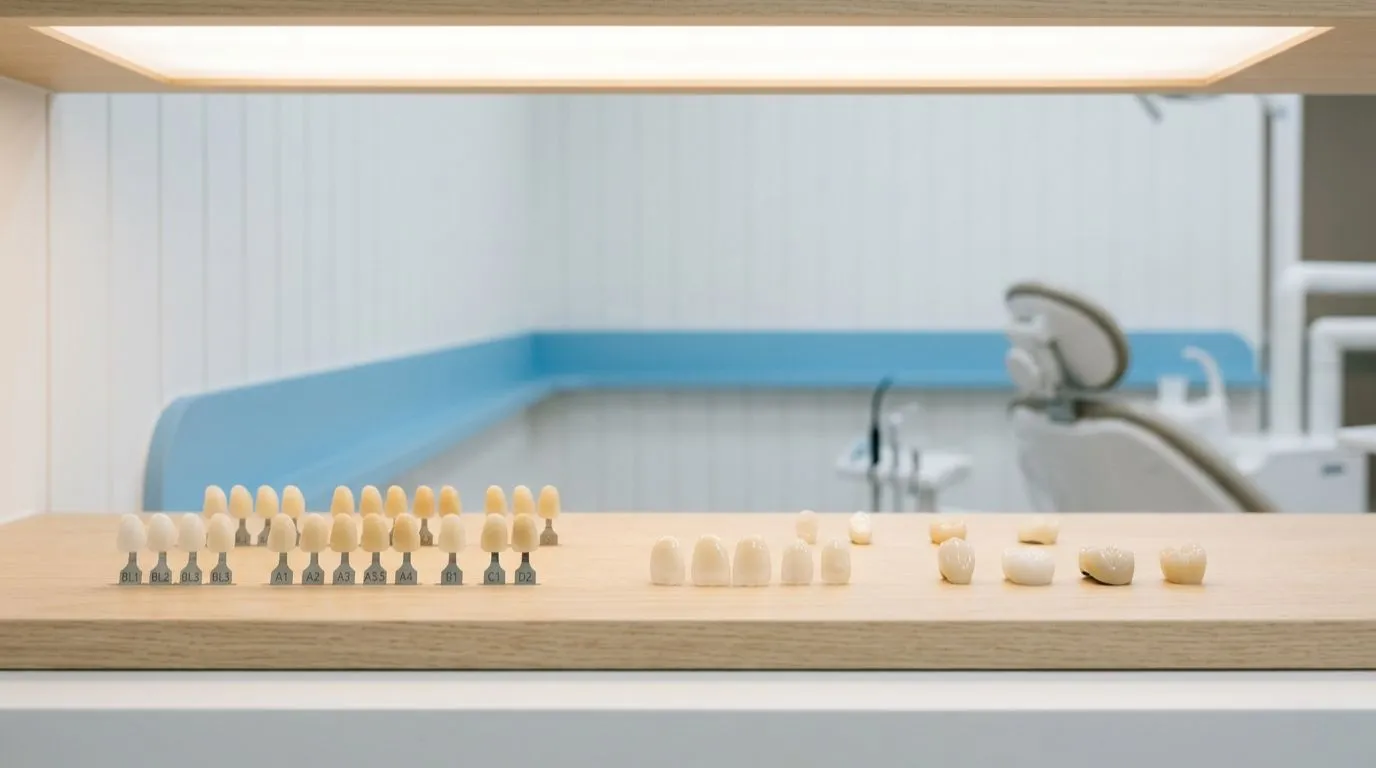
Material choice often matters more than the crown vs veneer decision itself. Here’s the cheat sheet.
| Material | Strength (MPa) | Translucency | Tooth prep | Best scenario |
|---|---|---|---|---|
| Composite resin | 80–120 | Moderate | Minimal (or none) | Same-day fix, budget, single tooth, reversible-ish |
| Feldspathic porcelain | 90–110 | Highest | 0.3–0.5 mm | Multi-tooth smile makeover, ultra-natural |
| E-max (lithium disilicate) | 360–400 | Excellent | 0.5–1 mm (veneer) / 1.5 mm (crown) | Front teeth, high aesthetics, single crowns |
| LiSi-press | 350–420 | Excellent | 0.5–1 mm | Cosmetic veneers, premolars |
| Zirconia (multilayer) | 900–1,200 | Good (modern) | 1.5–2 mm | Molars, grinders, severely stained substrates needing opacity |
| PFM | High (metal core) | Acceptable | 1.5–2 mm | Budget option, posterior |
Material decision shortcut
- Front tooth, single, beautiful translucency goal: E-max
- Multiple front teeth, full smile makeover: Porcelain or LiSi-press veneers
- Posterior tooth (molar/premolar): Zirconia crown
- Severely discoloured front tooth needing opacity: Zirconia veneer or full E-max crown
- Budget single-tooth fix, same-day: Composite veneer
Read our deep-dive on composite veneers in Bangkok or ceramic (porcelain) veneers in Bangkok.
How Long Do They Last?
Realistic lifespans by material, assuming reasonable home care, no chronic grinding, and 6-monthly dental check-ups:
| Restoration | Typical lifespan | Maximum lifespan with great care |
|---|---|---|
| Composite veneer | 5–7 years | 10 years |
| Porcelain veneer | 10–15 years | 20+ years |
| E-max veneer | 10–15 years | 20+ years |
| E-max crown | 10–15 years | 20+ years |
| Zirconia crown | 15–20+ years | 25+ years |
| Zirconia veneer | 15–20+ years | 25+ years |
What shortens the lifespan
- Bruxism (teeth grinding) without a night guard — the single biggest factor. Can halve lifespan.
- Hard-food habits — biting ice, hard candy, pen caps, opening bottles with teeth
- Poor oral hygiene — gum recession exposes the margin where the restoration meets the tooth, allowing decay underneath
- Skipping check-ups — small chips and cracks caught early can be repaired; left alone, they become full failures
Warranty at Dental Veneer Bangkok
All crowns and veneers placed at our clinic come with a 1-year warranty covering fractures, debonding, and material failures. Damage from improper use (grinding without a night guard, biting hard objects) is excluded. Beyond the warranty, repairs and replacements are quoted case by case at our standard pricing.
Tooth Preparation, Pain & Recovery
Both procedures are routine and completed under local anaesthesia. Here’s what’s actually different.
Pain during the procedure
- Veneer: Minimal. Many patients don’t even need anaesthesia for no-prep or composite veneers. For traditional porcelain veneers, local anaesthetic numbs the gum and slight enamel reduction is painless.
- Crown: More significant tooth preparation, always done under local anaesthetic. Painless during the procedure.
Post-op sensitivity
- Veneer: Mild. Some hot/cold sensitivity for 1–3 days as the tooth adjusts to the bonded shell.
- Crown: Moderate. Because more dentin is exposed during prep, sensitivity to hot, cold, and pressure can last 1–2 weeks while the tooth recovers. Over-the-counter ibuprofen is usually enough.
Recovery timeline
- Composite veneer: No recovery — eat normally same day. Avoid hard foods for 24 hours.
- Porcelain veneer: 2–3 days of mild sensitivity. Soft diet for the first day after final bonding.
- Crown: 5–7 days of intermittent sensitivity. Avoid sticky and very hard foods for the first week. Bite adjustment may be needed at a follow-up.
Bite adjustment
A common post-crown issue: the new crown feels “high” when biting. This is normal and easily corrected with a quick polishing visit. Always book a follow-up 1–2 weeks after a crown is placed.
Cost Comparison: Bangkok vs US, UK, Australia
Cost is rarely the deciding factor between crown and veneer (the medical indication is). But it’s almost always the deciding factor between getting it done at home or flying to Bangkok.
Per-tooth pricing (mid-range cosmetic clinics, 2026)
| Restoration | Bangkok (THB) | Bangkok (USD) | USA | UK | Australia |
|---|---|---|---|---|---|
| Composite veneer | 4,000 | ~$120 | $250–1,500 | £200–500 | A$400–800 |
| Composite veneer (digital design) | 6,000 | ~$185 | — | — | — |
| Porcelain veneer | 12,000–14,000 | ~$370–430 | $925–2,500 | £500–1,200 | A$1,500–3,000 |
| E-max crown | 16,000 | ~$490 | $1,000–3,500 | £600–1,200 | A$1,500–2,500 |
| Zirconia crown | 18,000 | ~$550 | $1,200–3,000 | £700–1,500 | A$1,800–3,500 |
Bangkok prices reflect Dental Veneer Bangkok’s standard rates (April 2026). International prices are typical mid-range cosmetic-clinic ranges; insurance coverage varies. Always confirm with a free consultation.
Are veneers cheaper than crowns?
Generally yes, but it depends on the material and case complexity. A composite veneer is much cheaper than any crown. A porcelain veneer is usually 20–30% cheaper than a comparable E-max crown, since less tooth preparation and slightly less material is involved.
Insurance reality
- Crowns are sometimes partially covered by dental insurance because they’re considered restorative (medically necessary).
- Veneers are almost never covered because they’re considered cosmetic.
- Out-of-pocket cost in the US/UK/AU often makes Bangkok competitive even with a flight + hotel factored in.
The Bangkok savings example
For a typical 6-tooth porcelain veneer smile makeover:
| Bangkok | USA | |
|---|---|---|
| 6 porcelain veneers | $2,220–2,580 | $5,550–15,000 |
| Round-trip flight (US to BKK) | ~$900–1,400 | included |
| Hotel (10 days, mid-range) | ~$700–1,200 | included |
| Total trip cost | ~$3,820–5,180 | $5,550–15,000 |
| Savings | — | $1,700–9,800 |
Plus you get a 10-day Bangkok holiday in the deal. Read more on dental tourism in Thailand.
Reversibility, Warranty, and “What If I’m Wrong?”
A common patient question: what if I make the wrong choice? Here’s the honest answer.
Veneers are technically irreversible
The 0.5 mm of enamel removed for a veneer never grows back. However, you can later upgrade a veneer to a crown if needed (more tooth removal at that point) — so a veneer doesn’t trap you.
Crowns are essentially irreversible
A crown removes 1.5–2 mm of tooth structure all around, which cannot be replaced. You generally cannot downgrade a crown to a veneer — there’s not enough tooth left to bond to. This is why prosthodontists default to the most conservative option that solves the problem.
What happens at year 10–15
- Veneers: Often need replacement at year 10–15 for porcelain, year 5–7 for composite. Replacement is usually a like-for-like swap.
- Crowns: Last 10–25+ years depending on material. Replacement involves removing the old crown carefully and placing a new one — usually no further tooth reduction needed.
What happens if a restoration fails within warranty
At Dental Veneer Bangkok, the 1-year warranty covers free replacement for crowns or veneers that fracture, debond, or fail due to material defects. Failures from improper use (grinding without a night guard, trauma) are excluded but are quoted at standard rates for replacement.
For international patients, a virtual diagnostic call via WhatsApp can usually determine whether an issue requires returning to Bangkok or can be repaired by a local dentist with our records and material specs.
Combined Cases: When You Need Both
Many cosmetic patients aren’t choosing between crown OR veneer — they need both. A typical combination case might look like this:
Case example: A 45-year-old patient arrives with a chipped front-left central incisor (large chip, exposed dentin), a previously root-canal-treated front-right central incisor, and three discoloured but structurally healthy teeth on either side. The treatment plan: 2 E-max crowns on the central incisors + 4 porcelain veneers on the surrounding teeth, all colour-matched.
Why prosthodontist expertise matters in combined cases
The challenge in combined cases is shade-matching across different materials. An E-max crown and a feldspathic porcelain veneer have slightly different translucency profiles — to make the final smile look uniform, the prosthodontist must:
- Choose materials with compatible optical properties
- Specify identical shade codes (e.g. A1, A2 from the VITA shade guide) for both lab orders
- Plan for slight thickness variations to compensate for material density differences
- Often use the same dental lab for both restorations
Why we’re well-suited to combined cases
Both lead dentists at Dental Veneer Bangkok are board-certified prosthodontists — Dr. Busakorn Osartalart (Diploma of the Thai Board of Prosthodontics) and Dr. Waruka Promsri (Prosthodontics specialist, Special Instructor at Rangsit University). Combined cases are core to prosthodontic training in a way they aren’t for general dentistry.
See real before/after results on our smile makeover veneer page and crown options.
Crown vs Veneer in Bangkok: What to Expect
If you’ve chosen Bangkok for your treatment — or you’re weighing whether to — here’s the practical reality of getting a crown or veneer at our Siam clinic.
Treatment timelines aligned to a Bangkok trip
| Procedure | Total days | Clinic visits | Suitable trip length |
|---|---|---|---|
| Composite veneer (single) | 1 day | 1 | Long weekend |
| Composite veneer (digital design) | 3 days | 2 | 4–5 day trip |
| Porcelain veneer (multiple teeth) | 10–12 days | 3 | 12–14 day holiday |
| E-max crown | 7 days | 2 | 8–10 day trip |
| Zirconia crown | 7 days | 2 | 8–10 day trip |
| Smile makeover (combined crowns + veneers) | 10–14 days | 3–4 | 2-week holiday |
Who you’ll be treated by
Dr. Busakorn Osartalart (Dr. Nan) — Aesthetic and restorative dentistry
- DDS, Khon Kaen University
- Diploma, Thai Board of Prosthodontics
- Diploma, Thai Board of Orthodontics
- 5+ years restorative and cosmetic experience
Dr. Waruka Promsri (Dr. Ple) — Prosthodontics
- DDS (first-class honours), Rangsit University
- Advanced Restorative Concept for GPs, Mahidol University
- Prosthodontics, Institute Dentistry
- Special Instructor, Rangsit University
What’s included
- Free initial consultation (in person at our Siam clinic, or via WhatsApp video for international patients)
- All X-rays, scans, and digital impressions
- CAD/CAM-fabricated crowns and veneers from our in-house dental lab — no shipping wait
- Final fitting, bite adjustment, and polish
- 1-year warranty on all restorations
- Virtual follow-ups via WhatsApp after you fly home
Practical info for international patients
- 70% of our patients fly in from France, the UK, the USA, and Australia
- Located in central Siam (BTS Siam, Exit 6) — easy access by skytrain, taxi, or hotel transfer
- English-speaking team
- Most procedures: same-day or next-day flying is safe (no sedation, only local anaesthesia)
- Air-conditioned recovery area, complimentary refreshments
Book your free consultation — in person or via WhatsApp video. We’ll review your case and confirm whether a crown or veneer is right for you, with transparent pricing.
Conclusion

The crown vs veneer choice comes down to tooth condition first, aesthetics second, and budget third — in that order.
If your tooth is healthy and the issue is purely cosmetic, a veneer is almost always the right call: more conservative, more aesthetic, often cheaper. If your tooth is structurally compromised, decayed, or post–root canal on a back tooth, a crown is the only safe option. For everything in between — borderline structural concerns, intrinsic discoloration, post-RCT front teeth — a free consultation with a prosthodontist is the most reliable way to choose.
Book Your Free Consultation — in-person at our Siam clinic, or virtually via WhatsApp video call. We’ll review your case, recommend the right restoration, and give you transparent pricing — no obligation.
Frequently Asked Questions
Should I get a veneer or a crown?
A veneer is best if your tooth is structurally healthy and the issue is cosmetic (colour, minor chip, gap, slight rotation). A crown is needed when the tooth is broken, has a large failed filling, has had a root canal on a back tooth, or has lost more than 50% of its structure. For borderline cases, an in-person consultation is the only reliable way to decide.
Can a veneer replace a crown?
No. A veneer covers only the front face of a tooth and provides no structural reinforcement. A crown covers the entire tooth and protects it from chewing forces. If your dentist has recommended a crown, switching to a veneer is not safe.
Can the same tooth get both a crown and a veneer?
No, not on the same tooth. They’re alternatives, not complements. However, in combined cases, one tooth may receive a crown while the adjacent tooth receives a veneer — this is common in smile makeovers.
How much enamel is removed for a crown vs a veneer?
A veneer removes about 0.5 mm of enamel from the front face only. A crown removes about 1.5–2 mm from all sides of the tooth — three to five times more total tooth structure.
Are veneers cheaper than crowns?
Usually yes. A composite veneer is the cheapest cosmetic option. A porcelain veneer is typically 20–30% cheaper than a comparable E-max crown. Zirconia crowns are usually the most expensive option.
How long do crowns and veneers last?
Composite veneers last 5–7 years. Porcelain and E-max veneers last 10–15+ years. E-max crowns last 10–15+ years. Zirconia crowns can last 20+ years. Lifespan depends heavily on home care, grinding habits, and check-up frequency.
Are veneers reversible?
Technically no — the 0.5 mm of enamel removed doesn’t grow back. However, a veneer can later be replaced or upgraded to a crown if needed. Crowns are more clearly irreversible because more tooth structure is removed.
Will a crown or veneer affect my bite?
A well-placed crown or veneer should feel like your natural tooth. If a crown feels “high” when biting, a quick adjustment visit fixes it — this is normal and expected within the first 1–2 weeks.
Are crowns or veneers more painful?
Neither is painful during the procedure thanks to local anaesthesia. Post-op, crowns cause more sensitivity (1–2 weeks) than veneers (1–3 days) because more dentin is exposed during preparation.
Can crowns or veneers be whitened?
No — porcelain, ceramic, zirconia, and composite materials don’t respond to bleaching agents. If you want whiter teeth around your restorations, do the whitening before placing the veneers or crowns so they can be colour-matched to your final shade.
How many days do I need in Bangkok for crown or veneer treatment?
A composite veneer can be done in 1 day. A crown takes 7 days (2 visits). A porcelain veneer takes 10–12 days (3 visits). A combined smile makeover with both crowns and veneers usually takes 10–14 days.
Why are crowns and veneers cheaper in Bangkok than in the US, UK, or Australia?
Lower clinic operating costs (rent, staff salaries, insurance), favourable currency exchange rates, and high competition between Bangkok cosmetic clinics. Quality of materials (E-max, zirconia from the same global suppliers) and prosthodontist training (Thai Board) match Western standards.