
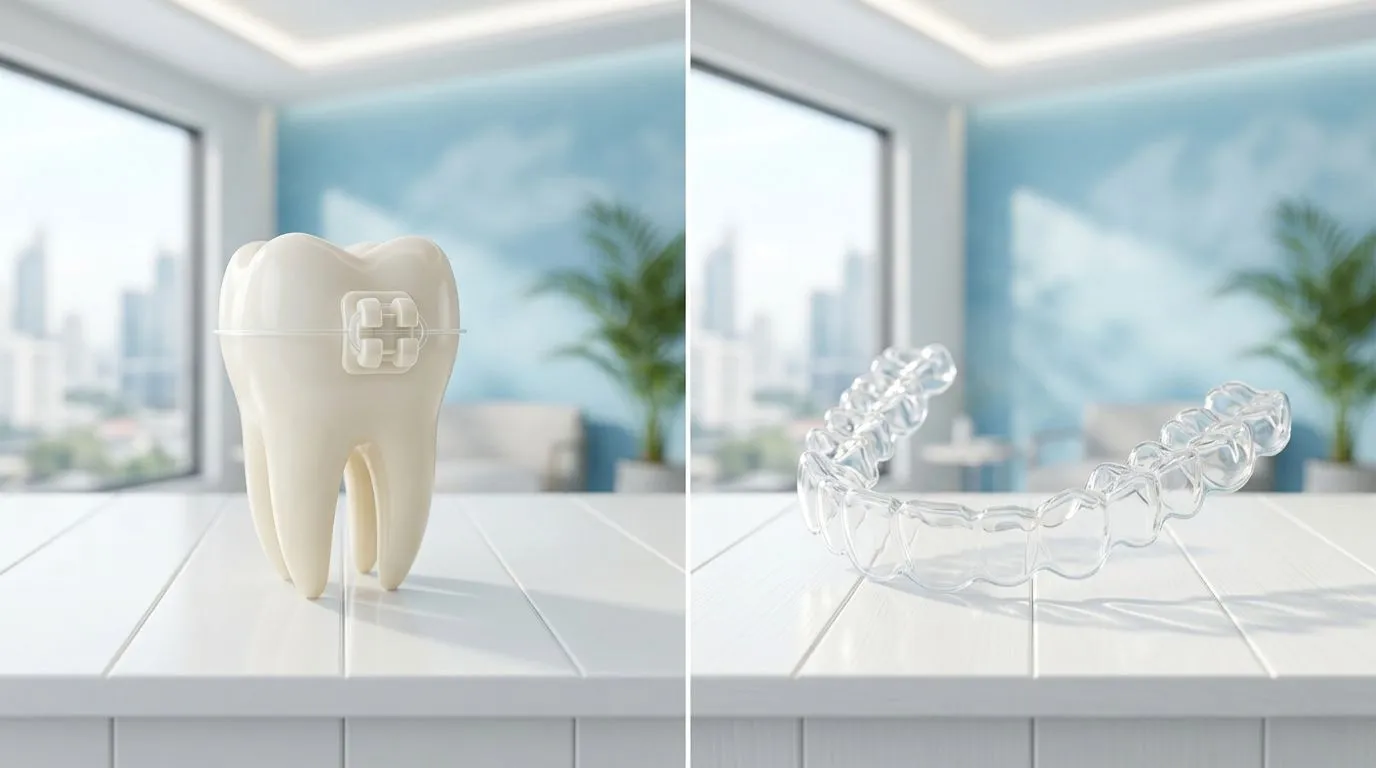
If you’re choosing between Damon braces and Invisalign, you’re already past the “do I want orthodontic treatment?” stage. Now you’re picking between two premium branded systems. Most articles you’ll read on this comparison are written by clinics that sell one of the two — and they tend to favour whichever they offer.
This guide is different. We don’t offer Damon braces or Invisalign brand specifically at our Bangkok clinic. We offer ceramic braces and the Align Plus aligner system (alternatives discussed at the end). That gives us a unique position: we have no commercial reason to favour either Damon or Invisalign, so we can compare them honestly.
The article is reviewed by Dr. Busakorn Osartalart, who holds the Thai Board of Orthodontics diploma — qualified to discuss both systems clinically, even though we don’t directly provide them.
Quick answer: Both Damon braces and Invisalign are excellent premium orthodontic systems. Damon wins for severe crowding, complex bite correction, large rotations, and patients who can’t manage the 22-hours-per-day aligner discipline. Invisalign wins for adults prioritising aesthetics, removability, and lifestyle flexibility for mild-to-moderate cases. Neither is “better” universally — fit-to-case decides.
Important disclosure first — we don’t sell either brand
Before we go further, full transparency: our Bangkok clinic does NOT offer Damon braces or Invisalign brand specifically. We offer ceramic braces and the Align Plus clear aligner system (alternatives discussed in detail at the end). Why does this matter? Every other top-ranking article on this comparison is written by a clinic that sells one or both brands — meaning their analysis is commercially biased toward whichever they make money on.
We have zero financial incentive to recommend one over the other. That makes our comparison genuinely neutral. If after reading this you decide Damon or Invisalign is right for your case, we’ll happily recommend a Bangkok clinic that offers it.
Damon vs Invisalign at a Glance — 8-Axis Comparison
| # | Comparison axis | Damon Braces | Invisalign |
|---|---|---|---|
| 1 | Cost (Bangkok 2026) | 70,000–95,000 THB (Damon Empower 72K, Q2 75K, Clear 85K — CDC published) | 79,000–200,000 THB (Express 79K → Comprehensive 180K — BIDC published) |
| 2 | Treatment time | 12–24 months (Cochrane: no significant difference vs traditional braces) | Mild-moderate non-extraction: 6.31 months FASTER than fixed (PMC6343314); extraction cases: 44% LONGER |
| 3 | Visibility (aesthetics) | Damon Q metal: visible silver brackets / Damon Clear: subtle ceramic brackets, silver wires visible | Virtually invisible at conversational distance; attachments visible up close in some cases |
| 4 | Removability & eating | Fixed appliance: 24/7 wear, sticky/hard food restrictions, brushing harder | Removable: eat anything, brush normally, but 22-hour daily wear required |
| 5 | Case complexity range | Handles severe crowding, large rotations, complex bite correction predictably | Mild-moderate cases ideal; severe cases: 17.2% of patients switch to fixed mid-treatment (ScienceDirect 2022) |
| 6 | Hygiene & periodontal impact | Higher plaque, gingival, and bleeding indices (more complex to clean) | Lower plaque/gingival/bleeding indices (PMC6343314) — periodontal advantage |
| 7 | Compliance burden | LOW: fixed, can’t be removed, no patient discipline needed | HIGH: 22hr/day wear required; only 6% of cases finish without refinements (avg 2.5 refinement rounds) |
| 8 | Peer-reviewed evidence quality | Damon “faster treatment” marketing claim NOT supported by Cochrane Review or Healthline analysis. Concern: arch expansion linked to >1mm bone recession in >20% of patients (Cattaneo et al.) | Equivalent ABO Objective Grading scores to fixed braces (no significant clinical difference). Limitations on torque control, occlusal contact, retention vs fixed |
Quick read: Both are excellent premium systems. Damon wins on compliance (always on) and complex case predictability. Invisalign wins on aesthetics, lifestyle, and periodontal health. Neither is universally “better.”
TL;DR by case type:
- Severe crowding / complex bite correction → Damon
- Mild-moderate cosmetic alignment + want lifestyle freedom → Invisalign
- Aesthetics + complex case capability → Damon Clear (ceramic Damon)
- Mild-moderate alignment + travel flexibility → Invisalign or alternatives
- Tight budget but want premium-equivalent outcome → Bangkok-based alternatives (see section below)
What Are Damon Braces? (Self-Ligating System Explained)
Damon braces are a self-ligating bracket system manufactured by Ormco. Unlike traditional braces that use elastic ligatures (the small rubber bands) to hold the archwire, Damon brackets feature a built-in sliding door mechanism that secures the wire.
The technology
- Sliding-door brackets — door opens/closes to insert or remove the archwire
- No elastic ligatures — eliminates the friction and replacement cycle of traditional ligatures
- Lower friction force — wire moves more freely, theoretically allowing teeth to move with lighter forces
Damon variants
- Damon Q — metal brackets, the workhorse
- Damon Clear — ceramic (tooth-coloured) brackets, more aesthetic
- Damon Q2 — newer generation with smaller bracket profile
Marketing claims to evaluate
Ormco marketing emphasizes faster treatment times (sometimes claimed as 6 months shorter than traditional braces) and less discomfort. The peer-reviewed evidence is more nuanced:
- The Cochrane Review on self-ligating brackets found no significant difference in treatment time vs conventional braces in most studies
- Some studies show modestly less discomfort early in treatment due to lower initial wire forces
- The bracket design quality and orthodontist’s planning matter more than the brand specifically
What Is Invisalign? (Clear Aligner System Explained)
Invisalign is the original and most widely-known clear aligner system, manufactured by Align Technology. It uses a series of custom-made transparent plastic trays to gradually move teeth.
The technology
- SmartTrack thermoplastic — proprietary material developed for elastic recovery and predictable force application
- 3D digital scanning — replaces putty impressions
- ClinCheck planning software — the largest treatment planning library in the industry
- Sequential trays — typically changed every 1-2 weeks
- Attachments — small tooth-coloured composite bumps that improve aligner grip for complex movements
- Refinements — additional aligner sets at end of treatment for fine-tuning
Invisalign variants
- Invisalign Comprehensive — for full-treatment cases
- Invisalign Lite — for mild-moderate cases (limited tray count)
- Invisalign Express — for very mild cases (5-7 trays)
- Invisalign Teen — adolescent-specific protocols
Clinical track record
Invisalign has 25+ years of clinical data and is the most extensively studied clear aligner system. Peer-reviewed evidence shows:
- Equivalent outcomes to fixed braces for mild-moderate cases (Rossini et al. 2015)
- More predictable than competitor aligner brands due to refinement library size
- Less effective for severe rotation or significant bite correction (compared to fixed appliances)
Treatment Time: Which Is Faster?
The honest answer: case complexity drives treatment time more than the brand.
Typical durations
| Case complexity | Damon braces | Invisalign |
|---|---|---|
| Mild | 12-15 months | 6-12 months |
| Moderate | 15-22 months | 12-18 months |
| Complex | 22-30 months | 18-30+ months (with refinements) |
Marketing claims vs reality
- “Damon is 6 months faster than traditional braces” — context-dependent. Sometimes true for specific case types, often not. Cochrane Review found no significant difference.
- “Invisalign is faster than braces” — for mild-moderate cases, often comparable to Damon. For complex cases, Invisalign frequently takes longer due to refinement rounds.
What actually predicts faster treatment
- Case complexity (less crowding = faster)
- Patient compliance (especially for Invisalign — wear time discipline)
- Orthodontist’s planning skill (more important than the brand)
- Initial bite alignment (less correction needed = faster)
Cost Comparison: US, UK, Australia, Thailand
US
- Damon braces: $4,500–$7,500
- Invisalign: $4,000–$8,000
UK
- Damon braces: £3,500–£6,000 (~$4,400–$7,580)
- Invisalign: £3,000–£5,500 (~$3,800–$6,940)
Australia
- Damon braces: A$5,500–$8,500 (~$3,620–$5,600)
- Invisalign: A$6,000–$9,000 (~$3,950–$5,930)
Bangkok (real published prices, when these specific brands are offered)
Damon braces in Bangkok (CDC Dental published rates):
- Damon Empower: 72,000 THB (~$2,050)
- Damon Q2: 75,000 THB (~$2,150)
- Damon Clear (ceramic Damon): 85,000 THB (~$2,450)
- Wider Bangkok market range: 70,000–95,000 THB (per ExpatDen Bangkok braces guide)
Invisalign in Bangkok (BIDC published tier rates):
- Invisalign Express (5-7 trays): 79,000 THB
- Invisalign Lite: 135,000 THB
- Invisalign Moderate: 160,000 THB
- Invisalign Comprehensive: 170,000–180,000 THB (~$5,150–$5,455)
- Wider Bangkok market range: 79,000–200,000 THB
Sources: CDC Dental Bangkok orthodontics fee schedule (cdc.dental), BIDC Invisalign Fee page (thaibraces.com), ExpatDen Bangkok Braces Guide.
Why Bangkok pricing for Damon and Invisalign brands is closer to Western pricing than other treatments
Both Damon and Invisalign are licensed branded systems. Clinics pay licensing fees + lab fees to Ormco / Align Technology. These fees are roughly the same regardless of where the clinic is located — meaning the cost savings advantage of Bangkok is smaller for branded systems than for generic alternatives.
This is why Bangkok-based clinics offering Align Plus (instead of Invisalign brand) or ceramic braces (instead of Damon) can pass dramatically larger savings to patients — they don’t pay the brand licensing premium.
Which System Works Better for Specific Cases?
The clinical decision depends on what your teeth actually need.
Mild crowding or spacing (most common adult cosmetic case)
- Both work equivalently. Aligners (Invisalign or alternatives) win on aesthetics; Damon wins on lower compliance burden.
Severe crowding (>5mm)
- Damon (or any fixed appliance) generally more predictable. Aligners can handle severe crowding but often require extractions and longer treatment with multiple refinements.
Open bite or deep bite
- Damon often preferred for predictable correction. Invisalign can correct mild open bites but struggles with significant vertical discrepancies.
Class II/III (jaw position) correction
- Complex — both have limitations. Severe skeletal Class II/III often requires surgical orthodontics, regardless of system. Hybrid approaches (Invisalign + elastics, or Damon + elastics) common for moderate cases.
Large rotations (canines, premolars rotated >20°)
- Damon more reliable for predictable rotation. Invisalign can rotate teeth but requires attachments and often refinements.
Adults with previous orthodontic treatment (relapse)
- Invisalign typically wins — minor correction of post-braces relapse is exactly what aligners do best.
For more on case suitability and what aligners specifically can/can’t do, see our Clear Aligners Thailand guide.
Aesthetics: Damon Clear vs Invisalign

If aesthetics matter most:
Damon Clear (ceramic Damon brackets)
- Tooth-coloured ceramic brackets
- Visible up close but no metal appearance
- Brackets stay bonded to teeth throughout treatment
- Wires are visible (silver thin wires)
Invisalign
- Virtually invisible at conversational distance
- Attachments (tooth-coloured bumps) are visible up close in some cases
- Trays removed for eating/photographs
Real-world visibility test
Take a photo of yourself smiling. Imagine each option:
- Damon Clear: silver wires across each tooth, subtle ceramic brackets
- Invisalign: clear plastic over teeth, attachments may show in some cases
Most adults rank visibility as: Invisalign least visible > Damon Clear > metal Damon > metal traditional.
Comfort, Lifestyle, and Compliance
Damon braces
- Pros: Lower friction means less initial soreness vs traditional braces. No daily compliance requirement (always on).
- Cons: Eating restrictions (no sticky candy, hard nuts, popcorn, ice). Brushing/flossing more complex. Periodic emergency visits for broken brackets.
Invisalign
- Pros: Eat anything (trays removed). Brush/floss normally. No emergency visits typically.
- Cons: 22-hour daily wear required — biggest reason aligner cases fail is compliance failure. Speech adjustment 1-2 weeks. Discipline required for tray changes.
Compliance reality check
Invisalign clinical studies show that treatment success drops sharply when daily wear time falls below 20 hours. If you’re not certain you can commit to that discipline, Damon (always on, no compliance issue) is the safer choice.
Maintenance, Retention, and Long-Term Outcomes
Both require lifetime retainers
After active treatment:
- Both systems require fixed and/or removable retainers indefinitely
- Standard protocol: full-time wear first 12 months, then nighttime indefinitely
- Relapse risk is similar between systems if retention is followed
Honest note on long-term outcomes
The peer-reviewed evidence (10+ year studies) shows that the orthodontist matters more than the brand. A board-certified orthodontist with experience in both systems will deliver better long-term stability than a general dentist using either system.
What the Research Actually Shows (Peer-Reviewed Evidence)
This is where most consumer comparisons fall short. Here’s what published clinical evidence says — facts most clinic blogs ignore.
Treatment quality: aligners vs fixed braces
A 2018 systematic review and meta-analysis (Rossini et al., PMC6343314) of clear aligner outcomes found:
- No statistically significant difference in ABO Objective Grading System scores between aligners and fixed appliances (p=0.05)
- Aligners are 6.31 months faster for non-extraction cases (95% CI [-8.37, -4.24], P<0.001)
- BUT aligners are 44% LONGER for cases requiring extractions
- Aligners underperform on: occlusal contact, tooth torque control, transverse expansion, retention
- Aligners outperform on: segmented movement, periodontal health (lower plaque/gingival/bleeding indices)
The Invisalign refinement reality
A 2022 ScienceDirect retrospective study found:
- 17.2% of Invisalign patients eventually switch to fixed braces mid-treatment
- Only 6% of Invisalign cases finish with zero refinements
- Average 2.5 refinement scans per completed Invisalign case
- This isn’t a quality flaw — it’s a planning reality of the technology
The Damon arch expansion concern
The Damon system promotes “lighter forces” and arch expansion as advantages. Independent peer-reviewed research tells a more nuanced story (Cattaneo et al., reviewed in Kevin O’Brien orthodontic blog):
- Buccal bone thickness reduction of 0.2 mm or 23% loss in incisors
- Bone area loss of 1.2 mm or 13% with Damon expansion
- Over 20% of patients experienced ≥1 mm bone recession on at least one tooth
The Cochrane Review verdict on self-ligating brackets
The 2014 Cochrane systematic review on self-ligating brackets vs conventional brackets found:
- No significant difference in treatment time
- No significant difference in clinical outcomes
- Damon’s marketing claims of faster treatment “aren’t supported by research” (per Healthline 2026)
Common Myths, Debunked

Myth 1: “Damon braces are always faster than traditional braces.”
False. Cochrane Review found no significant treatment time difference. Some cases are faster with Damon, some aren’t.
Myth 2: “Invisalign can fix any case.”
False. Severe crowding, large rotations, and significant bite correction often require fixed appliances or hybrid approaches. Invisalign has clear limits — 17.2% of patients switch to braces mid-treatment.
Myth 3: “Self-ligating brackets move teeth without force.”
False. The biology of tooth movement is identical regardless of bracket type. Self-ligating brackets reduce friction in the bracket, not the force on the tooth.
Myth 4: “Invisalign is just as effective as braces for everything.”
False. Invisalign equals braces for mild-moderate non-extraction cases (and is faster). For severe cases requiring extractions, fixed appliances are typically faster and more predictable.
Myth 5: “Damon arch expansion preserves bone better than traditional braces.”
Partially false. Independent research (Cattaneo et al.) shows Damon expansion can cause measurable buccal bone loss in 20%+ of patients.
Myth 6: “The cheaper option is always lower quality.”
False. The orthodontist’s planning skill drives outcomes more than brand premium. A board-certified orthodontist using a mid-tier system often outperforms a generalist using premium brands.
If You’re Considering Treatment from Bangkok: What’s Actually Accessible
This is where we have to be honest. We don’t offer Damon braces or Invisalign brand specifically at our clinic.
For Bangkok-based dental tourism patients comparing Damon vs Invisalign, here’s the practical reality:
Damon braces in Bangkok
- Limited availability — only some Bangkok clinics carry Ormco-licensed Damon brackets
- Pricing typically 80,000-150,000 THB when available
- Same monthly visit problem as traditional braces (impossible without shared-care for international patients)
Invisalign in Bangkok
- Available at certified Invisalign provider clinics
- Pricing 120,000-250,000 THB (closer to Western pricing due to brand licensing fees)
- Best brand for complex cases needing extensive refinement
Bangkok-accessible alternatives we offer
Two alternatives deliver comparable clinical outcomes for the majority of cases at significantly lower cost:
For Damon alternative — Ceramic braces (50,000-65,000 THB, ~$1,390-$1,810)
- Tooth-coloured brackets — similar aesthetics to Damon Clear
- Same biomechanical principles (the orthodontist’s planning matters more than the bracket brand)
- Broader case range than aligners
- Significantly lower cost than Damon
Full details in our Braces in Thailand guide.
For Invisalign alternative — Align Plus (15,000-175,000 THB, case-dependent)
- Same underlying technology (3D scanning + sequential thermoplastic aligners)
- Comparable outcomes for mild-moderate cases (the most common adult cosmetic demand)
- Lower cost than Invisalign brand
Full details in our Clear Aligners Thailand guide.
The honest framing
Align Plus is not Invisalign. Ceramic braces are not Damon Clear. They’re different products with different brand R&D budgets and proprietary materials.
But for the majority of adult orthodontic cases — particularly cosmetic alignment, mild-moderate crowding, gap closure, and post-braces relapse — the clinical outcome with a board-certified orthodontist is the deciding factor, not the brand. A board-certified orthodontist using ceramic braces or Align Plus will deliver outcomes equivalent to a similar specialist using Damon or Invisalign for these case types.
If you have a complex case requiring premium-brand precision (severe skeletal correction, large rotations needing refinement libraries), Damon or Invisalign brand may be worth the cost premium and the search for a Bangkok provider that carries them.
For most other cases, our alternatives deliver comparable outcomes at meaningful savings — particularly relevant given the Bangkok travel context.
How to Choose: Questions to Ask Any Orthodontist
Whether you choose Damon, Invisalign, ceramic braces, or aligners, ask these:
- Are you board-certified in orthodontics? (Not just a general dentist with bracket training)
- How many cases like mine have you treated? (Volume drives planning skill)
- What outcome do you predict and in what timeframe? (A good orthodontist can show you a simulation)
- What are the brand-agnostic alternatives for my case? (Honest answer reveals their commercial bias)
- What’s the retention plan? (Lifetime retainers — confirm they’re included)
- Who handles emergencies during treatment? (Especially important for Damon if you’re abroad)
- What’s your refinement policy? (For Invisalign-style aligners specifically)
Conclusion: There’s No Universal Winner

Both Damon braces and Invisalign are excellent premium orthodontic systems with strong clinical track records. The decision between them comes down to your specific case + your lifestyle priorities — not which is “better” universally.
For Bangkok-based dental tourism patients, the bigger decision is often whether the brand premium is worth it vs comparable alternatives (ceramic braces, Align Plus aligners) that deliver similar clinical outcomes for the majority of cases at substantially lower cost.
The most important variable is the orthodontist. Always verify Thai Board of Orthodontics certification (or equivalent in your country) before committing to any system.
Book Your Free Consultation — Send us photos of your current bite via WhatsApp. Dr. Busakorn (Thai Board Orthodontics) will assess your case honestly and recommend the right system — including whether Damon or Invisalign is genuinely worth the brand premium for your situation.
Frequently Asked Questions
Can I switch from Invisalign to Damon braces mid-treatment?
Yes — and 17.2% of Invisalign patients do, according to a 2022 ScienceDirect retrospective study. Switching usually happens 6-12 months into treatment when planned tooth movements aren’t tracking as predicted in ClinCheck. Cost impact: typically equivalent to starting Damon fresh, since the new treatment plan is essentially independent. Talk to your orthodontist before paying anything if your case is borderline complex — this is a real risk to plan for.
Are Damon braces’ faster-treatment claims supported by research?
No, according to Healthline’s 2026 review and the Cochrane systematic review on self-ligating brackets. Both found no significant treatment time difference between Damon and conventional braces. Damon’s marketing emphasizes faster results, but peer-reviewed evidence doesn’t support a universal speed advantage. Some cases are faster with Damon, some aren’t — depends on the specific tooth movements required.
What is the refinement rate with Invisalign?
According to industry studies, only 6% of Invisalign cases finish with zero refinements. The average is 2.5 refinement scans per completed case. This isn’t a quality flaw — it’s a planning reality of clear aligner technology. Reputable Invisalign providers include refinements in the package price; budget providers often charge per refinement.
Does Damon arch expansion cause gum recession?
Independent peer-reviewed research (Cattaneo et al., reviewed in Kevin O’Brien orthodontic blog) has documented concerning patterns with Damon-style arch expansion: buccal bone thickness reduction of 0.2 mm or 23% loss in incisors, bone area loss of 1.2 mm or 13%, and over 20% of patients experiencing ≥1 mm bone recession on at least one tooth. This is rarely discussed in clinic marketing. It doesn’t make Damon dangerous, but it does mean the “lighter forces, no extractions” claim has trade-offs worth discussing with your orthodontist.
What if neither Damon nor Invisalign is available in my city?
You have legitimate alternatives that achieve comparable outcomes for most case types:
- For Damon Clear alternative (aesthetic fixed appliance): Ceramic braces with self-ligating brackets (3M Clarity SL, etc.) — same biomechanical principles, often half the cost
- For Invisalign alternative (clear aligners): Align Plus, ClearCorrect, Spark, or other clear aligner systems — same underlying technology, lower brand premium
- The orthodontist’s planning skill matters more than the brand. A board-certified orthodontist using mid-tier systems often delivers outcomes equivalent to Diamond Provider clinics using premium brands.
Why is orthodontics so much cheaper in Bangkok?
Lower clinic operating costs (rent, staff salaries, no insurance overhead), favourable currency exchange rates, and high competition between Bangkok cosmetic clinics. Material quality (3M brackets, Invisalign trays manufactured by Align Technology globally) and prosthodontist training are equivalent to Western standards. Savings come from operational economics, not corner-cutting. Most importantly: Bangkok clinic published prices are the same for foreign and Thai patients — no “tourist surcharge.”
Are Damon Clear and ceramic braces the same thing?
No, but they’re closely related. Both use tooth-coloured ceramic brackets for aesthetics. The difference: Damon Clear is a specific Ormco-branded self-ligating ceramic system (sliding-door brackets, no elastic ligatures). Standard ceramic braces use traditional elastic ligatures. Clinical outcomes are similar; cost difference is significant (Damon Clear premium reflects brand licensing fees). For most patients prioritizing aesthetics + cost-efficiency, standard ceramic braces deliver comparable visible results.
Are Damon braces faster than Invisalign?
Not consistently. Cochrane Review of self-ligating brackets found no significant treatment time advantage. Case complexity drives treatment time more than the brand.
Which is more painful, Damon or Invisalign?
Damon: lower friction = often less soreness than traditional braces, especially early treatment. Invisalign: mild pressure for 1-3 days each new tray, generally less acute pain than braces. Both are tolerable with over-the-counter ibuprofen.
How much do Damon braces cost vs Invisalign in Bangkok?
When available in Bangkok, Damon is typically 80,000-150,000 THB ($2,425-$4,545); Invisalign 120,000-250,000 THB ($3,640-$7,580). Bangkok-based alternatives (ceramic braces 50,000-65,000 THB; Align Plus 15,000-175,000 THB) offer comparable outcomes for most cases at significantly lower cost.
Can Invisalign treat severe crowding?
Limited cases. Mild-moderate crowding works well with Invisalign. Severe crowding (>5mm) often requires extractions and complex refinement plans, where fixed appliances (Damon, conventional braces) are more predictable.
Do I need to choose a brand, or just a good orthodontist?
The orthodontist matters more. Peer-reviewed long-term studies show that planning skill drives outcomes more than brand premium. A board-certified orthodontist using mid-tier systems often outperforms generalists using premium brands.
Can you switch from Damon to Invisalign mid-treatment?
Possible but rare. Requires complete bracket removal, re-scanning, new treatment plan. Significant cost and time impact. Usually only done if patient circumstances change dramatically (e.g. compliance issues with braces, major lifestyle change).
Does insurance cover Damon braces and Invisalign?
Both are typically partially covered by US private dental insurance (around 50% up to a maximum benefit, often $1,500-$3,500 lifetime). UK NHS doesn’t cover either. Check your specific plan.
Do Damon braces stain teeth more than Invisalign?
Neither stains teeth directly. Damon Clear (ceramic) brackets can yellow with coffee/tea/curry consumption — replaceable but adds maintenance. Invisalign trays don’t stain teeth but can themselves discolour if you drink coffee while wearing them (which you shouldn’t — remove for hot drinks).
Are Damon braces more effective than Invisalign for bite correction?
For severe bite correction (open bite, deep bite, Class II/III), fixed appliances like Damon are generally more predictable. Invisalign can address mild bite issues with attachments + elastics but has limits.