 Written by Dr. Nan
If you’ve been quoted $5,000-$8,000 for braces in the US, UK, or Australia, you’ve probably wondered whether Thailand could do the same treatment for less. The short answer: yes, by 60-75%. The longer answer involves a logistics question worth understanding before booking: braces require monthly adjustments for 12-24 months, which is impossible for international patients to manage as a single trip.
This guide covers the real cost of braces across Bangkok clinics in 2026, the two main types (metal and ceramic), and crucially, the shared-care model that makes braces feasible for dental tourism patients, where Bangkok handles bonding and removal, and a local orthodontist abroad handles routine adjustments.
Braces in Thailand: Market Cost Overview (2026)
Bangkok market range
For full transparency, here’s the broader range you’ll find when comparing Bangkok clinics:
| Type | Bangkok market range (THB) | Notes |
|---|---|---|
| Metal braces | 35,000–100,000 | Premium clinics reach the 100K mark |
| Ceramic braces | 50,000–100,000 | Premium tier 70-100K |
| Damon Speed self-ligating | 80,000–160,000 | See Damon vs Invisalign comparison |
| Invisalign clear aligners | 79,000–240,000 | See clear aligners alternative |
| Brava by BRIUS (lingual) | 238,000–350,000 | Premium niche |
Per-clinic price comparison (Bangkok 2026 published rates)
For full apples-to-apples transparency comparing major Bangkok clinics:
| Clinic | Metal braces (THB) | Ceramic (THB) | Clear aligners (THB) | Damon (THB) |
|---|---|---|---|---|
| Dental Veneer Bangkok | 35,000 | 50,000 | 15,000–175,000 (Align Plus) | N/A |
| CDC Dental | 45,000–48,000 | N/A | 49,000–164,000 (Invisalign) | 72,000–85,000 |
| Bangkok Smile | 42,000–60,000 | 48,000–69,000 | 49,000–179,000 (Invisalign) | N/A |
| Smile Signature | 50,000–60,000 | 65,000–85,000 | 79,000–160,000 (Invisalign) | N/A |
| BIDC | 65,000–75,000 | 75,000–90,000 | 79,000–200,000 (Invisalign) | N/A |
| Thantakit | 50,000–100,000 | 70,000–100,000 | 89,000–240,000 (Invisalign) | 100,000–160,000 |
| HeySmile | 1,500/mo (≈40K) | N/A | 49,000–159,000 (Invisalign) | 3,000/mo (≈75K) |
Sources: Dental Veneer Bangkok 2026 price list (dentalveneerbangkok.com), ExpatDen Bangkok braces guide, and each competing clinic’s published 2026 fee schedule. Use this as a starting reference. Always confirm with the clinic directly before booking.
What “all-inclusive” pricing means at Bangkok clinics
Several Bangkok clinics publish “all-inclusive” pricing covering consultation, X-rays, scans, bracket bonding, all in-clinic adjustments, debonding, and the first set of retainers. Others price individual line items separately. When comparing quotes, check whether the following are included:
- Initial consultation
- Panoramic and cephalometric X-rays
- 3D intraoral scan or impressions
- Treatment planning
- Bracket bonding and all in-clinic adjustments
- Wire changes throughout treatment
- Debonding (bracket removal)
- First set of retainers (clear or fixed wire)
- Post-treatment X-rays and photos
- Bracket breakage warranty under normal use
If any of these are charged separately, factor them into your comparison.
Standards & accreditation
Reputable Bangkok dental clinics operate under Thai Dental Council registration with annual licensing audits. The Thai Dental Council (ทันตแพทยสภา) is the equivalent of the US ADA / UK GDC: the regulatory body that licenses every dentist practicing in Thailand. Major facilities maintain ISO sterilization protocols, and several Bangkok hospitals (Bumrungrad International, BIDC) hold JCI (Joint Commission International) accreditation , the global gold standard for healthcare quality.
When choosing a clinic, look for:
- Thai Dental Council registration (mandatory)
- Named orthodontist with Thai Board of Orthodontics diploma (specialty credential)
- Published pricing
- Clear shared-care policy if you’re an international patient
For our specific clinic information, pricing, and orthodontist credentials, see our braces in Bangkok service page. For a focused breakdown of what the price covers, see our guide to braces cost in Thailand.
Why Braces Are Cheaper in Thailand (Without Being Lower Quality)
The 60-75% savings vs Western countries comes from operational economics, not corner-cutting:
- Lower clinic operating costs: Bangkok rent, staff salaries, and overhead are a fraction of London/New York/Sydney
- No insurance overhead: Thai clinics don’t process insurance claims, no billing department
- Public dental school training pipeline: Thai dentists complete a 6-year DDS, with specialists adding 3+ years of board-certified residency at the same standard as US/UK/AU schools
- Currency arbitrage: favourable THB/USD exchange rates
Material quality is identical. Brackets used by reputable Thai clinics are sourced from the same global manufacturers (3M Unitek, Ormco, GAC, American Orthodontics) used in Western practices.
For US benchmark: the average US orthodontic case runs $5,000–$7,500 for traditional braces. Thai pricing at $970–$1,810 represents 65-85% savings on the treatment alone.
Types of Braces Available in Thailand
Two systems dominate the Thai market: traditional metal braces and ceramic (clear) braces. A few clinics also offer premium systems like Damon self-ligating or Invisalign aligners at significantly higher price points.
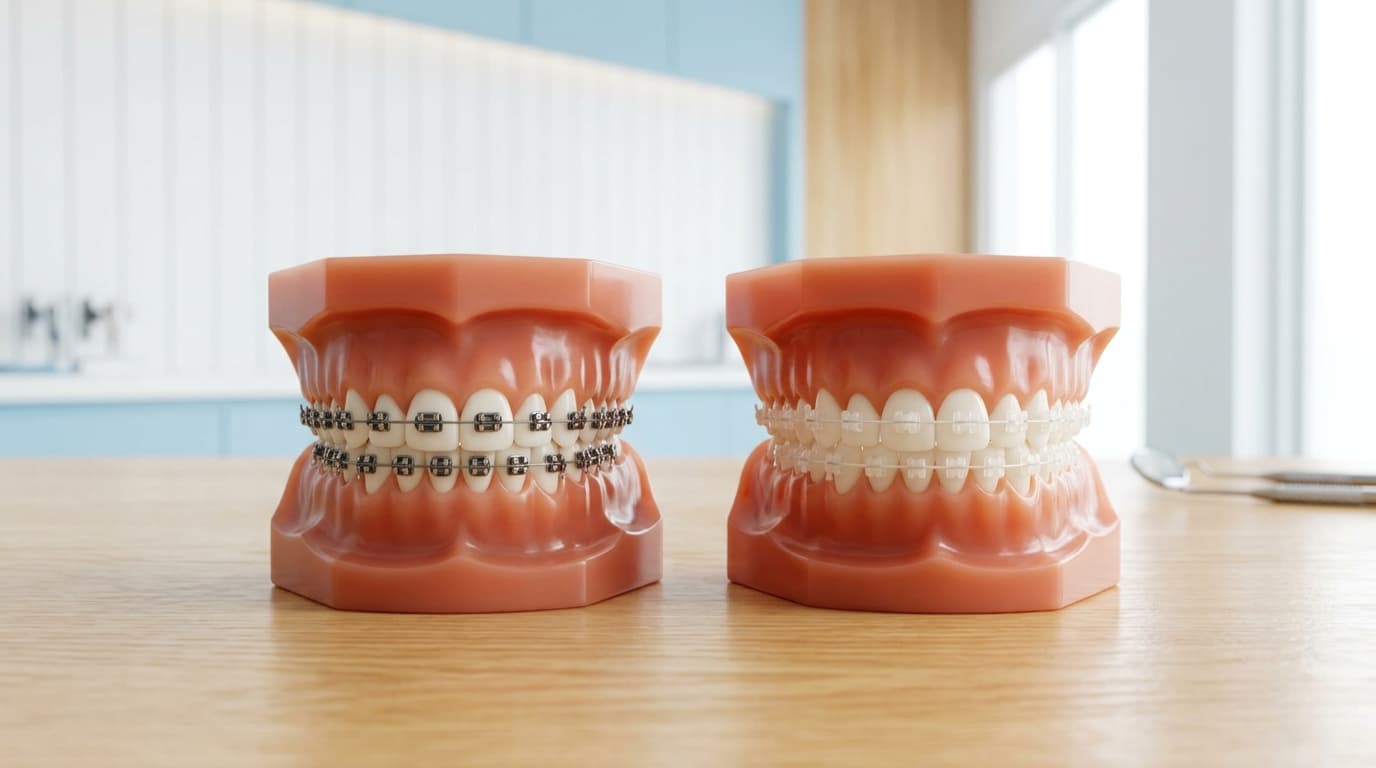
Metal braces (35,000–50,000 THB at most clinics)
The workhorse of orthodontics. Stainless steel brackets bonded to the front of each tooth, connected by an archwire. Adjustments tighten or guide the wire to gradually move teeth.
- Common bracket brands at Thai clinics: 3M Unitek standard, 3M Clarity (premium metal), American Orthodontics, GAC
- Pros: Most cost-effective, fastest treatment for most cases, durable, predictable outcomes
- Cons: Visible silver appearance, food restrictions
- Best for: Patients prioritising cost, complex movements, severe crowding cases
Ceramic (clear) braces (50,000–65,000 THB at most clinics)
Tooth-coloured ceramic brackets that blend with natural enamel. Same mechanical principle as metal braces, less visible.
- Common bracket brands at Thai clinics: 3M Clarity ADVANCED, 3M Clarity SL (self-ligating ceramic)
- Pros: Significantly less visible than metal (often called “clear braces”), same effectiveness as metal
- Cons: Brackets slightly more fragile than metal, important if you’re doing shared-care abroad. Slightly higher cost
- Best for: Adults concerned about appearance, professionals, anyone wanting subtle treatment without switching to aligners
Premium systems available at some Thai clinics
A few Bangkok clinics offer Damon Q / Damon Clear (Ormco self-ligating system) at 80,000–160,000 THB, Invisalign clear aligners at 79,000–240,000 THB, or Brava by BRIUS lingual brackets at 238,000–350,000 THB. Most international patients find that conventional metal or ceramic braces deliver equivalent outcomes at one-third to one-fifth the cost. For comparable aesthetic alternatives, see our Clear Aligners Thailand and Damon vs Invisalign comparison guides.
If aesthetics are critical, also consider clear aligners in Thailand: completely invisible, removable, and better suited to international patient logistics.
Treatment Timeline: Month-by-Month Milestones
Most patients want to know “when will I see results?” Here’s the realistic month-by-month timeline, and our guide to how long braces take explains what speeds treatment up or slows it down:
| Stage | Timeline | What you’ll experience |
|---|---|---|
| Month 0 (bonding) | Day 1 | Brackets placed, first archwire (light NiTi). Mild pressure for 3-5 days |
| Months 1-3 | Initial alignment | Significant rotation correction visible. Adjustments every 4-6 weeks |
| Months 3-6 | Levelling | Bite begins to coordinate. Wire upgrades to stiffer NiTi or stainless steel |
| Months 6-12 | Working phase | Major tooth movements, gap closure, alignment refinement |
| Months 12-18 | Detailing | Fine adjustments, root paralleling, occlusion (bite) optimization |
| Months 18-24 | Settling | Final positioning, minor refinements before debonding |
| Debonding visit | Final visit | Brackets removed, retainers fitted, photos taken |
| Retention phase | Lifetime | Retainers worn full-time year 1, then nighttime indefinitely |
Realistic expectations by case complexity
Braces treatment time depends on case complexity:
| Case complexity | Typical duration | In-person visits required |
|---|---|---|
| Mild (minor crowding/spacing) | 12–18 months | 12–15 visits |
| Moderate (full alignment + bite correction) | 18–24 months | 15–22 visits |
| Severe (extraction cases, skeletal correction) | 24–30 months | 22–28 visits |
The math that matters for international patients: even a “fast” 12-month case requires roughly 12-15 in-person clinic visits for adjustments. At one visit every 4-6 weeks, this is logistically impossible to manage with monthly flights to Bangkok.
This is the core problem. Most clinic websites quote durations and visit counts without translating them into a planning reality. The section below addresses what to do about it.
The Monthly Visit Problem (And How International Patients Actually Solve It)

Here’s what the monthly visit requirement actually means for international patients, and the three workable solutions.
The problem
Braces require physical bracket adjustments (a wire change, a tightening, an elastic addition) every 4 to 6 weeks throughout treatment. There’s no remote workaround for this. The orthodontist needs hands-on access to your mouth.
For 12-30 months of treatment, this means 12 to 28 in-person visits. Even if you live 30 minutes from the clinic, that’s a major commitment. For international patients flying from Europe, the US, or Australia, it’s not financially viable to fly to Bangkok every 4-6 weeks.
Three solutions that actually work
Solution 1: Shared-care / co-management (recommended for most international patients)
The most realistic option for adults living abroad:
- Your Bangkok clinic handles: Initial diagnosis, treatment plan, bonding (placing brackets), 1-2 mid-treatment milestone visits, debonding (removing brackets), retainer fitting
- Local orthodontist abroad handles: Routine adjustments every 4-6 weeks (wire changes, elastic additions, hygiene checks)
- Documentation transferred: Treatment plan PDF, X-rays, bracket specifications, intended movement timeline
This model requires you to secure a local orthodontist before you fly to Bangkok. The next section walks through the workflow.
Solution 2: Stacked stays in Bangkok
For patients with flexibility (retired, remote workers, sabbaticals):
- Plan 3-4 trips of 2-3 weeks each over the treatment period
- Accept slightly slower progress between trips (teeth need consistent adjustment intervals for optimal movement)
- Total Bangkok time: 8-12 weeks across the full treatment
This works if you can spread visits over a long timeline and don’t mind a slower pace.
Solution 3: Switch to clear aligners instead of braces
Aligners require dramatically less in-person time:
- Initial in-person visit: 3-5 days for scan, plan approval, first 2-3 sets of trays
- Subsequent aligner sets shipped to your home country
- Self-changes every 1-2 weeks
- In-person review only every 2-3 months
For most adult cosmetic cases (mild-moderate crowding, spacing, alignment), aligners deliver equivalent outcomes with a fraction of the travel logistics. This is genuinely the better option for most dental tourism patients.
See our clear aligners Thailand guide for the full logistics breakdown.
Shared-Care Orthodontics: Step-by-Step Workflow
If you want braces specifically (not aligners), here’s the workflow that makes it feasible from abroad. This is the standard model used by international patients across Bangkok clinics that accept dental tourism cases.
Pre-trip (4-6 weeks before flying to Bangkok)
- Secure a local orthodontist in your home country who accepts shared-care patients. Not all do, so call ahead. Many private orthodontists in the UK, US, AU, and EU are familiar with this model, especially for patients who started treatment elsewhere.
- Send your local orthodontist’s contact information to your Bangkok clinic so they can coordinate documentation.
- Book your initial Bangkok stay of 5-7 days for full diagnostics and bracket bonding.
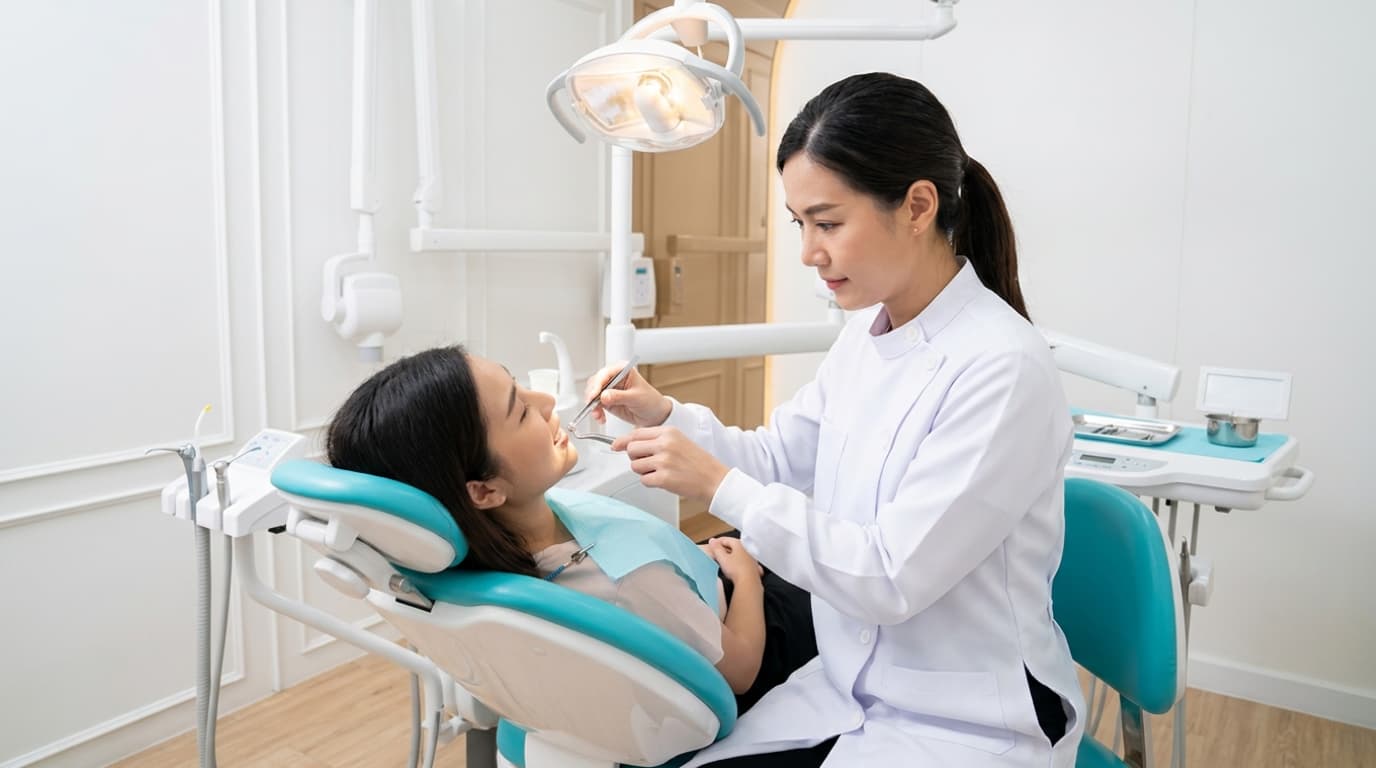
Trip 1 in Bangkok (5-7 days)
- Day 1: Comprehensive consultation, X-rays, intra-oral scans, treatment planning
- Day 2-3: Tooth preparation if needed (cleaning, separators)
- Day 4-5: Bracket bonding , the irreversible step that starts active treatment
- Day 6-7: First adjustment, take-home information packet for your local orthodontist (treatment plan, expected movement schedule, contact info)
Months 2 onwards (in your home country)
- Visit your local orthodontist every 4-6 weeks for routine adjustments
- They follow your Bangkok orthodontist’s treatment plan, performing wire changes and elastic placement
- Most charge per visit (~$50-150 in the US, £40-100 in the UK)
- Photos sent periodically to your Bangkok clinic for treatment progress review
Mid-treatment Bangkok visit (optional, around month 9-12)
- 2-3 day trip for in-person review with your Bangkok orthodontist
- Adjustment to treatment plan if needed
- Coincides with vacation, business trip, or another dental procedure
Final trip (5-7 days)
- Debonding (bracket removal) in Bangkok
- New impression for retainers
- Retainer fitting and bite check
- Final photos and treatment summary
What documentation your Bangkok clinic should provide for your local orthodontist
- Full treatment plan (PDF) with expected tooth movements
- Pre-treatment X-rays (panoramic + cephalometric)
- Bracket specifications and bonding adhesive used
- Wire sequence schedule (which wires to use at which stage)
- Direct WhatsApp or email contact for clinical questions
What to ask your local orthodontist before agreeing
- Do you accept transfer / shared-care patients?
- What’s your per-visit fee?
- Are you comfortable following a treatment plan from another orthodontist?
- Will you handle emergencies (broken brackets, poking wires) during treatment?
Metal vs Ceramic Braces: Which Should You Choose?
| Factor | Metal | Ceramic |
|---|---|---|
| Cost | 35,000–50,000 THB | 50,000–65,000 THB |
| Visibility | Highly visible (silver) | Subtle (tooth-coloured) |
| Treatment time | Same as ceramic | Same as metal |
| Durability | Highest, brackets rarely break | Slightly fragile, small risk of bracket fracture |
| Staining risk | None (brackets don’t stain) | Low (modern ceramic doesn’t stain, but ligatures can yellow with coffee/curry) |
| Suitability for shared-care | Best, local orthodontists most familiar | Good, but flag bracket fragility to local orthodontist |
Quick recommendation:
- Cost-driven? Metal
- Adult, professional, image-conscious? Ceramic (or consider clear aligners)
Braces vs Clear Aligners for International Patients
For most adult cosmetic cases, clear aligners are dramatically better suited to dental tourism logistics than braces. Our guide on clear aligners versus braces walks through which one fits which case, and our guide to adult braces in Thailand covers the age, health and logistics questions adults ask most.
| Factor | Braces (metal/ceramic) | Clear aligners |
|---|---|---|
| In-person visits | Every 4-6 weeks (12-28 total) | Every 2-3 months (4-6 total) |
| Remote-friendly | No, needs physical adjustment | Yes, trays shipped abroad |
| Treatment of severe cases | Best for complex movements | Limited (mild-moderate cases only) |
| Cost in Thailand | 35,000–65,000 THB | 15,000–175,000 THB (case-dependent) |
| Suitable for shared-care | With local orthodontist | Better, minimal local support needed |
| Eating restrictions | Yes (sticky/hard foods) | None (trays removable) |
For complex case decisions and brand alternatives, see our Damon braces vs Invisalign comparison.
Bottom line for international patients: if your case is mild to moderate (crowding, spacing, alignment of front teeth), aligners are the more practical choice. If your case is severe (significant skeletal issues, complex bite correction, large rotations), braces deliver more predictable outcomes but require the shared-care logistics described above.
Visa & Stay Length for Braces Treatment in Thailand
For international patients planning braces with the shared-care model, your visa needs depend on how you’ll structure visits.
Standard 60-day tourist visa (most common)
Sufficient for the initial bonding stay (5-7 days) and final debonding stay (5-7 days). Extendable by 30 days at Thai immigration if needed for unforeseen treatment adjustments.
Long-stay options if you plan multiple Bangkok months
- Thailand Privilege Visa: 5-20 year multi-entry, premium pricing
- Education visa: for patients combining treatment with Thai language courses
- Retirement visa: for patients 50+ meeting financial requirements
About the DTV (Destination Thailand Visa)
The DTV launched in 2024 as a 5-year multi-entry visa for digital nomads, soft-power tourists, and medical tourism patients. Important caveat: DTV approval for orthodontic treatment specifically is uncertain. Some Thai embassies have approved it as legitimate medical tourism, others have rejected braces as “elective cosmetic.” If you’re considering DTV for braces, contact your nearest Thai embassy directly before applying.
The safer route for shared-care braces is multiple 60-day tourist visas across the treatment timeline.
Important warning: avoid “fashion braces”
Thailand has a documented black market in fashion/cosmetic braces installed by non-dentists in beauty parlours and shopping malls. These are illegal in Thailand and have caused serious infections, tooth loss, and at least one documented death. Only receive orthodontic treatment from a licensed dental clinic with a board-certified orthodontist on staff.
Conclusion: Braces Are Feasible from Abroad with the Right Plan

Braces in Thailand offer 65-85% savings on the treatment cost. For local Thai patients, they’re a straightforward choice. For international patients, the monthly visit requirement makes braces logistically complex unless you arrange shared-care with a local orthodontist before flying out.
Before booking, ask yourself: “Am I willing to coordinate with a local orthodontist for routine visits, or would clear aligners (with their dramatically simpler logistics) work for my case?” For mild-moderate adult cosmetic cases, aligners are usually the better international-patient choice.
If you’ve decided that braces are the right option for you and you’re considering treatment in Bangkok, our clinic offers metal and ceramic braces with full shared-care documentation support for international patients. See our braces in Bangkok service page for our specific pricing, orthodontist credentials, and booking workflow.
Send photos of your current bite via WhatsApp. We’ll assess shared-care feasibility, recommend the right system (braces or aligners), and quote exact pricing within 24 hours. Free virtual consultation, no commitment.
Frequently Asked Questions
How much do braces cost in Thailand?
Metal braces in Thailand cost 35,000–50,000 THB ($970–$1,390 USD) at most clinics. Ceramic (clear) braces cost 50,000–65,000 THB ($1,390–$1,810 USD). Premium clinics can reach 100,000 THB. Compared to $5,000–$7,500 in the US or £3,000–£5,000 in the UK, savings are 65-85% on treatment alone.
Can foreigners get braces in Thailand?
Yes, but the standard 12-24 month treatment with monthly adjustments isn’t compatible with long-distance travel. Most international patients use a shared-care model: a Bangkok clinic handles bonding and debonding, a local orthodontist abroad handles routine adjustments. Alternative: switch to clear aligners which are far more remote-friendly.
How long do braces take in Thailand?
12-18 months for mild cases, 18-24 months for moderate, up to 30 months for severe cases. Treatment time is the same regardless of country.
Can my home dentist continue my braces treatment?
Yes. This is the standard “shared-care” or “transfer” model. Your home country orthodontist can continue your treatment using documentation from your Bangkok clinic. Most private orthodontists in the UK, US, AU, and EU are familiar with this. Confirm in advance that your local orthodontist accepts shared-care patients.
Are clear aligners better than braces for international patients?
For most mild-moderate adult cases, yes. Aligners require only 4-6 in-person visits over the entire treatment vs 12-28 for braces. For severe cases (complex skeletal issues, significant rotations), braces remain more predictable. See our clear aligners guide for the full comparison.
Do braces hurt? How long does the pain last?
Mild discomfort for 3-5 days after each adjustment is normal. Over-the-counter ibuprofen handles it. By month 2 of treatment, most patients no longer notice any discomfort between adjustments.
What’s the difference between metal and ceramic braces?
Mechanical effectiveness is identical. Ceramic brackets are tooth-coloured (much less visible) but slightly more fragile than metal, relevant for shared-care patients whose local orthodontist may not be familiar with the specific ceramic system used.
Is it safe to get braces abroad?
Yes when treated by a board-certified orthodontist. Look for “Thai Board of Orthodontics” diploma, equivalent to US Board specialty certification. Avoid clinics that don’t name their orthodontist or use general dentists for orthodontic work.
What is shared-care orthodontics?
A workflow where the primary orthodontist (in Bangkok) handles bonding, mid-treatment milestones, and debonding, while a local orthodontist in your home country handles routine adjustments every 4-6 weeks. Standard practice for international and transfer patients.
Was this article helpful?