
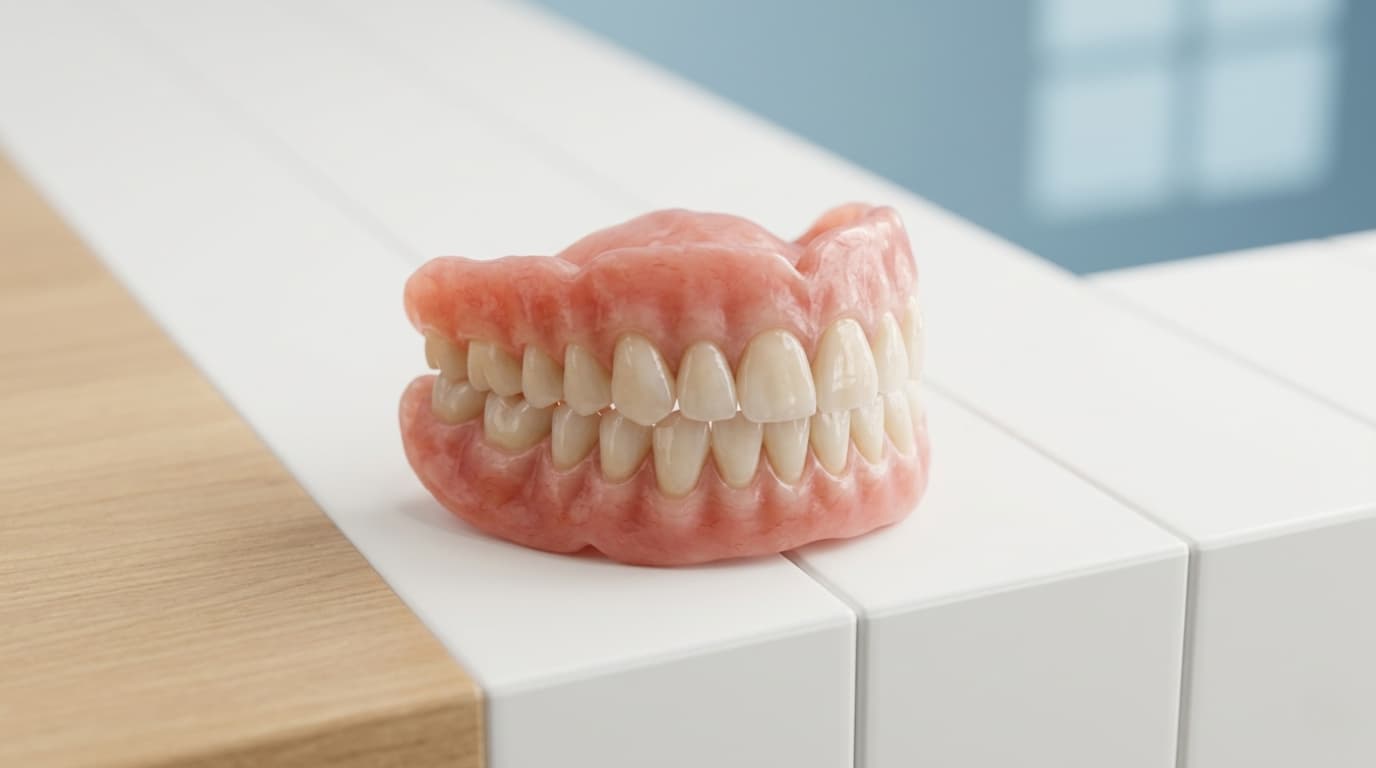
Dentures are the most overlooked option in dental tourism. Most cost-focused content assumes you’re choosing between bridges and implants, but for many cases, quality dentures at 1/10th the cost of implants are the right clinical choice. Particularly when bone density is insufficient, budget is tight, or you need a transitional solution while staging toward more permanent restorations.
This guide gives you the picture you actually need: real denture prices across Bangkok clinics, the five denture types and when each wins, materials breakdown (including Valplast flexible dentures), and a clear decision matrix for dentures vs bridges vs implants.
Quick answer: Dentures in Thailand cost from 3,000 THB ($90) for an acrylic partial to 15,000 THB per arch ($455) for a complete denture, depending on the clinic. Treatment takes 2-4 weeks. Compared to $1,800-$3,500 per arch in the US/UK/AU, savings are 80-90%. For some clinical situations (insufficient bone, elderly patients, multiple missing teeth in same arch), dentures are clinically optimal, not a “second choice.”
How Much Do Dentures Cost in Thailand? (2026 Market Overview)
Bangkok market pricing range
| Type | Bangkok market range (THB) | USD | Notes |
|---|---|---|---|
| Acrylic partial denture (1st tooth) | 3,000–5,000 | $90–$150 | +500 THB per additional tooth at most clinics |
| Metal base partial denture | 8,000–15,000 | $240–$455 | Range based on framework complexity |
| Valplast / flexible partial denture | 10,000–20,000 | $300–$600 | Aesthetic premium, no metal clasps |
| Complete denture (per arch) | 15,000–35,000 | $455–$1,060 | Premium clinics charge more |
| Complete denture (both arches) | 30,000–60,000 | $910–$1,815 | Upper + lower simultaneously |
| Immediate denture | 15,000–35,000 per arch | $455–$1,060 | Placed same-day after extractions |
| 2-implant lower overdenture | 120,000–200,000 | $3,640–$6,060 | 2 implants + complete denture + attachments |
| Reline (every 2-3 years) | 1,500–3,000 | $45–$90 | Resurface inner fit as bone resorbs |
| Repair | 1,500–3,000 | $45–$90 | Broken clasp, fractured tooth, cracked base |
Bangkok market pricing reflects 2026 published rates across major dental clinics including Dental Veneer Bangkok, CDC Dental, Bangkok Smile, and others. Premium clinics like Bangkok International Dental Center charge at the higher end. Verify current pricing directly with your chosen clinic before booking.
Why the 2-implant overdenture deserves serious consideration
The McGill Consensus Statement (Feine et al., 2002, J Prosthet Dent) established the 2-implant lower overdenture as the standard of care for edentulous mandibles, not conventional lower dentures. The York 2009 follow-up consensus reconfirmed this position.
The reasoning: lower complete dentures notoriously slip during eating and speaking due to lack of palate suction. Two strategically placed implants provide dramatic stability improvement at a fraction of full implant arch cost.
This is the most under-discussed dental tourism opportunity for edentulous patients. Across our review of 13 Thai clinic dentures pages, the McGill Consensus is rarely cited, yet the science is settled.
International cost comparison (complete denture per arch)
| Country | Cost (USD) | Savings vs Thailand |
|---|---|---|
| Thailand (Bangkok average) | $455–$1,060 | N/A |
| USA | $1,800–$3,500 | $740–$3,045 saved |
| UK | £1,200–£2,500 ($1,500–$3,150) | $440–$2,695 saved |
| Australia | A$2,000–$4,000 ($1,300–$2,600) | $240–$2,145 saved |
| Canada | C$1,500–$3,000 ($1,100–$2,200) | $40–$1,745 saved |
Bangkok average reflects standard 2026 rates. International prices sourced from ADA Survey of Dental Fees, NHS UK private treatment benchmarks, Australian Dental Association fee surveys.
For specific clinic pricing and what’s included, see our Dentures Bangkok service page.
Why Are Dentures So Much Cheaper in Bangkok?
The savings are not from quality compromise:
- Lower clinic operating costs: Bangkok rent, lab costs, and staff salaries are a fraction of Western markets
- No insurance overhead: Thai clinics don’t process insurance claims
- In-house labs: many premium Thai clinics operate their own dental labs, eliminating outsourcing markups
- Material quality is identical: same acrylics, Valplast thermoplastic, and metal alloys used by Western labs
Specialist credentialing is also equivalent. The Thai Board of Prosthodontics requires 3+ years of specialty residency after the 6-year DDS, comparable to US Board specialty certification.
Types of Dentures: Which One Is Right for You?
Five main denture types, each with specific clinical applications.
Complete (full) dentures
For complete tooth loss in one or both arches.
- Average cost in Bangkok: 15,000–35,000 THB per arch
- Best for: Edentulous patients (no remaining teeth in the arch)
- Treatment time: 2-4 weeks across multiple visits
Partial dentures
For patients with some remaining natural teeth.
- Average cost in Bangkok: 3,000–5,000 THB (acrylic) or 8,000–15,000 THB (metal base)
- Best for: Missing 1-3 teeth in a single area, or several missing teeth across an arch
- Anchored by: Clasps that grip remaining natural teeth
Immediate dentures (key for international patients)
Placed same-day after extractions while gums heal, so you’re never toothless during the healing period.
- Average cost in Bangkok: Same range as complete or partial (depending on case)
- Best for: Patients having multiple extractions who can’t fly home with missing teeth
- Important: May require relining after 3-6 months as gums heal and bone resorbs
Flexible (Valplast) dentures
Made from flexible thermoplastic material with no metal clasps visible.
- Average cost in Bangkok: 10,000–20,000 THB
- Best for: Front teeth replacement where aesthetics matter, patients with metal allergies
- Pros: Almost invisible clasps, flexible (more comfortable), thermal resistant
- Cons: Cannot be relined easily (typically replaced rather than adjusted)
Implant-supported dentures (overdentures)
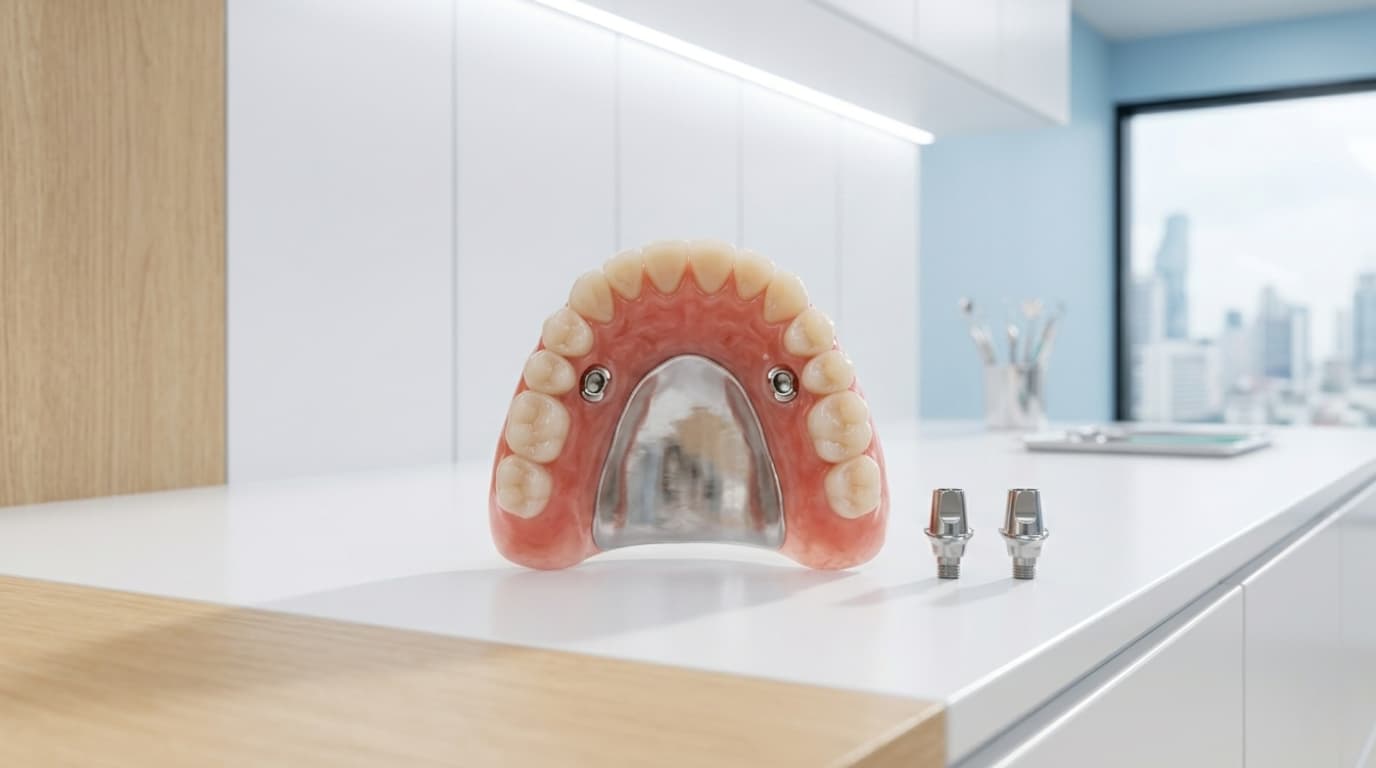
A removable denture that snaps onto 2-4 implants for dramatically improved stability.
- Average cost in Bangkok: 120,000–355,000 THB depending on configuration
- Best for: Edentulous patients who struggle with conventional denture retention (especially lower arch)
- Gold standard: McGill Consensus Statement (2002) recommends 2-implant lower overdenture as standard of care for edentulous mandible
For implant-supported solutions in detail, see our Dental Implants Bangkok page.
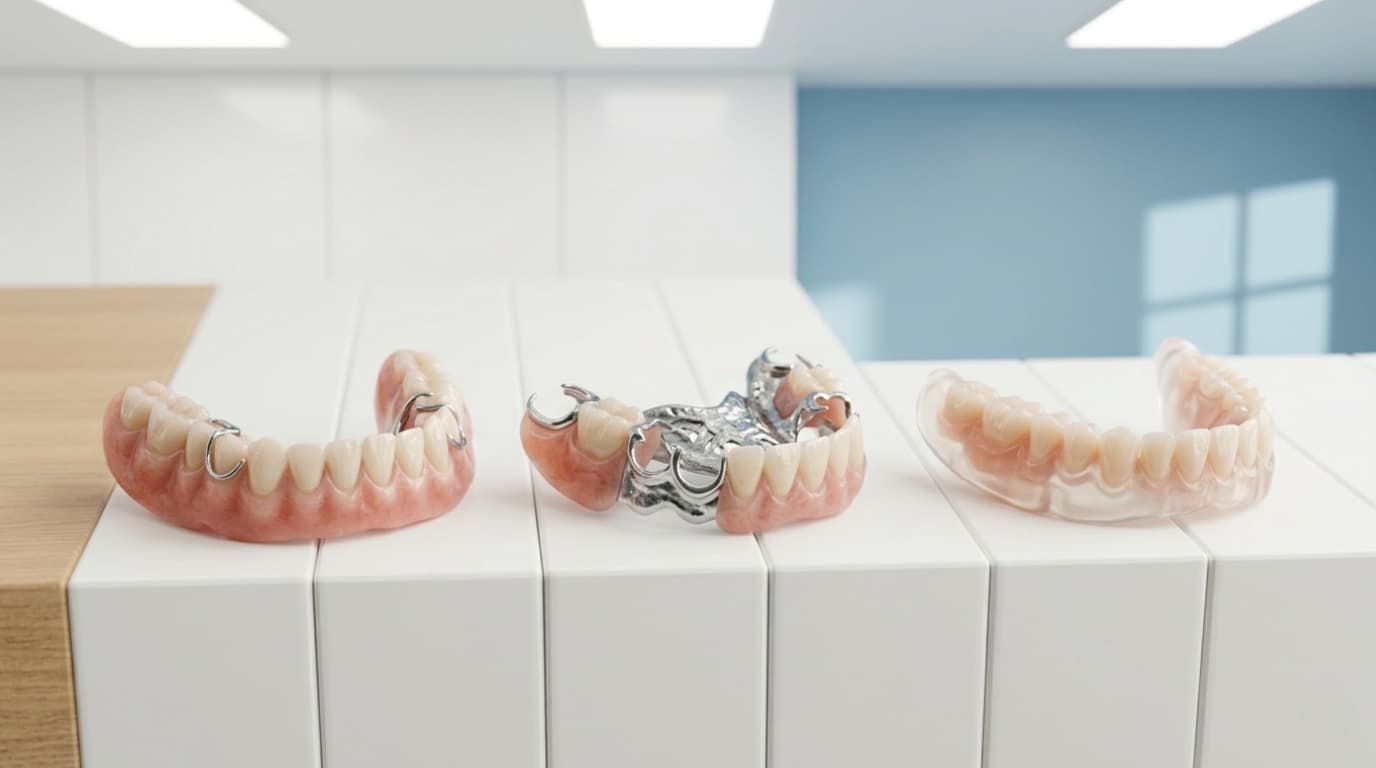
Partial Dentures in Thailand: Acrylic vs Metal vs Valplast
Acrylic partial denture
The entry-level option. Pink acrylic base with white acrylic teeth, held by metal clasps.
- Pros: Cheapest option, easy to add teeth later, good as transitional/healing denture
- Cons: Bulkier, less stable than metal base, clasps visible
Metal base partial denture
Cast metal framework (cobalt-chromium alloy) supporting acrylic teeth and gum-coloured saddles. The standard prosthodontist choice for long-term partial dentures.
- Pros: Thinner, stronger, more stable, longer-lasting (10-15 years)
- Cons: Visible metal clasps unless using acetal alternative
- Cast metal frameworks last decades with proper care
Valplast flexible dentures
Thermoplastic nylon resin: flexible, translucent (gum colour shows through), no metal.
- Pros: Almost invisible clasps, flexible/comfortable, hypoallergenic (no metal)
- Cons: Cannot be easily relined, harder to repair if broken
- Best for: Aesthetics-critical front-tooth replacement, metal allergies
Acetal clasps (tooth-coloured upgrade)
Tooth-coloured nylon clasps that replace visible metal hooks. Can be added to any partial denture for aesthetic improvement, typically at a moderate per-clasp upgrade cost.
Best for: Front-area partial dentures where clasp visibility matters.
Material decision shortcut
| Priority | Recommended type |
|---|---|
| Cheapest cost | Acrylic partial |
| Long-term durability | Metal base |
| Maximum aesthetics | Valplast or metal base + acetal clasps |
| Metal allergy | Valplast |
| Front teeth area | Valplast or acetal clasp upgrade |
Complete Dentures in Thailand: Process & Timeline
What the standard process looks like at most Bangkok clinics
A complete denture is fabricated across 4-5 visits:
- Initial consultation and treatment planning
- Multiple impression appointments (preliminary + final)
- Try-in appointment (wax model, you preview before final fabrication)
- Final fitting and bite adjustment
- 1 follow-up adjustment within the first month
Upper vs lower fit challenges
Upper dentures generally fit better than lower. The hard palate provides natural suction for upper denture retention. The lower jaw doesn’t have this, which is why lower dentures notoriously feel less stable and slip more easily.
Solution for unstable lower dentures: 2-implant overdenture. Two implants in the lower jaw with a snap-on denture transforms stability dramatically. This is the gold-standard solution recommended by the 2002 McGill Consensus Statement for edentulous lower jaws.
Realistic expectations
Complete dentures take 2-6 weeks to feel “normal.” Speech adjusts within 1-2 weeks; eating confidence builds over 4-6 weeks. Some patients use dental adhesive during the adjustment period; many phase it out as they adapt.
Implant-Supported Dentures (Overdentures)
If you’re an edentulous patient struggling with conventional denture retention, implant-supported overdentures offer dramatic functional improvement.
How they work
- 2-4 implants placed in the jawbone (typically 2 for lower arch)
- Special attachments on the implants snap onto matching attachments inside the denture
- Denture clicks into place: significantly more stable than conventional dentures
- You can remove for cleaning
Bangkok market cost ranges
| Configuration | Total cost range (THB) | Total cost (USD) |
|---|---|---|
| 2-implant lower overdenture | 120,000–200,000 | $3,640–$6,060 |
| 4-implant lower overdenture (more stable) | 220,000–350,000 | $6,670–$10,610 |
| 2-implant upper overdenture | 120,000–200,000 | $3,640–$6,060 |
When to upgrade from conventional to implant-supported
- Lower denture won’t stay in place during eating or talking
- You’re tired of using denture adhesive daily
- You want to eat tougher foods (steak, apples, raw vegetables)
- Bone resorption under conventional denture has become problematic
Bone requirements
Implants require sufficient jawbone height and density. Pre-implant CBCT scan determines feasibility. Patients with severe bone loss may need bone grafting first (additional cost) or may be better candidates for All-on-4 full-arch implants.
Treatment Timeline: Can You Get Dentures in 2-4 Weeks?
Yes, denture treatment fits within a 2-4 week trip to Thailand.
Standard timeline (no extractions needed)
| Visit | Day | Activity |
|---|---|---|
| 1 | Day 1 | Consultation, X-rays, preliminary impressions |
| 2 | Day 4-7 | Final impressions, bite registration |
| 3 | Day 10-14 | Try-in appointment (wax model preview, you approve before final) |
| 4 | Day 17-21 | Final delivery, bite adjustment |
| 5 | Day 25-28 | Follow-up, minor adjustments |
Timeline with extractions (immediate denture)
| Visit | Day | Activity |
|---|---|---|
| 1 | Day 1 | Consultation + extractions + immediate denture placed |
| 2 | Day 8-14 | Healing check, denture adjustment |
| 3 | Day 21-28 | Final adjustment before flying home |
| Future | 3-6 months later | Reline (can be done in home country or on return trip) |
For international patients
Option A: Single trip (3-4 weeks): Complete the entire treatment in one extended Bangkok stay. Fly home with finished dentures.
Option B: Split trip (2 trips of 1-2 weeks): Trip 1 for impressions and try-in. Trip 2 (4-6 weeks later) for final delivery and adjustment. Useful if you can’t take 3-4 weeks at once.
Are Dentures Right for You? Dentures vs Bridges vs Implants
This is the central question. Here’s the framework.
Decision matrix
| Factor | Dentures (best) | Bridges (best) | Implants (best) |
|---|---|---|---|
| # missing teeth | Many in one arch | 1-3 adjacent | 1-2 (or full arch) |
| Bone volume | Doesn’t require bone | Requires healthy abutments | Requires sufficient bone |
| Age | Better for elderly | Mid-life or older | Best for younger patients |
| Budget | Lowest cost | Mid-cost | Highest upfront cost |
| Treatment time | 2-4 weeks | 7-10 days | 3-6 months |
| Trips to Thailand | 1 trip | 1 trip | 2 trips |
| Lifespan | 5-10 years | 10-15 years | 25+ years |
| Replaceable/upgradeable | Easy to modify | Replaceable | Implant integrates with bone |
| Medical conditions | Safest for compromised health | Routine prep needed | Surgery: contraindications apply |
When dentures are clinically optimal (not just cheapest)
- Insufficient bone for implants and patient declines bone grafting
- Multiple medical conditions that contraindicate surgery (uncontrolled diabetes, anticoagulants, recent chemotherapy, severe osteoporosis on bisphosphonates)
- Elderly patients (75+) where 5-10 years of comfortable function is the realistic timeframe
- Multiple adjacent missing teeth in same arch where bridges would require unusually long spans
- Budget reality where implants would mean delaying treatment indefinitely
- Transitional solution while staging toward implants or full-mouth rehabilitation
When bridges are usually better
- 1-3 adjacent missing teeth with healthy abutment teeth on both sides
- Patient wants fixed (non-removable) solution
- Single-trip feasibility important
Compare in detail with our Dental Bridges Thailand guide.
When implants are usually better
- Younger patient with decades ahead
- Sufficient bone density
- Want to preserve neighbouring teeth
- Long-term cost-per-year is more important than upfront cost
Younger Patients & Special Cases (Not Just Elderly)
The “dentures = elderly” stereotype misses important patient populations:
Hypodontia / congenital missing teeth
Some patients are born missing one or more permanent teeth (~5-7% of the population). Dentures (often partial) can be the most appropriate solution during teen and early adult years before bone is mature enough for implants.
Trauma cases
Sports injuries, car accidents, falls can knock out multiple front teeth. Immediate partial dentures placed same-day allow you to function and look normal during the healing period before considering longer-term restoration (implants or bridges).
Interim dentures while staging toward implants
Patients planning implants but unable to afford the full cost upfront, or needing 12+ months of bone grafting/healing, can use an interim denture during the wait.
Multiple missing teeth in young adults
Severe decay, poor previous dental work, or specific medical conditions can leave young adults missing multiple teeth. Quality dentures restore function and appearance affordably until permanent solutions are feasible.
Living with Dentures: Comfort, Eating, Speaking
The adjustment period (2-6 weeks)
- Week 1: Speech may sound slightly different (“S” and “F” sounds adjust most). Practice by reading aloud.
- Week 1-2: Increased saliva production is normal. Body adjusts quickly.
- Week 2-4: Start with soft foods, gradually reintroduce harder foods.
- Week 4-6: Eating confidence builds. Most patients eat normally by 6 weeks.
Foods to avoid early on
- Sticky foods (caramel, gum): can dislodge dentures
- Very hard foods (ice, hard nuts): can crack denture material
- Tough meats: cut into very small pieces during early weeks
Adhesives
- Helpful during adjustment period for confidence
- Not always necessary long-term with well-fitted dentures
- If you need adhesive constantly, consider implant-supported overdenture
Speech adaptation
Reading aloud daily for the first 2 weeks accelerates adjustment significantly. Most speech changes resolve within 7-10 days.
Will my face shape change with dentures?
Yes, and understanding this matters for long-term planning. When you lose teeth, the underlying jawbone gradually resorbs (shrinks) because it no longer receives the chewing forces that stimulate it. Conventional dentures sit on top of this bone but don’t prevent the resorption.
Annual bone loss with conventional dentures (peer-reviewed data):
- Year 1 after tooth loss: 25% of bone width lost
- Year 5: ~40% bone width loss
- Year 10+: progressive collapse, “sunken” facial appearance
This is why implant-supported overdentures matter: Implants integrate with the jawbone and transmit chewing forces back into the bone, dramatically slowing resorption. Patients who switch from conventional dentures to implant overdentures often report not just better function but an immediate improvement in facial appearance, because their jaw structure is preserved.
If you anticipate needing dentures for 10+ years, the long-term facial preservation benefit alone often justifies the implant overdenture investment.
Snap-on Smile is NOT a denture (clarification)
Some patients confuse “Snap-on Smile” (and similar branded systems) with dentures. They’re different products:
- Snap-on Smile (~7,500 THB per arch in Bangkok): A removable cosmetic veneer-substitute that snaps over your existing natural teeth. For patients with natural teeth wanting a quick aesthetic upgrade.
- Dentures: A prosthesis replacing missing teeth. Required when natural teeth have been lost.
If you have most of your natural teeth and want a cosmetic improvement, you’re looking at veneers or Snap-on Smile, not dentures.
Maintenance, Relining & Lifespan
Daily care
- Remove dentures at night (let gums recover, prevent bacterial growth)
- Clean dentures over a folded towel or bowl of water (in case of drops)
- Brush with denture cleaner (not regular toothpaste, which is too abrasive)
- Soak overnight in denture solution
- Brush gums with soft brush even when dentures are out
Reline every 2-3 years
Bone gradually resorbs under dentures, causing fit to loosen. Relining (resurfacing the inner surface to match changed bone) restores fit. Required every 2-3 years for most patients. Bangkok clinics typically charge 1,500–3,000 THB for a reline.
International patients: can be done by your Bangkok clinic on return visits, or by a local dentist using your treatment records.
Repair
Dropped denture, broken clasp, fractured tooth: most repairs are quick at Bangkok clinics, typically 1,500–3,000 THB.
Replacement every 5-10 years
Even with good care, denture base materials wear out. Plan for full replacement every 5-10 years. The American Dental Association notes most dentures need replacement at 5-7 years; well-cared-for metal-base partials can last 10+ years.
10-year cost-of-ownership comparison
| Option | Year 1 cost (Thailand average) | 10-year total (with replacements/relines) |
|---|---|---|
| Complete dentures (per arch) | $455 | ~$700 ($455 + 1 reline + replacement) |
| 3-unit bridge | $1,590 | ~$1,800 (1 minor maintenance) |
| Single implant + crown | $2,000 | ~$2,200 (no replacement needed) |
For pure budget-driven decisions, dentures dominate at every time horizon.
Choosing a Clinic in Bangkok: What to Look For
5 criteria for any denture clinic:
- Prosthodontist (specialist) involvement: Thai Board of Prosthodontics certification, the specialty credential for denture and prosthetic work
- In-house lab: controlled quality, faster turnaround, fewer outsourcing markups
- Aftercare for international patients: remote support, reline coordination on return trips, documentation transfer to your home dentist if needed
- Transparent pricing: published prices, no surprise upsells, written quote before any work starts
- Try-in appointment included: you should preview the wax model before final fabrication and be able to request changes
For our specific clinic information, prosthodontist credentials, and booking workflow, see our Dentures Bangkok service page.
Conclusion: Dentures Deserve Honest Consideration
For too many patients, dentures are dismissed as “the cheap second choice” when they’re actually the clinically optimal solution. Insufficient bone, multiple medical contraindications, advanced age, multi-tooth loss in the same arch, or budget reality: all of these favour dentures over implants or extensive bridgework.
At Bangkok pricing (3,000-15,000 THB), dentures restore function and appearance at a fraction of Western costs, with a 2-4 week treatment timeline that fits a single trip. For patients who need stability beyond what conventional dentures offer, 2-implant overdentures combine implant stability with denture economics.
If you’re considering denture treatment in Bangkok, our clinic offers all five denture types (complete, partial acrylic, partial metal, Valplast flexible, and implant-supported overdentures) with full international patient support. See our Dentures Bangkok service page for our specific pricing, prosthodontist credentials, and booking workflow.
Send us photos of your current dentition plus any recent X-rays via WhatsApp. We’ll recommend the best solution honestly, even if that means a 2-implant overdenture instead of conventional dentures, or a bridge instead of a partial. Free consultation, written quote within 24 hours.
Frequently Asked Questions
How much do dentures cost in Thailand?
Dentures in Thailand cost from 3,000 THB ($90) for an acrylic partial to 15,000 THB per arch ($455) for a complete denture at most Bangkok clinics. Premium clinics charge up to 35,000 THB per arch. Metal-base partial dentures: 8,000–15,000 THB ($240–$455). Valplast flexible dentures: 10,000–20,000 THB. Implant-supported overdentures: 120,000–200,000 THB ($3,640–$6,060) for a 2-implant lower configuration.
Are dentures cheaper in Thailand than in the US/UK/Australia?
Yes, typically 80-90% cheaper. A complete denture per arch costs $455 average in Thailand vs $1,800-$3,500 in the US, £1,200-£2,500 in the UK, or A$2,000-$4,000 in Australia. Even with flights and a 3-week Bangkok stay, total is dramatically lower than Western treatment.
How long do dentures last?
5-10 years for most acrylic and metal-base dentures. Metal-base partials can last 10-15 years with good care. Valplast dentures typically replaced at 5-7 years. Lifespan depends on bone changes (gradual resorption requires relining), oral hygiene, and accidental damage.
How long does it take to get used to dentures?
2-6 weeks for full adjustment. Speech adapts within 1-2 weeks. Eating confidence builds over 4-6 weeks. Many patients use mild adhesive during the adjustment period and phase it out once they adapt.
Will my dentures slip when I eat or speak?
Upper dentures generally stay in place well due to natural palate suction. Lower dentures can slip more easily. This is why 2-implant lower overdentures are the gold-standard solution for stable lower dentures. Adhesive helps during adjustment; for chronic slipping, implant-supported overdentures are the durable fix.
Do dentures hurt at first?
Mild gum tenderness for the first 1-2 weeks is normal as gums adapt. Sore spots indicate the denture needs adjustment: return to the clinic for spot-relief grinding (typically included in initial fitting at Bangkok clinics).
Are flexible (Valplast) dentures more comfortable than acrylic?
Many patients find Valplast more comfortable due to its flexibility and lighter weight. Trade-offs: cannot be relined easily (must replace), harder to repair, slightly higher cost than basic acrylic. Best for front-tooth aesthetic cases or metal allergies.
Can I get dentures in 2 weeks in Thailand?
Yes, single-trip dentures fit within 2-4 weeks. For complete dentures: 4 visits over 2-3 weeks. For partial dentures: faster, often 2-3 visits over 1-2 weeks. Allow 4 weeks for safety buffer.
When do dentures need to be relined?
Every 2-3 years for most patients. As jawbone gradually resorbs under dentures, the fit loosens. Relining (resurfacing the inner surface to match changed bone) restores fit. Costs 1,500–3,000 THB at Bangkok clinics.
Can dentures be repaired if they break?
Yes, most repairs (broken clasp, fractured tooth, cracked base) cost 1,500–3,000 THB at Bangkok clinics. For international patients, Bangkok clinics typically ship repair instructions for local dentists, or fix on your next return trip.
Dentures vs implants: which is better?
Neither is universally better. Dentures win on cost, treatment time, no surgery required, and suitability for patients with insufficient bone. Implants win on long-term lifespan (25+ vs 5-10 years), bone preservation, and stability. For elderly patients or those with limited budget/bone, dentures are often the right clinical choice.
Are dentures or bridges better for missing teeth?
For 1-3 adjacent missing teeth with healthy neighbours: bridges. For multiple missing teeth in the same arch, or when adjacent teeth aren’t suitable abutments: partial dentures. For complete tooth loss in an arch: complete dentures or implant-supported overdentures.
Can I switch from dentures to implants later?
Yes. Many patients use dentures as transitional solutions, then upgrade to implants when budget allows or bone health permits. Wearing dentures doesn’t prevent future implant placement, though some bone resorption may have occurred during the denture period.
Can I sleep with my dentures in?
Not recommended. Removing dentures at night allows gum tissue to recover, prevents bacterial overgrowth, and reduces risk of fungal infections (denture stomatitis). Clean and soak dentures overnight in denture solution.