 Written by Dr. Nan
If you have been comparing ways to straighten your teeth, you have probably seen "Invisalign" and "clear aligners" used as if they were two separate treatments. They are not. Sorting out what the words actually mean changes how you read every price quote and clinic offer you come across.
So the honest framing is this. Invisalign is a premium label. Other clinic-fitted aligner systems are the same kind of treatment delivered with different lab technology and a different price tag. And cheap mail-order aligners are a genuinely different, riskier thing. Below we break all three apart so you can read any quote clearly.
Invisalign is a brand, clear aligners are the category
Think of it the way you would think of tissues. Kleenex is a brand; tissue is the product. People say "pass me a Kleenex" even when the box is something else. Invisalign has the same hold on orthodontics. It launched the modern clear aligner in the late 1990s, spent two decades marketing it, and became the name patients ask for by default.
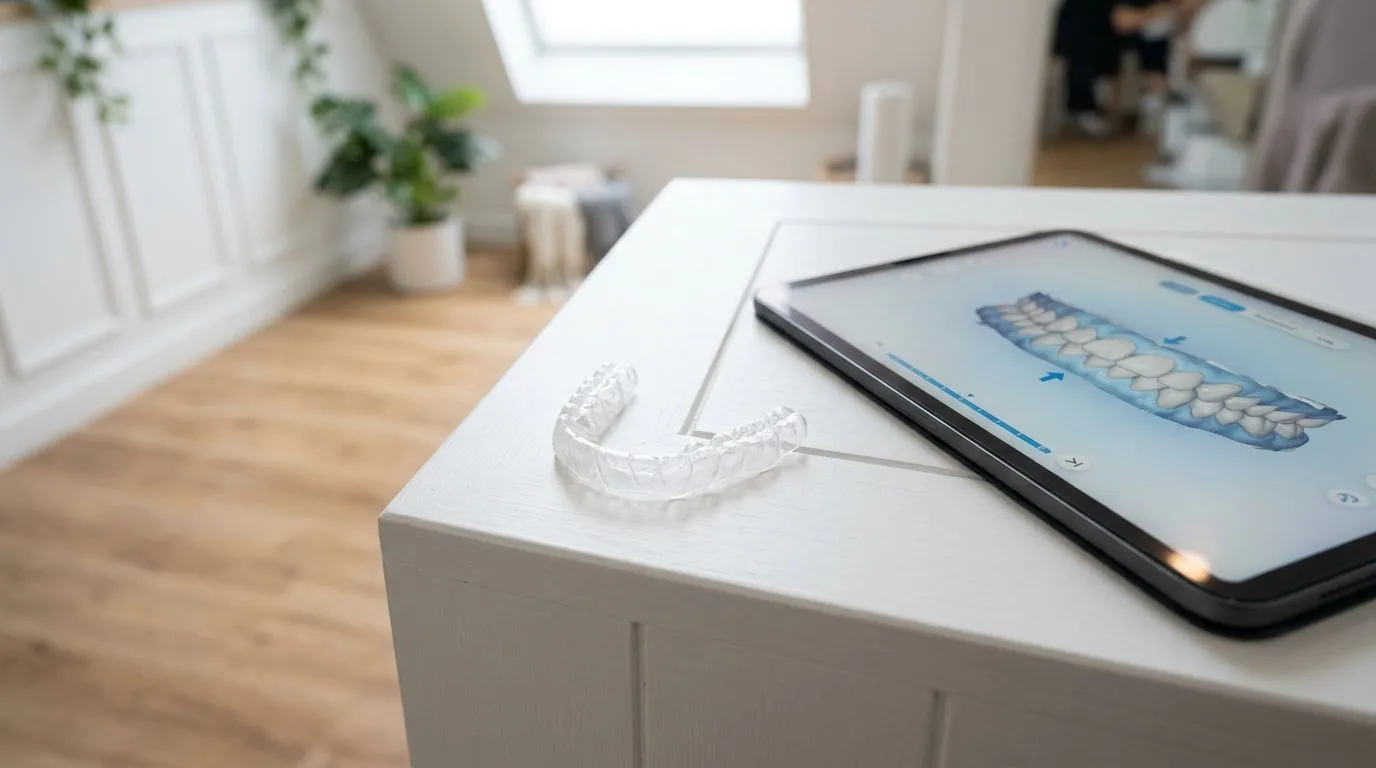
That does not mean other aligners are knock-offs. A clear aligner is simply a set of custom, transparent plastic trays:
- Your teeth are scanned and a treatment plan is designed in software.
- A series of trays is made, each one nudging your teeth a little closer to the final position.
- You wear each tray 20 to 22 hours a day and switch to the next every one to two weeks.
That description fits Invisalign and it fits the clinic-fitted aligners we use in Bangkok equally well. The mechanism is identical.
What differs between brands is the plastic formula, the planning software, the size of the historical case library behind the system, and the cost. Those things matter, but they are differences of degree within one treatment, not a different treatment.
Where Invisalign genuinely differs from other aligners
Invisalign earns its reputation in a few concrete ways, and it is worth being straight about them:
- A proprietary plastic (marketed as SmartTrack) and a very large library of treated cases that feed its planning software. For complicated movements, rotating a stubborn canine, closing a tricky bite, that depth of data can mean fewer refinement rounds.
- The most familiar name to patients, which is part of what you pay for.
Other clinic-fitted aligner brands use their own medical-grade plastics and 3D digital planning. For the cases most adults actually want fixed, gaps, mild to moderate crowding, crooked front teeth, and relapse after old braces, they produce very comparable results.
The big practical difference patients feel is price. Because Invisalign is the market leader, it carries a brand premium that other capable systems do not.
The point is not that one is "good" and the other "bad." It is that the right system depends on how complex your case is and what you are willing to pay for a name.
The real divide: dentist-supervised vs mail-order DTC
Here is the comparison that protects you more than the brand question. Many "cheap aligner" ads you see online are direct-to-consumer kits. You take your own impressions at home or get a one-off scan, post them off, and trays arrive with little or no ongoing care from a qualified clinician.
Clear aligners work by applying controlled force to your teeth, and your teeth sit in living bone and gum. Moving them without someone checking your gum health, your roots, and your bite is where things go wrong.
Unsupervised movement can loosen teeth, open a bad bite, or worsen problems you did not know you had. That is the genuine risk, and it has nothing to do with whether the box says Invisalign.
Both Invisalign and the aligners we fit in Bangkok are dentist-supervised:
- Your suitability is assessed first, with X-rays and photos.
- Your plan is designed and monitored by an orthodontist, with check-ups every six to eight weeks with us, so the movement is corrected if it drifts off plan.
- If a tooth needs more than aligners can safely deliver, you are told before you commit, not after.
When you weigh your options, sort them into "supervised by a clinician" and "not." That line matters far more than the brand line.

Invisalign vs clinic aligners vs mail-order: side by side
| Feature | Invisalign (brand) | Our clinic clear aligners | Mail-order DTC kits |
|---|---|---|---|
| What it is | Premium clear aligner brand | Clinic-fitted clear aligner system | Home-impression aligners |
| Dentist supervision | Yes, in person | Yes, in person | Little to none |
| 3D digital scanning | Yes | Yes | Often self-taken impressions |
| Best for | Mild to complex cases | Mild to moderate cases | Very minor cases only |
| Track record / case library | Largest in the industry | Established system, real oversight | Limited, no clinical exam |
| Typical cost (Thailand) | Higher (brand premium) | From ฿15,000 (about $440) | Cheapest, highest risk |
| Safety check before starting | Full assessment | Full assessment + X-rays | Usually skipped |
Which one suits which case?
- ✅ Mild to moderate problems, the kind most adults are dealing with (gaps, minor crowding, crooked front teeth, relapse after teenage braces): a quality clinic-fitted aligner system gives you genuinely comparable results to a branded one, with closer hands-on care and a lower price.
- ❌ Genuinely complex movements (severe rotations, big bite corrections, jaw discrepancies): you want the most advanced planning available, and sometimes that points toward a premium branded system or even toward fixed braces instead. Some bites simply move faster and more predictably with braces, which is worth weighing if cost is not your only concern.
We compare those routes in more detail in our guide to Damon braces vs Invisalign and our broader clear aligners versus braces breakdown, and you can read more about how aligner treatment works for international patients in clear aligners in Thailand.
If your case is borderline, that is exactly what the assessment is for. An honest clinic will tell you when aligners are the wrong tool and point you to braces in Bangkok instead, rather than selling you trays that cannot deliver.
What you actually pay, and what is included
This is where the brand question becomes a money question. Branded aligner treatment in the US, UK, Australia, and Singapore commonly runs into the thousands. Clinic-fitted clear aligners in Bangkok start from ฿15,000, roughly $440, with the full case range typically falling between ฿15,000 and ฿175,000 depending on how much movement you need and how long it takes.
That price is not a stripped-down service. It includes:
- your consultation
- 3D digital scanning rather than messy putty impressions
- your custom trays
- progress monitoring through to retention
- a written one-year warranty against fractures, with free replacement except where damage is due to misuse
You are not trading care for a cheaper sticker; you are skipping the brand premium and the Western cost base. Our guide to clear aligners cost in Thailand explains what drives that range and what a complete quote should include.
Common questions before you decide
- Will it hurt more or less than Invisalign? No, because it is the same kind of treatment. Any clear aligner feels tight for a day or two each time you change trays, as that pressure is what moves your teeth. There is no drilling and no metal to rub against your cheeks, so most patients describe it as pressure rather than pain, branded or not.
- How long will treatment take? For mild to moderate cases, typically six to eighteen months, with each tray worn one to two weeks. Brand claims about faster timelines mostly come down to wear schedule and case complexity, not magic. The honest driver is how far your teeth need to move and how consistently you wear the trays.
- Do I have to keep flying back to Bangkok? No. Because check-ups fall every six to eight weeks rather than every month, many international patients plan a couple of trips around their treatment or arrange remote monitoring between visits. That spacing is one reason aligners travel well for dental tourism.
- Is the cheaper option lower quality? Not when it is dentist-supervised. The thing that protects your teeth is the clinical oversight, the assessment, the X-rays, the monitoring, and that is built into clinic-fitted treatment regardless of brand. What you save by skipping a premium label is brand premium, not safety.

Conclusion
Invisalign is a clear aligner, not an alternative to one. The choice that genuinely affects your result and your safety is whether a dentist is supervising your treatment, not which brand name is printed on the tray.
Dentist-fitted clear aligners give most patients the same kind of straightening as a premium brand, with real oversight, at a price that makes treatment in Bangkok worth the trip. You can explore our clear aligner treatment in Bangkok for the full detail.
If you want to know whether aligners are right for your teeth, send us a few photos and we will come back with an honest assessment of your case, your options, and your real cost before you commit to anything.
Was this article helpful?