 Written by Dr. Nan
This is a strictly two-country comparison, written by a Bangkok clinic, so read it with that in mind. We have tried to be honest about where Turkey genuinely beats us. If you want a wider view, see our guide to the best countries for dental tourism.
The short answer: who wins on what
Different jobs have different winners. Here is the blunt version before we get into the numbers.
| What you need | Cheaper sticker | Better value (AU/UK/NZ) |
|---|---|---|
| A few veneers, cosmetic only | Turkey | Toss-up, depends on the dentist |
| Single implants | Turkey | Thailand, with brand + warranty |
| Full-arch / All-on-4 | Turkey (often) | Thailand, smallest gap, highest stakes |
| Crowns and bridges | Turkey | Thailand, clarity + aftercare |
| Avoiding over-treatment | Thailand | Thailand |
Turkey's edge is almost entirely about the number on the quote. Thailand's edge is about what happens to your teeth, and what happens if something needs fixing.
Is Thailand or Turkey cheaper? The real price comparison (implants, veneers, All-on-4)
Let us put honest ranges side by side. Turkey figures are typical advertised international-patient prices; ours are our actual clinic prices.
| Treatment | Turkey (typical advertised) | Thailand (our clinic) |
|---|---|---|
| Porcelain veneer (per tooth) | ~$250 to $400 | 12,000 to 14,000 THB (~$370 to $430) |
| Composite veneer (per tooth) | ~$150 to $250 | 4,000 THB (~$120) |
| Single implant | ~$500 to $900 | from 45,000 THB (~$1,320) |
| E-max crown | ~$200 to $350 | 16,000 THB (~$490) |
| Zirconia crown | ~$250 to $400 | 18,000 THB (~$550) |
Read that honestly: on porcelain veneers we are close, sometimes cheaper on composite depending on the Turkish clinic, and clearly more expensive on implants and crowns. We are not the cheapest chair in the world and we do not try to be.
What that headline table hides is what the implant actually is, which brand, whose hands, and what happens if it fails. That is the rest of this article. For the full breakdown on our side, see the true cost of veneers in Thailand and dental implant cost in Thailand.
Why implants and veneers cost less in Turkey
This is a fair question, and the answer is not "Turkey is a scam." Several real factors pull Turkish prices down:
- a weaker lira against the pound, euro and Australian dollar
- very high clinic volume in hubs like Antalya and Istanbul
- aggressive package pricing built to win the search-and-book European market
- lower labour and facility costs
But there is another factor the ads never mention: the cheapest packages are often built around a treatment plan that is faster and more profitable for the clinic, not necessarily better for your teeth.
When a "full smile" of veneers is quoted as one flat price for a set of eight or ten, the clinic is incentivised to standardise, work fast, and reduce as much tooth as needed to make a bulk case fit. That is where "Turkey teeth" comes from.
"Turkey teeth": why the cheap package can mean crowns on healthy teeth
"Turkey teeth" is the nickname for a specific over-treatment pattern that got popular through cheap all-inclusive smile packages. Here is the mechanism, said plainly.
- ✅ A true veneer is a thin shell bonded to the front of a tooth, and it needs only a small amount of enamel removed, sometimes almost none.
- ❌ A crown is a cap that covers the whole tooth, and to fit one the tooth has to be ground down on all sides, removing a large share of the healthy tooth structure.
Many budget "veneer" packages are not veneers at all. They are crowns marketed as veneers, because crowns are quicker to place across a whole smile and forgiving of alignment problems.
The catch is that grinding a healthy tooth down to a small peg is irreversible. You can never get that enamel back.
Aggressive reduction also brings the drill close to the pulp (the nerve inside the tooth), which raises the risk of nerve inflammation, pain, and an unplanned root canal down the line. Our clinic does not even offer root canal treatment, we refer that out, so this is not us upselling you on it. It is a genuine complication that turns a cosmetic trip into ongoing dental work for years.
Not every Turkish clinic does this, and good ones exist. But the risk lives inside the exact product that makes Turkey look cheapest: the flat-rate full-smile package. If you want to understand the difference for yourself before you book anything anywhere, read crown vs veneer.
Enamel matters: conservative veneers vs filing teeth down to pegs
Enamel is the hardest tissue in your body and it does not grow back. Minimally invasive dentistry, which is the modern standard, treats enamel as something to protect, not something to remove for convenience. The whole point of a veneer over a crown is that you keep most of your natural tooth.
At our clinic the default question is "what is the least we can do to get you the result you want," and we offer a real choice rather than defaulting everyone to full crowns:
- Composite is additive and very conservative.
- Porcelain veneers need only light preparation.
- Crowns are reserved for teeth that actually need the full coverage: heavily filled, broken, or root-canalled teeth.
If you are weighing the two materials, composite vs porcelain veneers walks through the trade-offs. And crucially, most people need far fewer veneers than a package tries to sell them, which is exactly why we wrote how many veneers you actually need.
Total trip cost, not sticker price: what you actually pay landed
Sticker price is one line. Landed cost is the whole thing. Here is honest math for a patient flying from Sydney, comparing a small case (say four porcelain veneers) in each country.
| Line item | Turkey | Thailand (our clinic) |
|---|---|---|
| 4 porcelain veneers | ~$1,000 to $1,600 | ~$1,480 to $1,720 |
| Return flight from Sydney | Long-haul, often similar or higher | Long-haul, often similar or lower |
| Hotel + food, ~7 days | Comparable | Comparable |
| Revision risk if a case goes wrong | Second long-haul trip, often at your cost | 1-year written warranty on the work |
The veneer line is close. The flights are a wash or slightly favour Thailand from the Asia-Pacific. The line that actually decides value is the last one.
If a Turkish crown-heavy job needs redoing, you are booking another long-haul flight and often paying again. A written warranty and an on-site lab that can remake a restoration while you are still in town changes the risk math completely. Cheap is only cheap if it holds.
The long-haul reality for Australia, NZ and the UK (proximity is a wash)
This is the point every Turkey-owned page skips, because it only helps European readers. Turkey's single biggest advantage is proximity, and that advantage is European. It is a short hop from London, Berlin or Amsterdam. It is not a short hop from you.
| From | To Istanbul/Antalya | To Bangkok |
|---|---|---|
| Sydney | ~20 to 24 hrs, usually 1+ stop | ~9 to 10 hrs, direct available |
| Auckland | ~24+ hrs, multiple stops | ~11 to 12 hrs, direct available |
| London | ~4 hrs direct | ~11 to 12 hrs |
For an Australian or a New Zealander, Turkey is farther than Thailand, not closer. For a UK patient Turkey is closer on the map, but the flight is short either way and the decision comes down to what happens in the chair, not the airport.
So when a comparison page says "Turkey wins on convenience," ask "convenient for whom." For most of our patients, the proximity argument runs the other way.
Multi-trip cases: why Bangkok suits implants and full-arch work
Implants are not a one-and-done holiday. The bone needs time to fuse to the implant before the final teeth go on, so a typical implant case runs 3 to 6 months and usually needs two trips. That structure means the quality of your follow-up matters more than the price of your first appointment.
Bangkok is built for this:
- Direct flights from Australia and New Zealand make the second trip cheap and painless to schedule.
- An on-site dental lab and 3D CT scanning mean planning, surgery and the final restoration are handled under one roof rather than outsourced.
When a case is going to span months and two visits, an anonymous package that assumes you will never come back is the wrong tool. For how patients actually stage these visits, see planning your dental trip to Bangkok and All-on-4 dental implants.
Named brands and named dentists, not an anonymous all-inclusive
Here is a test. Go to a cheap Turkish package page and try to answer two questions: which implant brand am I getting, and who is the dentist placing it. Most pages cannot tell you either. You get a price, a hotel, and an airport transfer.
We think that is exactly backwards. The two things that most affect a 20-year outcome are the implant system and the clinician, and those are the two things budget packages hide. So we name both.
| What you should know | Typical budget package | Our clinic |
|---|---|---|
| Implant brand | Often unnamed | Named, Neobiotech up to Straumann |
| Who does the work | Anonymous | Dr. Nan (Board Prosthodontics + Orthodontics), Dr. Ple (prosthodontist) |
| Lab | Outsourced | On-site |
| Imaging | Varies | 3D CT / CAD-CAM in house |
| Warranty | Often none in writing | 1-year written warranty |
Named brands matter because a premium system like Straumann has decades of data and globally available parts, so if you ever need service at home, your local dentist can source components. An unnamed implant is a black box.
If you want to go deeper on materials, zirconia vs E-max crowns shows the same "know exactly what you are getting" logic applied to crowns.
Which country is safer for dental tourism?
Both countries have excellent clinics and both have cut-rate ones, so "which country is safer" is the wrong question. "Which clinic is safer" is the right one:
- Both Turkey and Thailand host internationally accredited hospitals and clinics, including JCI-accredited facilities.
- Complications cluster around fast, high-volume cosmetic work and poor aftercare, not around one country. Surveys of patients treated abroad, including work reported through UK dental bodies, consistently find this.
That is why the safety conversation should be about conservatism and follow-up, not flags. A clinic that preserves enamel, names its brands, backs the work in writing and can see you again is lower risk wherever it sits. We spell out our side of that in is dental work in Thailand safe.
Veneers in Turkey vs Thailand: the cosmetic decision
If your case is purely cosmetic, a handful of front teeth, this is the closest call in the whole comparison. Turkey can be a bit cheaper per tooth on porcelain, and a good Turkish cosmetic dentist will do lovely work. The decision really comes down to two questions:
- Are you being sold veneers, or crowns dressed up as veneers?
- How many teeth actually need treatment? A conservative plan on six teeth beats an aggressive plan on ten every time, both for your enamel and often for your wallet.
That is the entire pitch for veneers in Bangkok: a real composite-or-porcelain choice, only the teeth that need it, and enamel kept wherever possible.
Full-mouth and All-on-4: where the price gap really lands
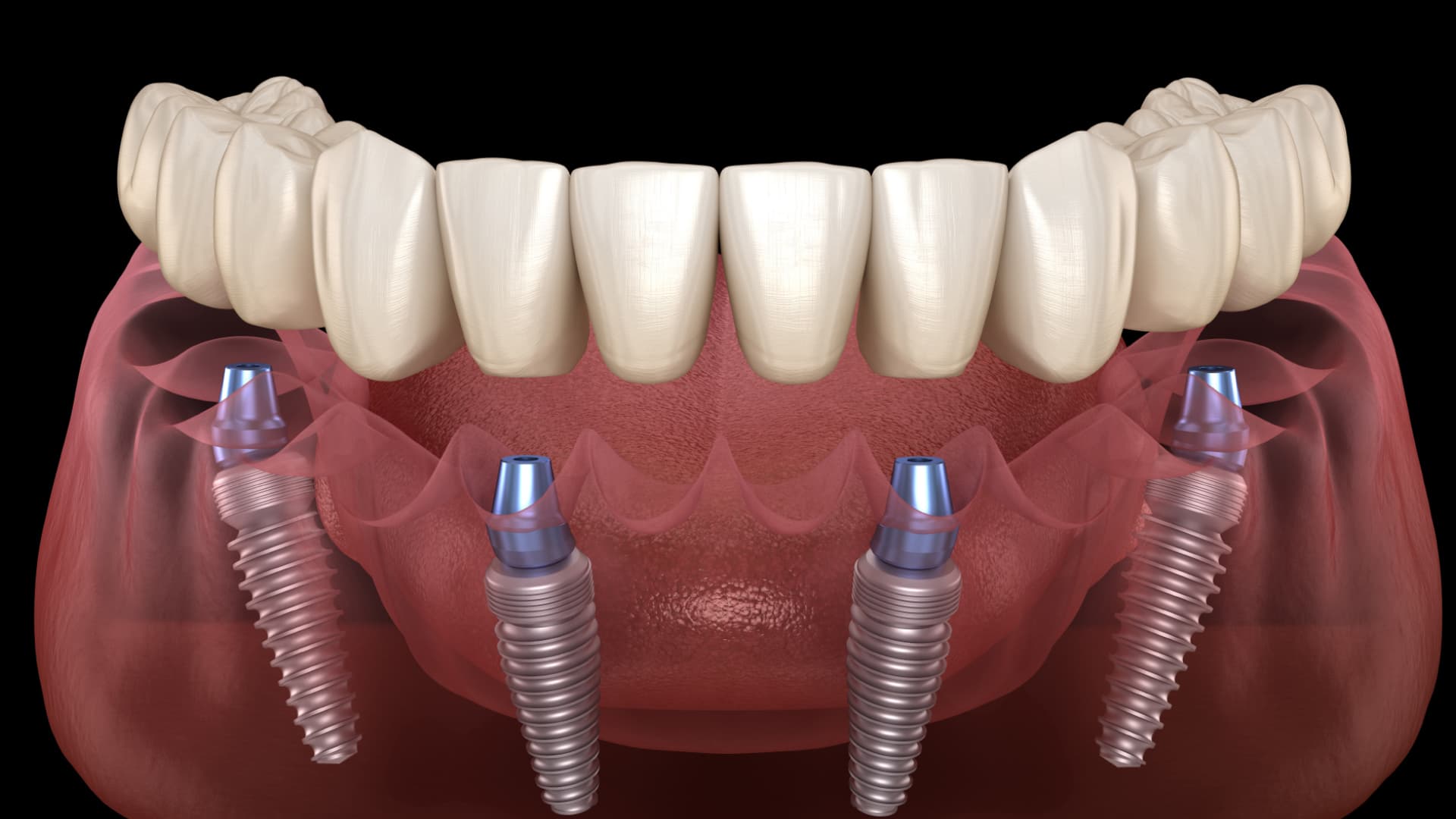
Full-arch is where the money is biggest and the price gap is at its most tempting. Our All-on-4 runs 350,000 to 500,000 THB per arch. Turkey often advertises full-arch lower.
But this is also where a cheap decision is hardest to unwind, because you are replacing a whole jaw of teeth on four to six implants. For a case this size, three things outweigh a few thousand dollars of sticker difference:
- The implant brand, so parts exist in 15 years.
- The imaging and planning, 3D CT and in-house lab, so the bite is right.
- The ability to fly back for the second stage and any adjustment.
Bangkok's direct flights and our on-site lab make the multi-visit reality of full-arch genuinely easier for Australian and New Zealand patients. The gap in price is real; the gap in what you are actually buying is bigger.
How to choose, and how to get a real quote before you fly
Do not choose a country. Choose a treatment plan. The right sequence is short:
- Get a plan you trust.
- Confirm it is conservative and preserves enamel.
- Confirm the implant brand and the dentist by name.
- Compare total landed cost, including the risk of a redo.
If Turkey wins on those terms for your case, go to Turkey with your eyes open. If Thailand wins, we would be glad to help.
Conclusion
Turkey is genuinely cheaper on the quote, and for a European patient chasing the lowest cosmetic price, that argument is real. But a dental trip is not a quote. It is a treatment plan, a clinician, a brand of implant, and what happens if something needs fixing from 10,000 km away.
On those terms, conservative enamel-preserving work, named dentists and brands, a written warranty, and direct flights home for the second visit, Thailand wins for most Australian, New Zealand and UK patients. Choose the plan, not the flag.
You do not need to fly here to decide between two countries. Send us a few photos of your teeth, tell us what you are after, and we reply within 24 hours with a specific quote from a named prosthodontist, whether your plan can stay conservative, and an honest read on whether Thailand or Turkey suits your case better.
Frequently Asked Questions
Is Thailand or Turkey cheaper for dental work?
Turkey usually has the lower sticker price, especially on implants and crowns. Thailand is close on porcelain veneers and can be cheaper on composite. Once flights and revision risk are counted, the gap narrows.
Is Turkey or Thailand better for dental implants?
Turkey is cheaper up front. Thailand tends to offer better overall value because you can get named brands (Neobiotech to Straumann), a written warranty, and easy direct flights for the second visit that implants require.
Why are dental implants cheaper in Turkey than Thailand?
A weaker currency, very high patient volume, and aggressive package pricing. The lowest prices sometimes reflect unnamed implant systems and faster, more standardised treatment plans.
Should Australians go to Thailand or Turkey for dental work?
For most Australians, Thailand. Turkey's proximity advantage is European. From Sydney, Bangkok is roughly 9 hours direct versus 20-plus hours to Turkey, which matters a lot for multi-visit treatment.
Are veneers cheaper in Turkey or Thailand?
Porcelain veneers are similar, Turkey sometimes slightly lower. The bigger cost driver is whether you are quoted true veneers or crowns, and how many teeth are treated.
What are "Turkey teeth" and why are they risky?
It is a nickname for crowns fitted in place of veneers, which means grinding healthy teeth down substantially. That is irreversible and raises the risk of nerve damage and root canals.
Which country is safer for dental tourism, Turkey or Thailand?
Both have excellent and poor clinics, including JCI-accredited ones. Safety depends on the clinic's conservatism and aftercare, not the country.
How long is the flight to Thailand versus Turkey from Australia or New Zealand?
Bangkok is about 9 to 10 hours direct from Sydney and 11 to 12 from Auckland. Turkey is roughly 20 to 24-plus hours with stops. Thailand is closer for the Asia-Pacific.
Do Turkish clinics fit crowns instead of veneers?
Some do, particularly in flat-rate smile packages, because crowns are faster across a full arch. Good clinics disclose this. Always confirm whether you are getting veneers or crowns.
Which country is better for a full-mouth or All-on-4 case?
Thailand suits full-arch work well because of the on-site lab, 3D CT planning, named implant brands, and direct flights for the required second trip. The price gap is smallest and the stakes highest here.
Was this article helpful?