 Written by Dr. Nan
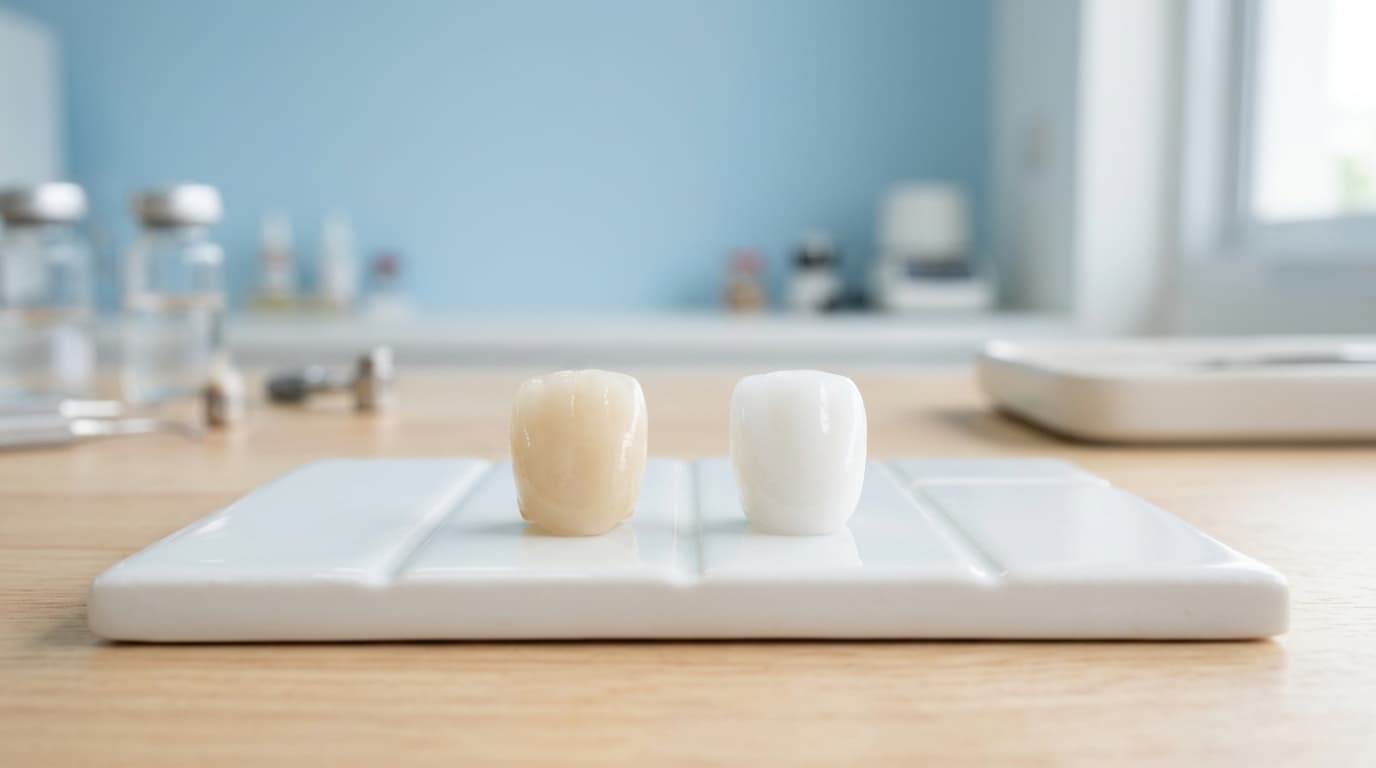
If you’ve been told you need a dental crown, the next decision is which material, and the two leading modern options are zirconia and E-max (lithium disilicate). If you’re still deciding whether a crown is even the right restoration in the first place, our crown vs veneer guide covers when each one applies. Most articles will tell you “E-max for front teeth, zirconia for back teeth” and stop there. The real decision is more nuanced: there are at least 14 specific clinical scenarios where one wins decisively over the other, and a few where they’re equivalent.
This guide is written by board-certified prosthodontists who place both materials weekly at our in-house Bangkok lab. We’ll cover the actual flexural strength numbers, real clinical study survival rates, the bonding chemistry that affects long-term outcomes, and a decision matrix you can apply to your specific tooth.
Zirconia vs E-max: At-a-Glance Comparison
| Feature | E-max (Lithium Disilicate) | Zirconia (Y-TZP) |
|---|---|---|
| Composition | 70% lithium disilicate crystals in glass matrix | Yttria-stabilized zirconium dioxide |
| Flexural strength | 470–530 MPa | 557–1,200 MPa (depending on generation) |
| Fracture toughness (K1c) | ~2.0 MPa√m | 5–10 MPa√m |
| Translucency | Excellent (HT grade) | Good (modern multilayer/HT) to opaque (3Y-TZP) |
| Best for | Anterior single crowns, premolars, color-match cases | Molars, bruxers, dark substrates, bridges |
| Tooth preparation | 1.0–1.5 mm | 0.5–1.0 mm |
| Bonding | Adhesive (HF etch + silane + resin cement) | Conventional cement OR adhesive (sandblast + MDP primer) |
| 5-year survival | 97.8% (Reich et al.) | 98% (Solá-Ruiz et al.) |
| 10-year survival | ~94% (Beier & Schmeiser) | 86–100% (depending on type, location) |
| Bangkok cost | 16,000 THB (~$470) | 18,000 THB (~$530) |
TL;DR:
- Visible single front tooth, normal color: E-max
- Molar, premolar, or bridge: Zirconia
- Dark or discoloured substrate (RCT, metal post): Zirconia (opacity masks)
- Limited interocclusal space: Zirconia (0.5 mm prep)
For full crown pricing breakdown including international comparisons, see our Dental Crown Cost Thailand guide.
What E-max Actually Is: Lithium Disilicate Glass-Ceramic
E-max is the brand name for IPS e.max, manufactured by Ivoclar Vivadent (Liechtenstein), the global gold standard for lithium disilicate ceramics. It comes in two main forms:
- IPS e.max CAD: pre-fabricated blocks milled in CAD/CAM systems (530 MPa flexural strength after crystallization)
- IPS e.max Press: pellets pressed into investment molds (470 MPa)
The microstructure that makes E-max unique
E-max is a glass-ceramic : 70% lithium disilicate crystals embedded in a 30% glass matrix. This dual-phase structure gives it two clinically important properties:
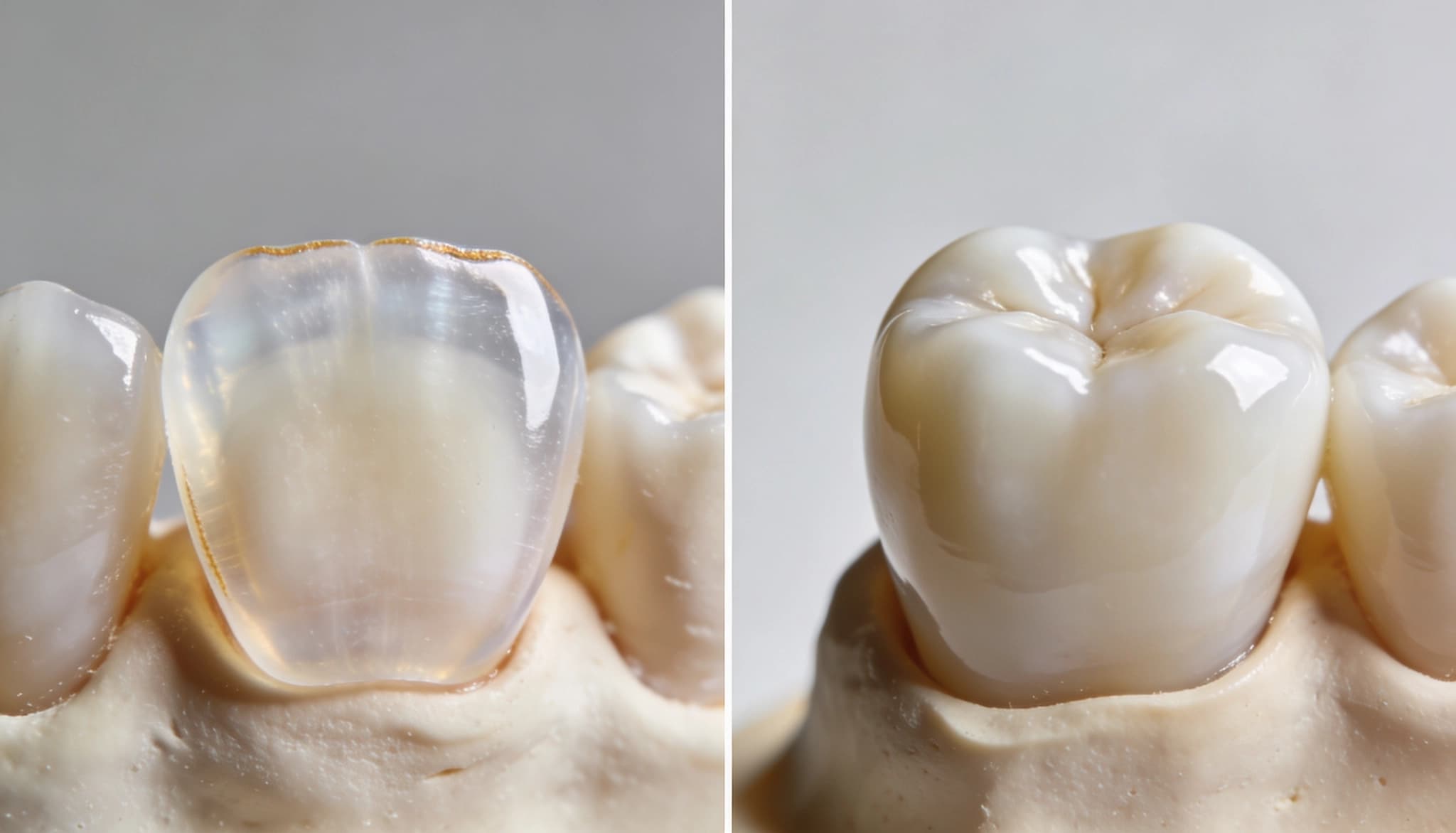
- Translucency: light passes through the glass matrix and scatters off the crystal interfaces, producing a “chameleon effect” that mimics natural enamel. This is why E-max looks so natural on visible teeth.
- Acid-etchability: the glass matrix can be etched with hydrofluoric acid, creating microporosity that bonds chemically to resin cements. This is critical for cementation strength.
Why E-max is still the prosthodontist’s anterior favourite
Despite zirconia’s strength advantage, E-max remains the preferred choice for single visible anterior crowns because no zirconia generation has fully matched its translucency-to-strength ratio. A 2023 randomised clinical trial (Esquivel-Upshaw et al., 3-year follow-up) confirmed E-max scored higher on aesthetic patient ratings than high-translucency cubic zirconia, with no significant difference in clinical survival.
Reference: Ivoclar IPS e.max CAD technical specifications.
What Zirconia Actually Is: Yttria-Stabilized Zirconium Dioxide
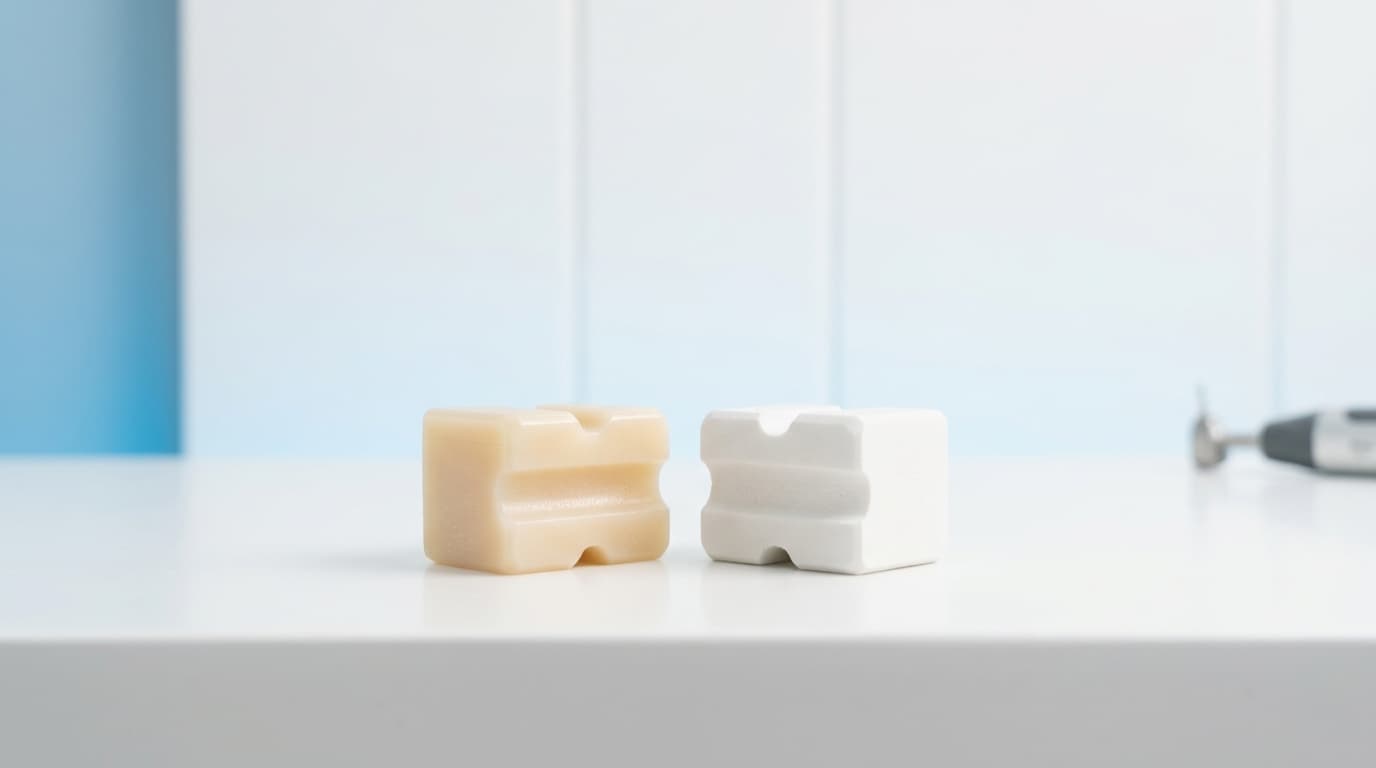
Zirconia in dentistry refers to yttria-stabilized zirconium dioxide , a polycrystalline ceramic with no glass content. It’s sometimes called “ceramic steel” because of its exceptional mechanical strength.
The three generations of dental zirconia
- 3Y-TZP (3 mol% yttria, tetragonal phase): the original “Full-Strength” zirconia. Flexural strength 1,100–1,200 MPa (highest of any dental ceramic). Trade-off: opaque, monochromatic. Best example: BruxZir Full-Strength, KATANA HT.
- 4Y / 5Y multilayer zirconia (cubic-tetragonal): newer generations with higher cubic-phase content. Lower strength (557–900 MPa) but dramatically higher translucency. Best examples: Kuraray KATANA STML (748 MPa) and UTML (557 MPa), 3M Lava Esthetic (800 MPa, 46% translucency), Cercon HT ML.
- Multilayer aesthetic zirconia (e.g. Lava Esthetic): pre-shaded blocks with built-in colour gradient (incisal-to-cervical) and high translucency. Approaches E-max aesthetics for the “is zirconia natural-looking?” question.
Why zirconia transformed posterior dentistry
Before monolithic zirconia (~2010), posterior crowns used PFM (porcelain-fused-to-metal), which exposed a metal margin at the gum line over time. Zirconia provided metal-free strength suitable for molars, eliminating the aesthetic compromise of PFM. If you are specifically comparing the modern metal-free option against the older metal-backed one, our zirconia vs PFM crowns guide covers that head-to-head. The 2025 Glidewell BruxZir vs E-max 10-year comparative trial reported 100% survival for monolithic zirconia vs 94% for E-max in posterior placements , confirming zirconia’s edge under heavy chewing forces.
References: 3M Lava Esthetic Technical Product Profile, Kuraray KATANA STML/UTML Technical Guide.
Strength and Fracture Resistance: The 1,000 vs 500 MPa Story
The most-cited difference between zirconia and E-max is flexural strength (resistance to bending forces). But the numbers vary widely by product, and strength alone isn’t the full story.
Real flexural strength by product (2026 data)
| Material | Brand / Type | Flexural strength (MPa) |
|---|---|---|
| E-max CAD | IPS e.max CAD (Ivoclar) | 530 |
| E-max Press | IPS e.max Press (Ivoclar) | 470 |
| Zirconia (translucent) | KATANA UTML (Kuraray) | 557 |
| Zirconia (translucent) | 3M Lava Esthetic | 800 |
| Zirconia (super-translucent) | KATANA STML | 748 |
| Zirconia (full-strength 3Y-TZP) | BruxZir Full-Strength, Cercon Base | 1,100–1,200 |
Plain-English read: Modern translucent zirconia (557–800 MPa) sits just above E-max (470–530 MPa). The strength gap has narrowed significantly. Full-strength 3Y-TZP zirconia is more than 2x stronger than E-max but loses translucency for it.
Fracture toughness (the more clinically relevant number)
Flexural strength measures resistance to bending. Fracture toughness (K1c) measures resistance to crack propagation, arguably more important for long-term survival under chewing fatigue:
- E-max: ~2.0 MPa√m
- 3M Lava Esthetic zirconia: 4.4 MPa√m
- Full-strength 3Y-TZP: 5–10 MPa√m
A higher K1c means small cracks won’t grow into catastrophic failure. This is why zirconia bridges can span 4+ units while E-max is limited to 3-unit anterior bridges only.
Practical bridge implications
| Bridge type | E-max | Zirconia |
|---|---|---|
| 3-unit anterior bridge | Approved | Approved |
| 3-unit posterior bridge | Not recommended | Approved |
| 4+ unit bridge | Not approved | Approved (up to 16 units) |
| Cantilever bridge | Not approved | Approved (single cantilever) |
Aesthetics and Translucency: Where E-max Still Wins (Mostly)
Translucency is the property that lets light pass through a crown the way it passes through natural enamel. It’s measured as % light transmittance.
Translucency grades
E-max grades:
- HT (High Translucency): anterior single crowns
- LT (Low Translucency): when you need to mask underlying color
- MO (Medium Opacity): substrates with some discoloration
- HO (High Opacity): heavily discoloured substrates
Zirconia grades (by manufacturer):
- Full-strength (3Y-TZP): opaque, ~30% transmittance
- HT (High Translucency): ~36–40% transmittance
- STML (Super Translucent Multilayer, KATANA): ~42% transmittance
- UTML (Ultra-Translucent Multilayer, KATANA): ~43% transmittance
- Lava Esthetic: 46% transmittance
How they actually look
Even with the newest UTML and Lava Esthetic zirconia (43-46% transmittance), E-max HT (~50% transmittance) still has the edge for single anterior crowns. The 3-year Esquivel-Upshaw RCT (2023) confirmed: E-max scored higher on patient aesthetic ratings than high-translucency cubic zirconia , with no significant difference in survival. For a focused look at the visible-tooth decision, see our guide to all-ceramic crowns for front teeth.
When zirconia opacity is a feature, not a bug
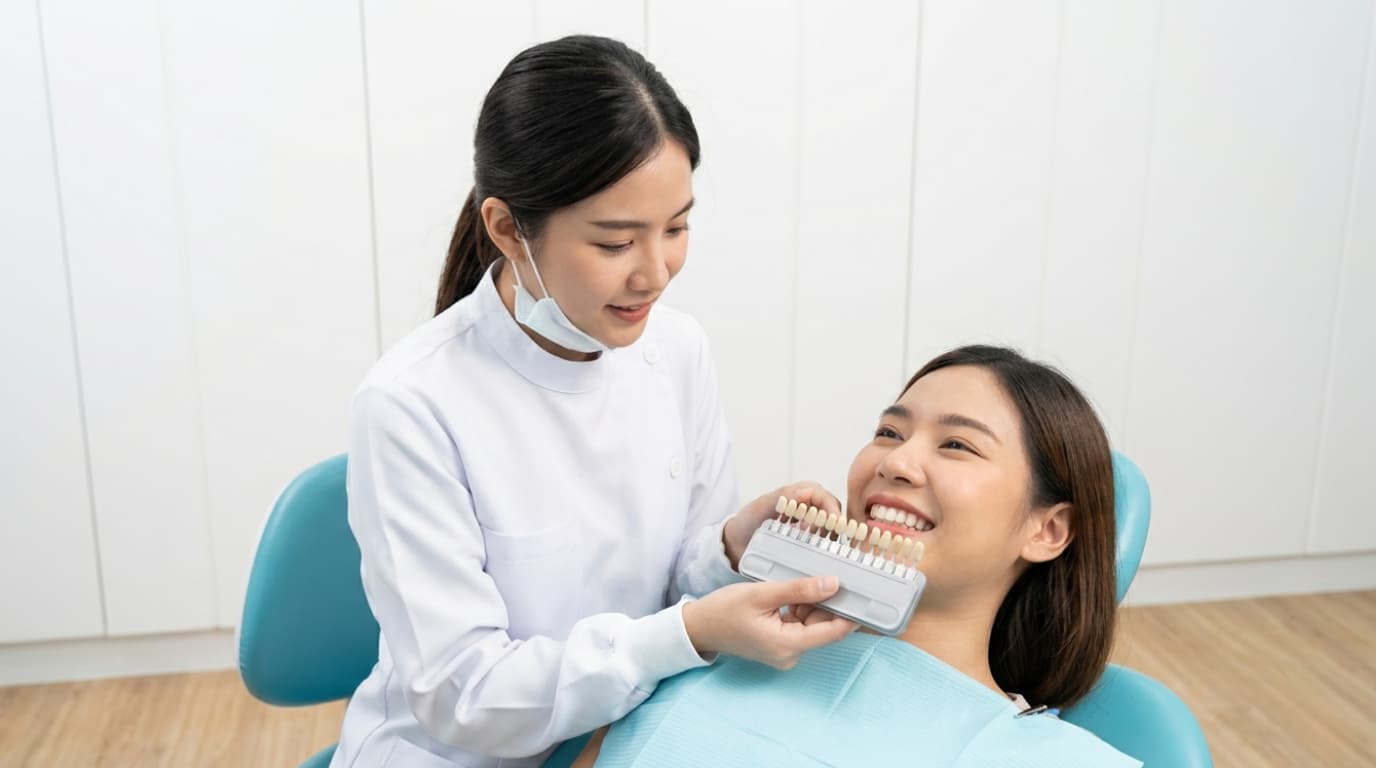
Counter-intuitively, zirconia’s opacity is the right choice for some anterior cases :
- Dark root-canal-treated tooth: the underlying gray-brown stump shows through E-max’s translucency. Zirconia’s opacity masks it cleanly.
- Metal post under the crown: same problem; zirconia hides it.
- Severely discoloured substrate: fluorosis, tetracycline staining, or post-trauma darkening.
- Single crown adjacent to bright white veneers: sometimes opacity is needed to match shade.
In these cases, multilayer zirconia gives you opacity without sacrificing realistic appearance : the modern compromise.
For more on dead-tooth-related discoloration and crown choice, see our Dead Tooth treatment guide.
Wear on Opposing Teeth: The Polished-Zirconia Myth Corrected
A common fear about zirconia: “Won’t its hardness destroy my opposing natural enamel?” This was a legitimate concern with glazed monolithic zirconia in early studies (2010-2014). Modern polished zirconia data tells a different story.
What recent clinical research shows
Key studies on opposing-tooth wear with monolithic zirconia:
- Stober et al. (2014): 6-month enamel wear opposite polished monolithic zirconia: comparable to enamel-on-enamel
- Mundhe et al. (2015): 1-year clinical trial: zirconia caused less enamel wear than metal-ceramic
- Esquivel-Upshaw et al. (2018): 1-year prospective, polished monolithic zirconia: ~42 μm wear at premolar, ~127 μm at molar, less than PFM and within enamel-vs-enamel range
The technique factor
The single biggest variable isn’t the material; it’s the finishing :
- Glazed zirconia (older technique): more opposing wear over time
- Polished zirconia (modern preferred technique): wear comparable to natural enamel
- Properly finished E-max: slightly higher wear than polished zirconia (E-max is “softer” but its glass crystals can rough abrasively)
Clinical bottom line
Both materials are safe for opposing natural teeth when properly finished. Choose your dentist by their finishing technique, not by avoiding zirconia. At our clinic, all monolithic zirconia crowns are polished (not glazed) per current best practice.
Bonding and Cementation: The Difference Most Patients Don’t Know About
This is the most under-explained difference between zirconia and E-max, and it has long-term clinical implications.
E-max bonding protocol (adhesive cementation)
E-max is almost always adhesively bonded with resin cement. The glass matrix in lithium disilicate allows acid etching to create microporosity, which bonds chemically to the resin cement.
The protocol:
- 5% hydrofluoric acid etch for 20 seconds: creates microporosity in the glass surface
- Rinse, dry, silane application (e.g. Ivoclar Monobond Plus): chemical primer
- Resin cement (e.g. Ivoclar Variolink Esthetic, 3M RelyX Ultimate): light- or dual-cured under rubber dam
Why this matters: Adhesive bonding strengthens the crown by ~30% by making it act as a single mechanical unit with the underlying tooth. This is what allows E-max crowns to be made thinner (1.0 mm minimum) without fracturing.
Zirconia bonding protocol (different chemistry)
Zirconia cannot be HF-etched (no glass content). Instead, two cementation paths exist:
Path A, conventional cementation (when prep is retentive):
- Sandblast inner surface with 50 μm aluminium oxide
- Apply MDP-containing primer (Z-Prime Plus, Clearfil Ceramic Primer)
- Cement with resin-modified glass ionomer (RMGI) like 3M RelyX Luting Plus
Path B, adhesive cementation (when prep is short or needs bond strength):
- Sandblast + MDP primer (as above)
- Resin cement with MDP-containing adhesive system
Why this matters:
- Easier to redo if needed: conventionally cemented zirconia can sometimes be removed with less tooth damage than fully bonded crowns
- Forgiving prep requirements: zirconia can be cemented even on minimally retentive preps where E-max would fail
- Repair complexity: if a zirconia crown chips, it cannot be intra-orally repaired; E-max chips can sometimes be patched with composite
Reference: Glidewell Chairside Magazine, Cementing Zirconia and Lithium Disilicate.
What this means for your clinical case
- If your tooth has good remaining structure: either material bonds well
- If your tooth is severely worn or has minimal retention: zirconia may be more forgiving
- If your tooth needs minimal preparation (limited interocclusal space): zirconia bonds successfully at thinner dimensions
Tooth Preparation: How Much Enamel You Keep
Conservative tooth preparation matters because every millimeter of natural tooth removed cannot be replaced. Here’s the comparison:
| Material | Minimum prep (mm) | Ideal prep (mm) |
|---|---|---|
| Zirconia (monolithic) | 0.5 | 1.0 |
| E-max (CAD or Press) | 1.0 | 1.5 |
Plain-English implications:
- Zirconia is the most conservative ceramic option: perfect for limited interocclusal space, worn teeth where additional reduction would compromise pulp health, or younger patients where enamel preservation matters most for the long-term.
- E-max requires more reduction (1.0 mm minimum incisally and occlusally) but rewards you with superior aesthetics on visible teeth.
Limited interocclusal space scenario
If your bite has worn down significantly (common in bruxers or older patients), there may not be 1.0 mm of clearance to fit an E-max crown without further reducing the opposing tooth. Zirconia at 0.5 mm is often the only viable choice in these cases.
Lifespan and Clinical Survival: What Real Studies Show
Both materials have strong long-term clinical data, with subtle differences by location and case type.
E-max survival data (peer-reviewed)
| Study | Duration | Survival rate | Sample |
|---|---|---|---|
| Reich et al. | 5 years | 97.8% | CAD/CAM single crowns |
| Beier & Schmeiser | 10 years | 96.7% | E-max Press monolithic + bilayered |
| Pieger systematic review | 5 years | 92% (posterior) | Single crowns + 3-unit FDPs |
| Rauch et al. | 14 years | 98.6% | E-max Press in severe wear patients |
References: Reich et al. (PubMed), Beier & Schmeiser J Prosthet Dent.
Monolithic zirconia survival data (peer-reviewed)
| Study | Duration | Survival rate | Sample |
|---|---|---|---|
| Solá-Ruiz et al. | 5 years | 98% | Monolithic zirconia crowns |
| Pjetursson systematic review | 5 years | 98.3% | Zirconia single crowns |
| Lim et al. retrospective cohort | 10 years | 86–94% | Monolithic zirconia (varies by location) |
| Glidewell BruxZir vs E-max trial | 10 years | 100% (BruxZir) vs 94% (E-max) | Posterior placements |
References: Solá-Ruiz et al. (PubMed), Pjetursson systematic review.
Bottom line on longevity
- At 5 years: both materials >95% survival, clinically equivalent
- At 10 years: zirconia edges ahead (especially in posterior placements and bruxers)
- At 14+ years: E-max in low-stress cases (anterior, non-bruxers) maintains very high survival
For most patients, the lifespan difference is academic. Both materials will likely outlast 15 years if properly cared for. The practical difference matters more in bruxism cases or full-mouth rehabilitation.
Biocompatibility and Gum Response
Both materials are metal-free, hypoallergenic, and biocompatible. Some specifics:
- Zirconia is exceptionally inert: the same material is used in orthopedic implants (hip and knee replacements) precisely because of its biocompatibility. Polished zirconia accumulates less plaque than glazed surfaces or PFM.
- E-max has excellent soft-tissue response, with hardness similar to natural enamel, gentle on opposing teeth and gums.
- Neither shows the gray-line gum recession issue that plagued PFM crowns over time.
For patients with metal allergies (nickel, chromium), both materials are completely safe.
Cost: Brief Comparison + Cross-Link
| Material | Per tooth at our clinic |
|---|---|
| E-max ceramic | 16,000 THB (~$470) |
| Zirconia | 18,000 THB (~$530) |
The $60 difference per tooth is rarely the deciding factor; clinical fit-to-case matters more.
Lifetime cost-per-year math (brief):
- E-max at $470 ÷ 12-year average lifespan = ~$40.83/year
- Zirconia at $530 ÷ 18-year average lifespan = ~$30.55/year
For full crown pricing including international comparisons, hidden costs, financing, and trip math, see our Dental Crown Cost Thailand guide.
The Decision Framework: 14 Clinical Scenarios
This is where most articles fall short. The “front E-max, back zirconia” rule oversimplifies real clinical decisions. Here’s the prosthodontist’s actual decision matrix:
| # | Clinical scenario | Recommended material | Why |
|---|---|---|---|
| 1 | Single anterior tooth, healthy substrate | E-max (or HT/multilayer zirconia) | Translucency wins for aesthetics |
| 2 | Single anterior tooth, dark substrate (RCT, metal post) | Zirconia | Opacity masks dark stump |
| 3 | Single anterior tooth, bruxism | Multilayer zirconia + night guard | Strength + acceptable aesthetics |
| 4 | Multiple anterior smile makeover (4-6 crowns) | E-max | Color matching with veneers easier |
| 5 | Single premolar, healthy bite | Either | Both perform well; choose by aesthetic priority |
| 6 | Single molar | Zirconia | Chewing forces favor strength |
| 7 | Posterior bridge (3+ units) | Zirconia | Only zirconia is approved for spans this long |
| 8 | Anterior bridge (≤3 units) | E-max or zirconia | Either approved; aesthetics decides |
| 9 | After RCT, anterior tooth | Depends on substrate color | Color of stump determines opacity needed |
| 10 | After RCT, posterior tooth | Zirconia | Strength + non-aesthetic location |
| 11 | Bruxism patient (any tooth) | Monolithic zirconia (3Y-TZP) + night guard | Maximum fracture resistance |
| 12 | Limited interocclusal space | Zirconia | 0.5 mm prep only feasible with zirconia |
| 13 | Implant-supported single crown | Zirconia or E-max (E-max requires Ti-base) | Both work; zirconia simpler workflow |
| 14 | Full mouth rehabilitation (12-20 crowns) | Mixed: E-max anterior, zirconia posterior | Material per location |
Edge cases your dentist will discuss
- Color matching adjacent veneers: if you have porcelain veneers on neighbouring teeth, your crown often needs to use the same material family for shade consistency. We typically recommend E-max crowns to match E-max veneers.
- Single crown next to a darker natural tooth: sometimes mild opacity (LT zirconia or E-max LT/MO) is the right choice to bridge the shade gap.
- Patient who plans to whiten natural teeth: whiten BEFORE crown placement so the crown can be matched to your final shade. Crowns themselves don’t whiten.
If you’re combining a crown with adjacent porcelain veneers, see our Porcelain Veneers Thailand guide for material matching considerations.
Why Both Prosthodontists at Dental Veneer Bangkok Work With Both Materials
The wrong question is “is your dentist a zirconia clinic or an E-max clinic?” The right question is “does your dentist routinely place both materials and choose the right one for each case?”
Dr. Busakorn Osartalart (Dr. Nan)
- DDS, Khon Kaen University
- Diploma, Thai Board of Prosthodontics
- Diploma, Thai Board of Orthodontics
- 5+ years restorative experience
Dr. Waruka Promsri (Dr. Ple)
- DDS (first-class honours), Rangsit University
- Prosthodontics, Institute of Dentistry
- Special Instructor, Rangsit University Faculty of Dentistry
- Specialist in full-mouth rehabilitation and combined material cases
At our in-house CAD/CAM lab in central Siam, we work with:
- Ivoclar IPS e.max CAD (lithium disilicate, 530 MPa)
- KATANA STML and UTML multilayer zirconia (Kuraray)
- Full-strength 3Y-TZP zirconia for high-stress posterior cases
- Multilayer aesthetic zirconia for anterior crowns needing opacity
This material breadth means we choose by clinical fit , not by what we have in stock.
Read full bios on our About Us page or learn more about our crown service.
Conclusion

Choosing between zirconia and E-max isn’t about which material is “better”. Both are excellent modern monolithic ceramics with proven 95%+ 5-year clinical survival. The decision is about matching the material to your specific clinical scenario.
E-max is the right choice when: your tooth is anterior, the substrate is normal-coloured, and translucent aesthetics matter most.
Zirconia is the right choice when: your tooth is posterior, you grind your teeth, the substrate is dark and needs masking, you have limited interocclusal space, or you need a multi-unit bridge.
For borderline cases (and there are many), a free consultation with a board-certified prosthodontist will give you the right answer based on your specific tooth’s anatomy, your bite, and your aesthetic priorities.
Send us photos of your tooth via WhatsApp. We’ll recommend the right material (zirconia or E-max) for your specific case, with a written quote within 24 hours. Free consultation, no commitment.
Frequently Asked Questions
Which is better, zirconia or E-max crown?
Neither is universally “better”; they’re best at different things. E-max wins on translucency for visible single anterior crowns. Zirconia wins on strength for molars, multi-unit bridges, bruxers, and dark substrates. Both have >95% 5-year survival rates in clinical studies.
Are E-max crowns stronger than zirconia?
No. E-max flexural strength is 470–530 MPa; modern zirconia ranges from 557 MPa (translucent multilayer) to 1,200 MPa (full-strength 3Y-TZP). Zirconia is significantly stronger overall, but E-max is plenty strong for most non-molar applications.
How long do zirconia crowns last vs E-max?
E-max: 10–15+ years (97.8% 5-year survival, ~94–96% at 10 years). Zirconia: 15–20+ years (98% 5-year survival, 86–100% at 10 years depending on type and location). For most patients in non-bruxism cases, both will outlast 15 years with proper care.
Which crown is best for front teeth?
For most cases, E-max wins on translucency for anterior crowns. Exception: if the underlying tooth is dark (root-canal-treated, metal post), multilayer zirconia masks the discoloration better.
Which crown is best for molars?
Zirconia. Molars take 200+ PSI chewing forces, and zirconia’s higher fracture toughness (5–10 MPa√m vs E-max’s 2.0) handles these forces better long-term.
Are zirconia crowns more expensive than E-max?
At our Bangkok clinic, yes, by about $60 per tooth (zirconia at $530 vs E-max at $470). The price gap reflects raw material cost; clinical labour is similar.
Do zirconia crowns wear down opposing teeth?
This was a concern with older glazed zirconia. Modern polished monolithic zirconia causes opposing-tooth wear comparable to natural enamel (Stober 2014, Esquivel-Upshaw 2018). The finishing technique matters more than the material itself: always confirm your dentist polishes (not glazes) zirconia crowns.
Can E-max be used on back teeth?
Yes, on premolars with healthy bites. For molars under heavy chewing forces or in bruxers, zirconia is the safer choice.
Is multilayer zirconia good for front teeth?
Yes: modern multilayer zirconia (KATANA UTML, 3M Lava Esthetic) approaches E-max aesthetics with translucency around 43-46%. It’s the right choice when you need both anterior aesthetics AND opacity to mask a dark substrate.
Why do dentists prefer zirconia for posterior teeth?
Three reasons: (1) chewing forces require maximum fracture resistance; (2) posterior teeth are less visible, so translucency matters less; (3) the 10-year clinical data shows zirconia outperforms E-max in posterior placements (Glidewell BruxZir trial: 100% vs 94%).
Can both crowns be color-matched to adjacent teeth?
Yes: both materials come in standard VITA shade ranges (A1-D4). Color-matching is more about lab artistry than material choice. For complex cases mixing crowns and veneers, using the same material family (both E-max) often makes shade matching easier.
Was this article helpful?