 Written by Dr. Nan
This guide is written to help you make the call honestly, not to talk you into the bigger number. Below you will find how each option works, when six beats four and when it does not, how the upper and lower jaw differ, and real single-clinic Bangkok pricing per arch and for a full mouth.
All-on-4 vs All-on-6 at a glance
| Factor | All-on-4 | All-on-6 |
|---|---|---|
| Implants per arch | 4 | 6 |
| Angulation | 2 straight front, 2 tilted back | Usually 2 straight, 4 spread, less extreme tilt |
| Grafting / sinus lift | Often avoided by angling implants | May need more bone, so grafting is more likely |
| Redundancy if one fails | Lower, the bridge relies on all 4 | Higher, 5 can often still hold the arch |
| Force distribution | Good, with a longer rear cantilever | Better across a wide or heavy bite |
| Best candidate | Average bite, adequate bone, most patients | Heavy bite, long arch, dense posterior bone |
| Bangkok price per arch | 350,000 to 500,000 THB | Typically higher, quoted after your CBCT |
The table is the short version. The rest of the page explains why each row lands where it does, so you can see which column is actually you.
What All-on-4 actually is, and why four implants can hold a full arch
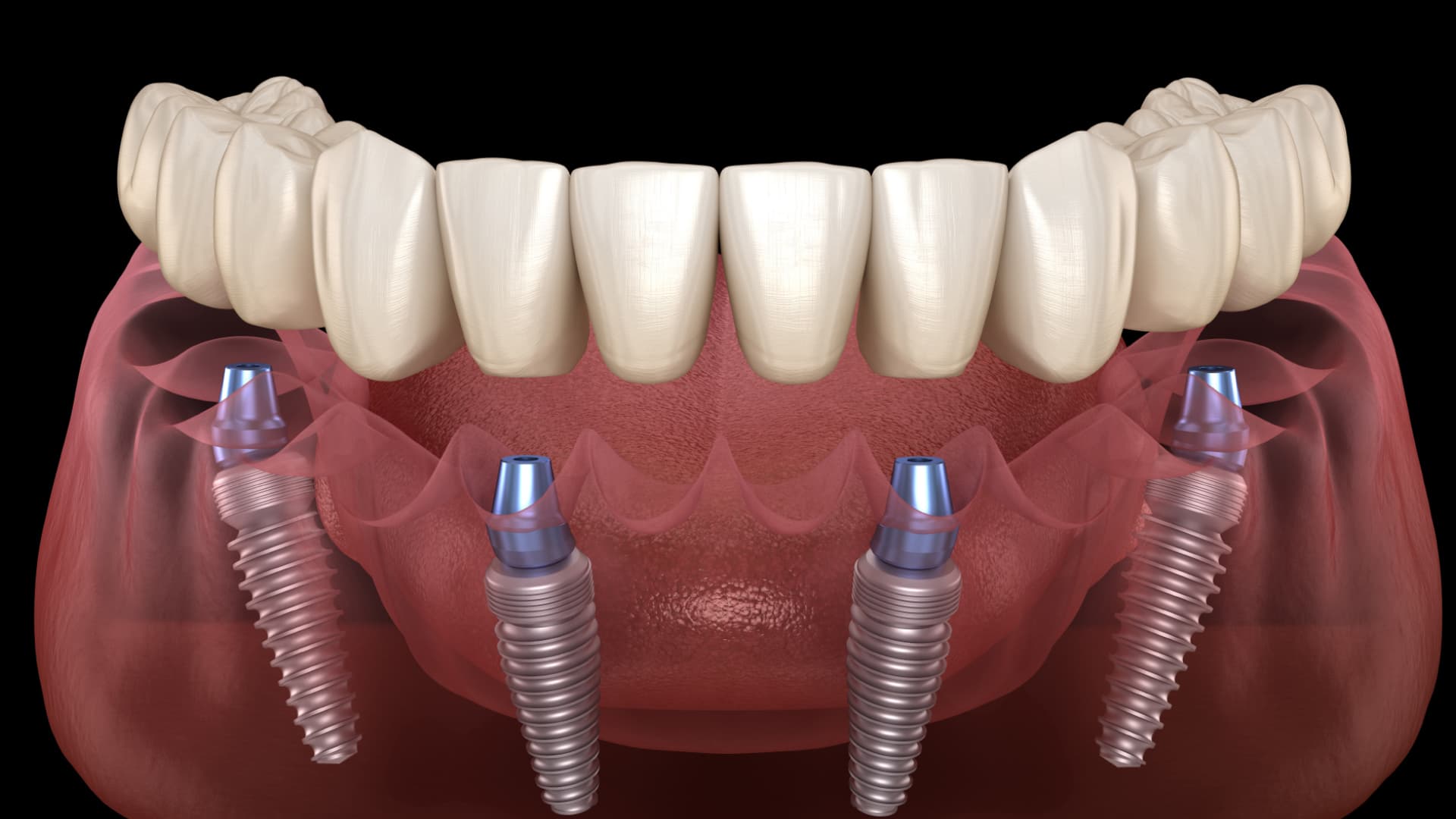
All-on-4 replaces every tooth in a jaw with one fixed bridge anchored on four implants:
- Two straight implants at the front, where the bone is naturally denser.
- Two tilted implants at the back, angled to reach solid bone while skipping the sinus and the nerve.
That tilt is the clever part. It gives the bridge a wide, stable footprint from only four posts, which is why so many people avoid the grafting they were told they needed elsewhere.
We are not going to re-teach the full procedure here. If you want the step-by-step, healing timeline, and recovery detail, read our complete All-on-4 guide and the step-by-step implant procedure.
The point for this decision is simple: four well-placed implants are a proven, load-tested way to carry a full arch, and for most patients that is the whole story.
What the two extra implants of All-on-6 really buy you
All-on-6 adds a fifth and sixth implant to the same arch. Those two posts do three concrete things:
- Redundancy. With four implants, the bridge depends on all four integrating and staying healthy. With six, if one ever fails, the remaining five can often continue to support the bridge while the failed site heals or gets replaced. You have a margin you did not have before.
- A shorter cantilever. The cantilever is the section of bridge that hangs behind the last implant, giving you those final molars. On four implants that overhang is longer, and a longer overhang acts like a lever on the rear implants every time you bite. Two extra implants placed further back shorten that overhang, so chewing force lands more directly on bone instead of torquing the end supports.
- Better force distribution. Six anchor points spread the same bite across more surface area. For an average bite this barely matters. For a strong or grinding bite, spreading the load is exactly what protects the whole system over ten and twenty years.
That is what you are paying for. Not stronger teeth day to day, but more margin, less leverage, and more spread. Whether that margin is worth the cost depends entirely on your anatomy and your bite.

When All-on-6 is genuinely worth it
There are real cases where we will recommend six, not four, and mean it:
- Heavy bruxism or a naturally strong bite. If you grind or clench, or you simply have powerful jaw muscles, the extra implants and shorter cantilever meaningfully reduce the load on each post.
- Denser posterior bone in the upper jaw. When there is enough solid bone at the back of the upper arch to place two more implants without heroics, using it is a genuine upgrade rather than a graft-heavy compromise.
- A longer or wider arch. A bigger jaw means a longer bridge and a longer cantilever on four implants. Six shortens the span and steadies it.
- You want a one-implant failure backup. Some patients simply value the redundancy, and that is a legitimate reason once you understand what you are buying.
If two or more of these apply to you, All-on-6 stops being an upsell and starts being the right plan.
When All-on-6 is oversold
Here is the part most pages skip. In many US clinics, All-on-6 is presented as the default premium option, the "better" tier, regardless of whether your case needs it.
For a patient with an average bite, adequate bone, and no grinding history, the fifth and sixth implants often add cost without adding a better outcome:
- ❌ The bridge does not last longer.
- ❌ It does not chew better.
- ❌ It does not look different.
You have simply paid for two implants your anatomy did not require.
The redundancy argument gets stretched too. Yes, six gives you a backup. But four implants restoring a full arch already carry very high long-term success rates, and a well-planned, well-maintained All-on-4 is not living on the edge.
Buying insurance against a low-probability event is a personal call, not a clinical necessity, and it should be priced and explained as exactly that. If a plan jumps straight to six without a scan-based reason, ask why.
Upper jaw vs lower jaw: why the answer often differs by arch
The two jaws are not the same material:
- The lower jaw is denser and more predictable, which is why All-on-4 performs so reliably down there.
- The upper jaw is softer, has the sinuses sitting close above the back teeth, and takes the brunt of an upward chewing force.
That combination is why the upper arch is the one where a fifth and sixth implant more often earn their place.
It is completely normal for the honest answer to be All-on-4 on the bottom and All-on-6 on top for the same person. Treating each arch on its own merits, rather than picking one label for the whole mouth, is how you avoid both over-treating the lower jaw and under-supporting the upper.
Bone, grafting and sinus lifts: how a CBCT scan decides four vs six for you
None of this is decided by a rule of thumb. It is decided by your bone, and the only way to see your bone in three dimensions is a CBCT, also called a 3D CT scan. The scan shows exactly how much bone volume and density you have at each planned implant site, where the sinus floor sits, and where the nerve runs.
That scan is what tells us whether six implants even fit, whether a small graft or a sinus lift would change the picture, and whether four angled implants can dodge the problem areas entirely. Sometimes the scan reveals so little usable bone that the conversation moves to the All-on-8 full-mouth technique or zygomatic implants instead.
We will not explain those here. The point is that the imaging leads, and the plan follows the imaging, never the other way around.
What both cost in Bangkok, per arch and full mouth
Real numbers from our clinic, not a range scraped from ten listings:
- A single implant starts from 45,000 THB, around $1,320, with a Neobiotech implant. Neodent, Straumann SLA, and Straumann SLA Active are available at higher price points.
- All-on-4 runs 350,000 to 500,000 THB per arch, depending on the implant brand and the final bridge material.
- All-on-6 sits above that, and we quote it only after your CBCT, because the honest price depends on how many extra procedures your bone needs.
Full mouth means both arches, so you roughly double the per-arch figure, again adjusted to your plan. For the complete breakdown across every option, see our full-mouth dental implant cost guide and what dental implants cost in Thailand. If you want the wider context on treatment abroad, dental implants in Thailand explained covers it.
Bangkok vs the US and Australia: the savings gap laid side by side
This is the number the US pages tend to leave out. Here is the same treatment across three countries, per arch. The US and Australian figures are typical advertised ranges rather than firm quotes, and your own local quote may differ.
| Treatment | United States | Australia | Bangkok (our clinic) |
|---|---|---|---|
| All-on-4, per arch | ~$20,000 to $30,000 | ~AUD 23,000 to 30,000 | 350,000 to 500,000 THB (~$10,300 to $14,700) |
| Full mouth, both arches | ~$40,000 to $60,000 | ~AUD 45,000+ | ~700,000 THB and up (~$20,600+) |
Even after flights and a hotel for two visits, the gap is wide enough that many patients fund an upper-arch All-on-6 with the money they save versus a single US arch. The savings are real, and they are the whole reason to research this properly rather than settle for whatever your local clinic quotes.
What if an implant fails, or you want to upgrade later
Implant failure is uncommon, but you deserve a straight answer on it.
- ✅ With All-on-6, the redundancy we described earlier is not just theory: lose one implant and the bridge usually stays supported on the remaining five while the site heals.
- ❌ With All-on-4, a failed implant is more disruptive and may mean the bridge comes off until the site is restored, sometimes with a replacement or an added implant.
You can also plan an upgrade path. In cases where the bone allows it, adding implants to convert an All-on-4 into a six-implant setup later is possible, though it is cleaner to make the right call at the start from your scan.
Our implants carry a one-year written warranty, and we handle complications directly rather than leaving you to sort it out at home. Honest failure handling is part of the plan, not a footnote.
How we decide with you
The call is never guesswork, and it is never made before we can see your bone. Here is how it actually gets decided, and who makes it:
- Photos first. Send a few photos and we give you an initial read and a ballpark quote within 24 hours.
- CBCT on arrival. The scan builds the plan on your real anatomy, so four versus six is answered by your bone, not a package name.
- Prosthodontist-led. Our restorative work is led by Dr. Waruka Promsri, with cosmetic direction from Dr. Busakorn Osartalart, Thai Board certified in both Prosthodontics and Orthodontics.
- On-site lab. Your bridge is made and adjusted here, not shipped out, which tightens the two-trip timeline: one trip to place the implants, three to six months of healing, then a second trip for the final fixed teeth.
- One-year written warranty. Every case carries it, and we handle any complication directly rather than leaving you to sort it out at home.
If you are weighing full-arch dental implants in Bangkok, the fastest way to know whether you need four or six is to let the scan answer it. You can compare specifics on All-on-6 dental implants in Thailand too.
Conclusion
All-on-4 is the honest default: four well-placed implants carry a full arch reliably for most people. All-on-6 earns its extra cost in specific, scan-visible situations, a heavy or grinding bite, a longer arch, softer upper-jaw bone, or the backup you want while healing far from the clinic.
The right answer is rarely one label for the whole mouth. It is one honest call per arch, made from a CBCT read by a prosthodontist, with the price quoted in writing before you commit to anything.
You do not need to fly here to find out where you stand. Send us a few photos of your teeth, tell us what you are after, and we reply within 24 hours with the honest call for your case, a realistic cost range for one arch or both, and whether anything should be handled first.
Frequently Asked Questions
What is the difference between All-on-4 and All-on-6 dental implants?
Both replace a full arch with a fixed bridge. All-on-4 uses four implants, two of them tilted to avoid grafting. All-on-6 uses six, adding redundancy, a shorter cantilever, and wider force distribution.
Is All-on-6 better than All-on-4?
Not universally. It is better for heavy bites, longer arches, and softer upper-jaw bone. For an average bite with adequate bone, All-on-4 gives the same result for less.
Do I need All-on-4 or All-on-6 for a full mouth?
A full mouth means treating both arches, and each arch is judged on its own. Many patients end up with four on the bottom and six on top.
How much more does All-on-6 cost than All-on-4?
More, because of two extra implants and any added bone work. We quote the exact difference after your CBCT rather than guessing.
Is All-on-4 strong enough to replace a full arch of teeth?
Yes. Four well-placed implants carrying a full arch is a proven, load-tested approach with high long-term success.
Does All-on-6 last longer than All-on-4?
Not automatically. It adds margin for demanding cases, but a well-planned, well-maintained All-on-4 lasts for many years too.
Which option needs bone grafting or a sinus lift?
All-on-4 is often designed to avoid both by angling implants. All-on-6 needs more bone, so grafting or a sinus lift is more likely. Your CBCT decides.
Is All-on-4 or All-on-6 better for the upper jaw versus the lower jaw?
The lower jaw is dense and suits All-on-4 well. The softer upper jaw is where the extra implants of All-on-6 more often earn their place.
What happens if an implant fails, and can you upgrade from All-on-4 to All-on-6 later?
With six, the bridge usually stays supported on five while a site heals. Upgrading four to six later is sometimes possible where bone allows, though planning it correctly from the start is cleaner.
How much do All-on-4 and All-on-6 cost in Thailand compared to the US and Australia?
Our All-on-4 runs 350,000 to 500,000 THB per arch, roughly $10,300 to $14,700, versus about $20,000 to $30,000 in the US and similar in Australia.
How many implants do you actually need for a full set of teeth?
Four per arch is enough for most people. Six is used when bite force, arch length, or bone conditions call for it.
Which has a longer recovery, All-on-4 or All-on-6?
Recovery is similar. Both heal over three to six months. More implants can mean slightly more initial soreness, but the timeline is comparable.
Was this article helpful?