 Written by Dr. Nan
I am Dr. Nan, and I lead the cosmetic and prosthodontic work at our Siam Square clinic, with full-arch cases planned alongside our prosthodontist Dr. Ple. This guide is written for someone weighing a full-arch rebuild abroad. I will tell you honestly who needs six implants and who does not, what it actually costs here, and what to expect when the treatment is split across two trips.
What All-on-6 dental implants actually are
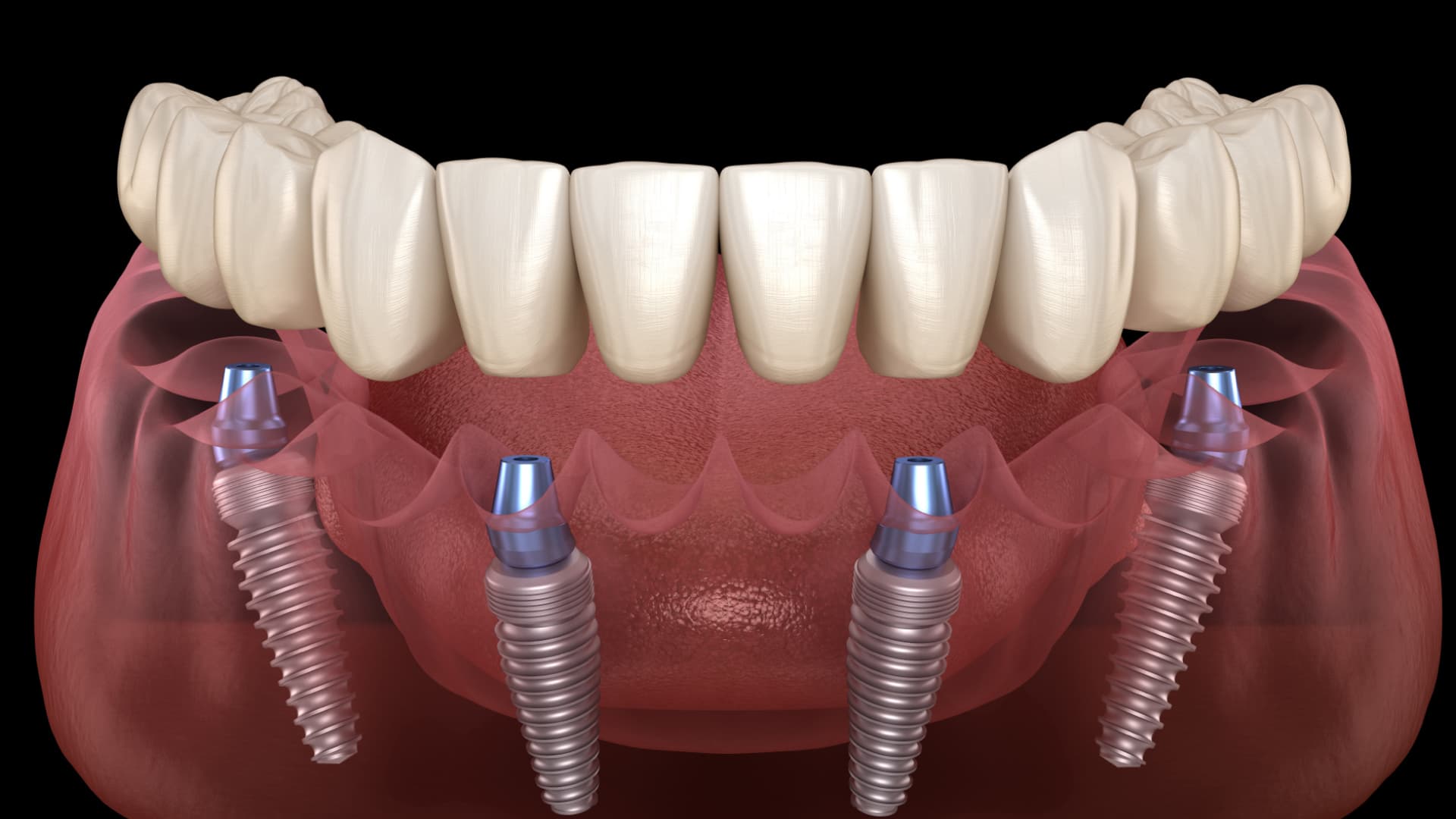
All-on-6 is a full-arch restoration. If you have lost, or are about to lose, all the teeth in your upper or lower jaw, we place six titanium implants into the jawbone and attach one fixed bridge across them.
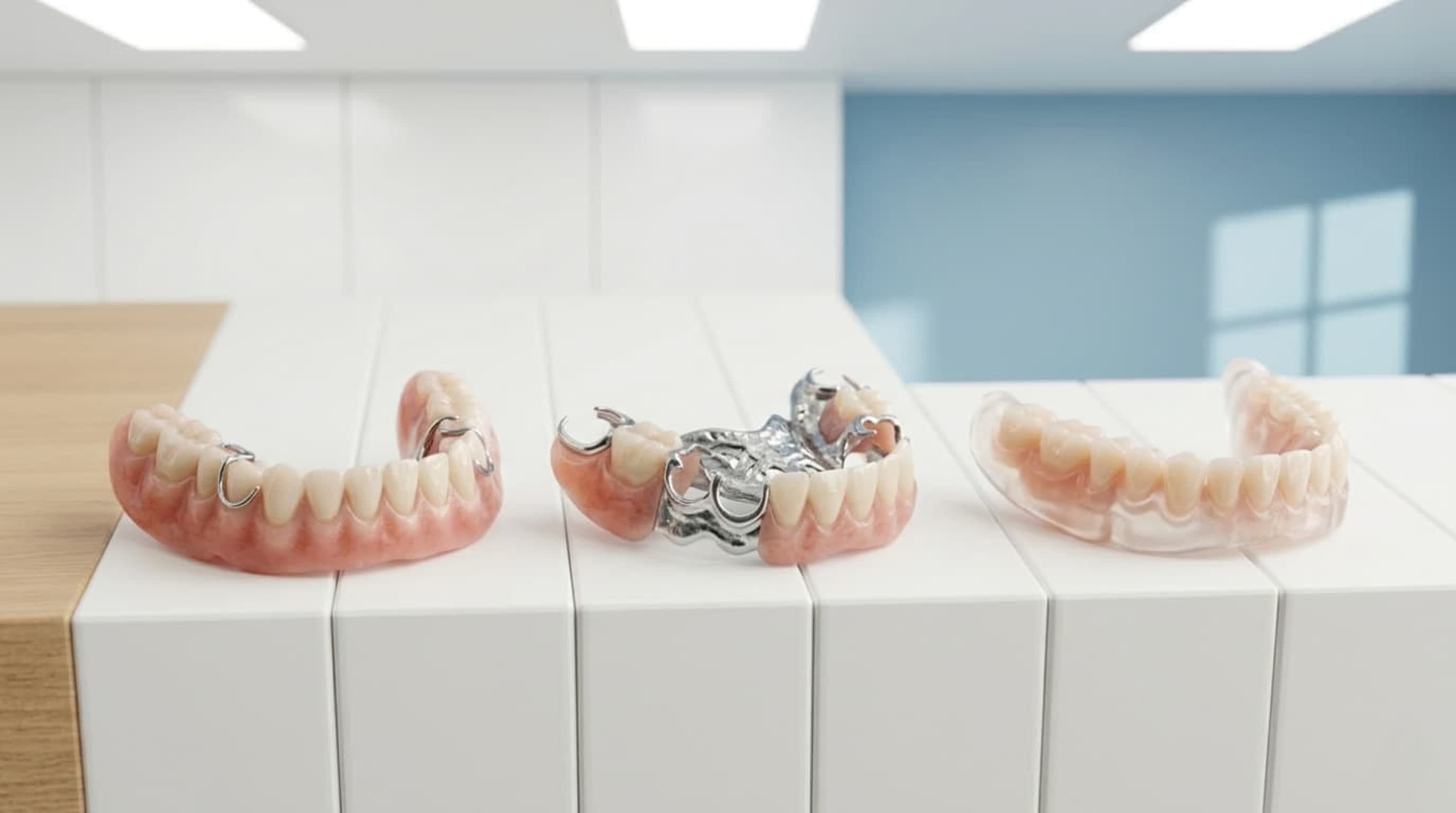
The bridge does not come out at night. It behaves like a set of teeth screwed into place, not a denture that sits on the gum.
Here is how the design works:
- Six implants spread your bite force across the whole arch.
- The back implants are often angled, which lets us anchor into denser bone and avoid the sinus without grafting.
- A multi-unit abutment sits on each implant, and the bridge attaches to those small connectors.
- Temporary teeth the same day. In most cases we fit a temporary set the day the implants go in, so you are not toothless while the bone heals. That is called immediate loading, and it is one of the reasons full-arch work has become so much more comfortable than it used to be.
If you want the fundamentals of how implants integrate and heal before you go further, the general guide to dental implants in Thailand covers the biology in plain language.
All-on-6 vs All-on-4 in one minute
Here is the honest version most pages will not give you: do not assume six beats four by default.
All-on-4 was designed to rebuild a full arch on the minimum number of implants that reliably works, and for a patient with reasonable bone, it works extremely well. Adding two more implants does not make your teeth prettier and does not shorten your healing time.
You are likely fine on four if:
- you have adequate bone volume and density
- you are replacing a lower arch (the lower jaw is denser)
- your bite is not unusually heavy
You genuinely benefit from six if:
- you have softer or thinner bone (very common in the upper jaw)
- you are restoring an arch that takes heavy chewing load
- you grind or clench
- you want the load spread so no single implant does too much work
That is the short version. If you want the full side-by-side with candidacy detail, read All-on-4 vs All-on-6: which one you actually need, and if you already suspect All-on-4 is your answer, the All-on-4 deep dive goes deeper on that specific option.
Why the extra two implants matter more when you are treating abroad
This is the angle no ranking page covers, and it is the one that actually changes the decision for international patients.
Full-arch healing takes three to six months. During that window the implants are fusing to your bone, a process called osseointegration.
If you lived down the road from the clinic and one implant was slow to integrate, we would simply see you, manage it, and carry on. But you are not down the road. You fly home to Sydney or Manchester between placement and the final bridge.
- ❌ On four implants, if one struggles during those months, you have less margin.
- ✅ On six, if one is slow, the arch is still supported by five, your temporary teeth stay put, and your second trip is not derailed.
The two extra implants function as insurance against the one thing you cannot easily fix from the other side of the world: distance.
I am not saying every traveler needs six. A patient with strong bone and a lower arch can fly home confidently on four.
But if your bone is borderline, the cost of upgrading to six is small next to the cost of an extra emergency flight, and for a lot of overseas patients that trade is worth making. This is exactly the kind of judgment call that a scan-based plan should spell out for you before you book anything.
Are you a candidate? What a 3D CT scan decides
You cannot know whether four or six is right for you from a photo alone, and you should be wary of anyone who quotes you a fixed number of implants before reading your bone. The decision is made on a 3D CT scan, also called a CBCT, read by a prosthodontist.
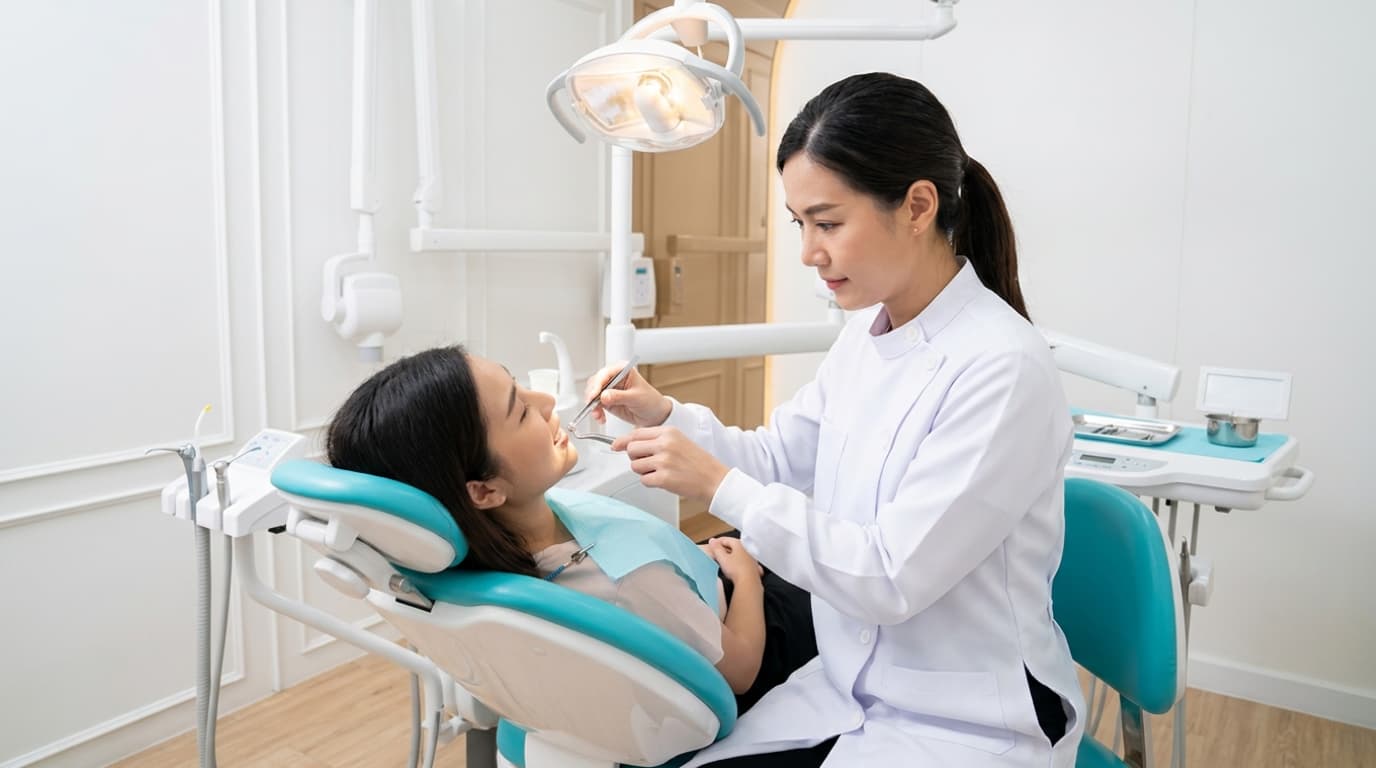
Here is what that scan tells us:
- Bone density and volume. How much bone you have and how solid it is decides how many implants the arch can carry and where they can go.
- Resorption. If teeth have been missing a while, the bone shrinks. We measure how much is left.
- Sinus proximity (upper arch). The sinus floor sits close to the upper back teeth. If it is low, we angle implants around it or plan a sinus lift.
- Whether you need groundwork first. Some patients need a bone graft or a sinus lift before implants can go in. That adds a healing stage, and you deserve to know that up front rather than discover it mid-treatment.
We do this scan on site, and Dr. Ple reads it as part of planning your case. That read is what turns "six is better" marketing into an actual, personal recommendation for your jaw. If bone grafting is likely for your case, dental implant costs in Thailand breaks down how that changes the plan and timeline.
All-on-6 cost in Thailand: how it is priced
We do not publish a single fixed All-on-6 price, and any page that gives you a precise per-brand number before seeing your jaw is guessing. The honest answer depends on your CT scan:
- how many implants your bone actually takes
- the implant system you choose
- whether you need an extraction, a graft or a sinus lift
What we can give you is the reference point. Our All-on-4 runs 350,000 to 500,000 THB per arch. All-on-6 adds two more implants and their components, so it sits above that, and we quote your exact figure in writing after the scan, before you commit to anything.
The implant system is the biggest single driver of the total. These are the systems we actually use, with their single-implant starting prices to give you a feel for the relative cost between them.
| Implant system | Single implant (THB) | Positioning |
|---|---|---|
| Neobiotech (Korea) | from 45,000 (~$1,320) | Best value, solid clinical record |
| Neodent (Brazil, Straumann Group) | from 49,000 (~$1,440) | Mid-tier, backed by Straumann |
| Straumann SLA (Switzerland) | from 80,000 (~$2,350) | Premium, long documented history |
| Straumann SLA Active (Switzerland) | from 85,000 (~$2,500) | Top-tier, fastest integration |
All figures are per arch, meaning one jaw; a full-mouth case rebuilds both arches.
Whichever system you choose, an All-on-6 arch in Bangkok lands well below what the same treatment costs in Australia, the UK, New Zealand or Canada. Your firm number comes after the scan, not as a moving target.
What the price includes, and what it does not
A per-arch quote should be a package, not a base rate that grows every visit. Here is what our All-on-6 arch price covers and what sits outside it.
Included in the arch price:
- the 3D CT scan and planning
- extraction of any remaining teeth in that arch
- the six implants and the multi-unit abutments
- the surgery and a same-day temporary bridge
- the final fixed bridge on your second trip
Not automatically included:
- bone grafting or a sinus lift, if your scan shows you need one
- treatment for the opposing arch (that is a separate arch price)
- general dental work on teeth we are keeping
If any of these apply, we tell you before you commit, so the number you see is the number you pay.
Choosing your final bridge material
The implants are your foundation. The bridge that sits on them is what you see and chew with, and the material changes both the price and how long it lasts.
| Bridge material | Look | Realistic lifespan | Relative cost | Best for |
|---|---|---|---|---|
| Acrylic hybrid | Good, slightly less lifelike | 5 - 10 years, teeth can wear or chip | Lowest | Budget-conscious, or as a long-term transitional bridge |
| Zirconia (full-arch monolithic) | Very natural, high strength | 15+ years with care | Highest | Most patients wanting a durable, definitive result |
| Porcelain-fused-to-metal (PFM) | Natural, metal substructure | 10 - 15 years, porcelain can chip | Mid | A middle ground between acrylic and zirconia |
For most full-arch patients I recommend zirconia as the final bridge. It resists staining, holds its color, and stands up to years of chewing.
Acrylic hybrids have their place, especially as a durable interim while your bone settles, but they wear faster. And because we run our own lab on site, we can make and adjust your bridge here rather than shipping impressions overseas and waiting weeks.
Your two-trip traveler timeline
Full-arch implant work abroad is almost always two trips, because the bone needs three to six months to heal between them. Here is how the trips break down.
- Trip one, about 5 to 7 days in Bangkok. Consultation and scan, any extractions, placement of the six implants, and fitting of your temporary fixed teeth. Most patients need a few review days after surgery before flying, which is why we budget close to a week. You fly home with a working set of teeth, not an empty mouth.
- At home, 3 to 6 months. Osseointegration. You live normally on your temporaries, and we stay in contact and answer questions remotely.
- Trip two, about 5 to 7 days in Bangkok. We confirm the implants have integrated, take final impressions, and fit your definitive bridge. Our on-site lab lets us build, try in, and finalize within the same visit.
So plan for two visits of roughly a week each, spaced three to six months apart. If you want the full clinical sequence, how the implant procedure works step by step walks through each stage, and implant recovery and aftercare covers the healing months in detail.

How much Australians, UK, NZ and Canadian patients save
The reason full-arch patients fly to Bangkok is simple arithmetic. The same treatment at home often costs close to double per arch, sometimes more.
| Country | Typical All-on-6 per arch at home | Rough saving in Bangkok |
|---|---|---|
| Australia | AUD 28,000 - 35,000 | 35 - 50% |
| United Kingdom | GBP 14,000 - 20,000 | 40 - 50% |
| New Zealand | NZD 28,000 - 38,000 | 35 - 45% |
| Canada | CAD 24,000 - 32,000 | 35 - 50% |
Even after two sets of flights and two weeks of accommodation, most patients still come out well ahead, and the margin is wider still on a full-mouth case covering both arches.
If you are rebuilding both jaws, full-mouth dental implants in Thailand covers that scenario, and for the most complex arches All-on-8 for full-mouth cases explains when eight implants come into play.
Is All-on-6 in Thailand safe, and what if an implant struggles after you fly home?
The honest concern with treating abroad is not the surgery day. It is the months afterward, when you are back home. Here is how we handle that:
- A 1-year written warranty on every full-arch case. If an implant fails to integrate or a problem develops within that period, we stand behind the work.
- One accountable point of contact. Your case is planned and restored by a prosthodontist rather than passed between anonymous hands.
- An on-site dental lab, so adjustments and remakes happen here, quickly, rather than being outsourced.
If an implant does struggle after you fly home, the six-implant design is exactly why that is manageable. Your arch is still supported, your temporary teeth stay in, and we plan the fix into your second trip instead of scrambling for an emergency flight.
We stay reachable by email and photo throughout your healing months. For the broader safety picture, standards, sterilization and dentist credentials, read whether dental implants in Thailand are safe.
Is it painful? Recovery and the first weeks
Full-arch surgery sounds daunting, and patients are often surprised by how manageable it is. The procedure is done under local anesthetic, with sedation available for anxious patients. Most people describe the discomfort afterward as swelling and soreness rather than sharp pain, controlled well with standard medication.
What recovery actually looks like:
- Days 1 to 5: swelling and some bruising, easing over the first week.
- The first weeks: soft foods while you heal. Soups, eggs, fish, yogurt, anything that does not ask your new implants to bite hard.
- The healing months: you gradually return to normal eating, and by the time your final bridge is fitted you are chewing with real confidence again.
The temporary teeth let you smile and speak normally throughout, which for most patients is the part that matters most.
Conclusion
All-on-6 is not an upgrade you buy, it is a decision your jawbone makes. With good bone, four implants rebuild an arch reliably. With softer bone, a heavy bite, or an ocean between you and the clinic during the healing months, the two extra implants buy you real margin.
In Bangkok, that decision is made properly: a CT scan read by a prosthodontist, an honest recommendation for four or six, and your exact price quoted in writing before you commit to anything. That is the version of dental tourism that works.
You do not need to fly here to find that out. Send us a few photos of your teeth, tell us what you are after, and we reply within 24 hours with whether four or six suits your case, a realistic cost range, and whether anything should be handled first.
Frequently Asked Questions
What is the difference between All-on-4 and All-on-6 dental implants?
All-on-4 supports a full arch on four implants; All-on-6 uses six. Six spreads bite force more widely and is often chosen for softer bone or heavier chewing loads. Four is entirely sufficient for many patients with good bone.
How much do All-on-6 dental implants cost in Thailand?
All-on-6 sits above our All-on-4 range of 350,000 to 500,000 THB per arch. Because it uses more implants, we quote your exact figure in writing after your CT scan rather than advertise a fixed number.
Is All-on-6 better than All-on-4?
Not automatically. It offers wider load distribution and, for travelers, more redundancy during healing. But a patient with good bone often does just as well on four. The right answer comes from your CT scan.
Am I a candidate for All-on-6, or do I need a bone graft first?
That is decided by a 3D CT scan read by our prosthodontist. Some patients need a bone graft or sinus lift first; many do not. We tell you before you commit.
Do you get teeth the same day with All-on-6?
In most cases yes. We fit a temporary fixed bridge the same day the implants are placed, so you are not without teeth while you heal.
How long do you stay in Thailand for All-on-6 implants, and how many trips?
Two trips of about 5 to 7 days each, spaced 3 to 6 months apart for healing.
What implant brands are used for All-on-6?
We use Neobiotech, Neodent and Straumann. The Korean-made Neobiotech offers the best value; the Swiss Straumann systems carry the longest documented track records.
What material is the final bridge, and how long does each type last?
Acrylic hybrid (5 to 10 years), PFM (10 to 15 years), or zirconia (15+ years). Zirconia is the most durable and natural-looking and is what I recommend for most patients.
How long do All-on-6 implants last, and what is the success rate?
The implants themselves can last decades, with full-arch implant success rates commonly reported above 95%. The bridge on top is replaced sooner depending on its material.
What happens if an implant fails after I fly home?
With six implants the arch stays supported by the rest, so your temporaries hold and we plan the fix into your second trip. It is covered by the 1-year written warranty.
Is All-on-6 dental work in Thailand safe?
Yes, at a properly equipped clinic. Ours is prosthodontist-led, with 3D imaging, an on-site lab, and a written warranty. See our full page on whether dental implants in Thailand are safe.
Does the All-on-6 price include extractions, CT scan, temporary teeth and the final bridge?
Yes. Our arch price covers the scan, extractions in that arch, the implants, abutments, same-day temporaries and the final bridge. Bone grafting or sinus lift, if needed, is quoted separately and disclosed up front.
How much can Australians and UK patients save on All-on-6 in Bangkok versus at home?
Often around 40 to 50% per arch, even after flights and accommodation.
Is All-on-6 painful, and what is recovery like?
It is done under local anesthetic with sedation available. Most patients report swelling and soreness rather than sharp pain, soft foods for the first weeks, and a return to normal eating over the healing months.
Was this article helpful?