 Written by Dr. Nan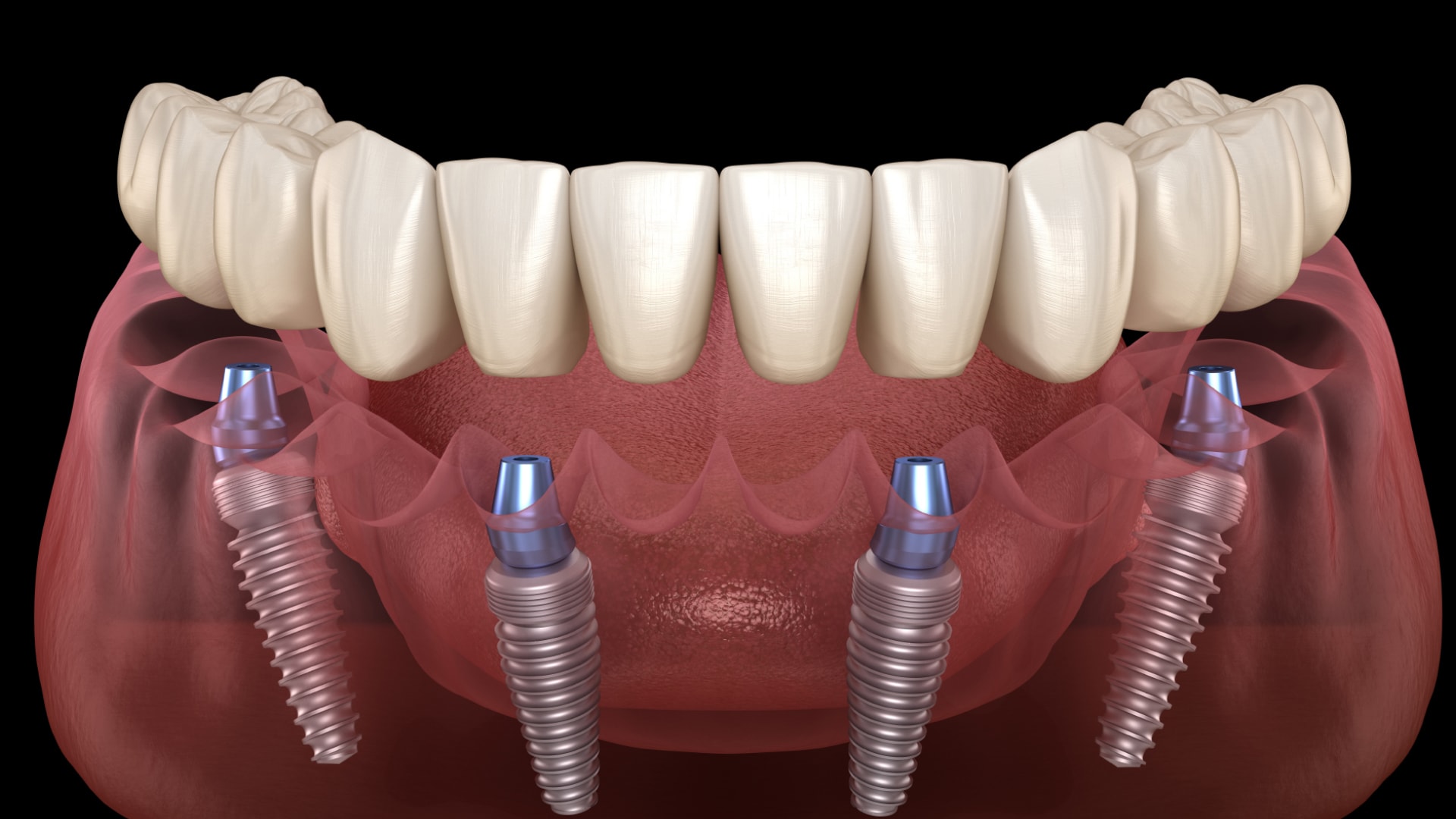
If you have looked into replacing all your teeth, you have probably run into a wall of names: All-on-4, All-on-X, full arch, full mouth, snap-on dentures, zirconia bridges. Half of them mean almost the same thing, and the other half are quietly priced very differently. This guide is built to be the one page that lays all of it out plainly, prices it against home, and tells you honestly who is a good candidate and who is not. When you are ready to see your own numbers, you can look at full mouth dental implants at our Bangkok clinic or read the broader full guide to dental implants in Thailand.
Full arch vs full mouth
This is the single biggest source of confusion, so let us fix it first.
A "full arch" is one jaw. You have an upper arch and a lower arch. "Full mouth" means both jaws, top and bottom, a complete set of teeth.
Here is why it matters for your wallet. Almost every price you see quoted online, including most of the numbers in this article, is per arch. When a page advertises "full mouth dental implants from $8,000," that figure is very often the price for a single arch, not both. If you need both jaws done, you double it.
So when you get any quote, ask one question: is this for one jaw or two? A per-arch price of 350,000 THB becomes 700,000 THB if you are replacing everything, top and bottom. Neither number is dishonest. They just answer different questions. Once you hold that distinction in your head, every option below becomes easy to compare.
Your four options, side by side
There are really only four ways to replace a complete arch of teeth with implants. Everything else is a variation on these. Here they are side by side.
| Option | Implants | Type | Cost per arch | Best for |
|---|---|---|---|---|
| All-on-4 | 4 | Fixed | from ~350,000 THB | Most patients wanting fixed teeth |
| All-on-6 | 6 | Fixed | Quoted after scan | Softer bone or heavy bite |
| All-on-8 | 8 | Fixed | Quoted after scan | Maximum support, longevity |
| Snap-on overdenture | 2 to 4 | Removable | Lower | Budget, removable option |
The first three are fixed. The teeth stay in your mouth and you clean them like natural teeth. The fourth clips onto implants and you take it out to clean. We go deeper into each of these in All-on-4 dental implants explained, All-on-6 dental implants in Thailand, and the All-on-8 and full-mouth technique. If you are torn between the first two, All-on-4 vs All-on-6: how to choose walks through it in detail.

How many implants do you need?
Here is the honest version that marketing pages skip: you do not choose the number of implants. Your prosthodontist does, after looking at a 3D CT scan of your jaw.
The number depends on a few things the scan reveals:
- Bone volume and density, and where your jaw is strongest
- Your bite force, and whether you grind or clench
- Which arch you are restoring (the lower jaw is denser than the upper)
Someone with dense bone and a light bite may do beautifully on four implants per arch. Someone with softer bone or a powerful bite may be advised toward six or eight, so the load spreads across more anchor points.
More implants is not automatically better, and fewer is not automatically cheaper in the way that matters. Four well-placed implants in good bone can outlast six poorly placed ones. The point of the CT scan and the in-person assessment is to match the number to your actual anatomy, not to a package name you picked online. When a clinic tells you the number before they have seen your scan, treat that as a sales figure, not a clinical one.
Fixed bridge or snap-on denture?
Once you know you are a candidate, the real decision is fixed versus removable.
A fixed full-arch bridge is screwed onto your implants and stays there. You do not take it out. It feels the closest to having your own teeth back. The bridge itself is usually one of two materials. A zirconia bridge is a strong, tooth-colored ceramic, very durable and natural looking, and it sits at the premium end. An acrylic hybrid uses acrylic teeth on a titanium framework, lighter on cost, still fixed, though the acrylic can wear or stain faster over the years.
A snap-on implant denture, also called an overdenture, clips onto two to four implants. You take it out to clean it and at night. It is dramatically more stable than a traditional denture that relies on suction and paste, so it will not slide when you eat or talk. It costs less because it uses fewer implants and a denture rather than a full bridge. The trade-off is that it is removable, and some people simply prefer the feeling of teeth that never come out.
Neither is the "right" answer. A fixed zirconia bridge is the closest thing to natural teeth and the highest investment. A snap-on overdenture is the value route that still gets rid of the wobble and the adhesive. Most people know within five minutes of hearing this which one is for them.
Are you a candidate?
Full arch implants work by fusing titanium posts into your jawbone, a process called osseointegration. That means you need enough healthy bone to hold them. This is where honesty matters more than optimism.
If you have lost teeth some time ago, the bone underneath tends to shrink. That is normal. It does not automatically disqualify you. Techniques like All-on-4 are specifically designed to angle implants into the areas where bone is usually still strong, which is exactly why they can often avoid grafting. But sometimes the bone is not enough on its own, and you will hear two terms.
A bone graft adds material to rebuild volume where bone has been lost. A sinus lift creates room for implants in the upper back jaw by gently raising the sinus floor and adding bone beneath it. Both are routine, both add time and some cost, and both are sometimes simply necessary. A clinic that never mentions the possibility is not being straight with you.
And here is the part almost no page will say out loud. Some people are not good candidates right now. Uncontrolled diabetes, active gum infection, heavy smoking, and certain medications all interfere with healing and osseointegration. In those cases the right advice is to stabilize the underlying issue first, not to rush into surgery. Being told "not yet" is a sign of a clinic protecting your outcome, not losing your business.
What it costs vs at home
This is the reason most international patients start looking abroad. The gap is large, and it is real. Prices below are indicative and per arch unless noted, then doubled for both arches.
| Treatment | Thailand / arch | Both arches | At home / arch |
|---|---|---|---|
| All-on-4 | from ~350,000 THB | ~700,000 THB | ~$20,000 to 30,000+ |
| All-on-6 / All-on-8 | Quoted after scan | Quoted after scan | ~$25,000 to 40,000+ |
| Single implant | from 45,000 THB | n/a | ~$4,000 to 6,000 |
Even after you add flights, a hotel for two trips, and meals, both arches in Thailand often come in around what a single arch alone costs at home. For a fuller breakdown, see dental implant cost in Thailand. The implant brand also moves the price. Systems range from Neobiotech (from 45,000 THB per single implant) and Neodent up to premium Straumann SLA and SLA Active, which cost more per post and factor into full-arch pricing too.
The traveler timeline
Full arch implant treatment is not a one-week holiday project, and you should be wary of anyone who says it is.
The realistic path is two trips over 3 to 6 months. On the first trip, the prosthodontist places the implants and, in many cases, fits a fixed temporary bridge so you leave with teeth, not gaps. You then fly home and heal while the implants fuse to the bone. On the second trip, once osseointegration is confirmed, you receive the final permanent bridge, custom made to fit precisely.
So what about "teeth in a day"? It is real, but the phrase is easy to misread. It means that on the day of surgery you can walk out with a fixed temporary set of teeth on the same implants, also called immediate load. It does not mean the final, permanent teeth are done that day. The temporary carries you through healing. The permanent bridge comes after your bone has integrated the implants. Anyone marketing "permanent teeth in a day" is stretching the truth. For the full sequence, read the implant procedure step by step and what to expect during implant recovery and aftercare.
Dentures now, fixed teeth later?
Yes, and for a lot of people this is the smart way to manage both the treatment and the budget.
You can start with an implant-supported overdenture, placing fewer implants now, and move to a fixed bridge later as finances or circumstances allow. In some staged plans, implants placed to stabilize a denture can be built into a later fixed solution rather than wasted. This lets you get out of a loose, uncomfortable denture quickly and at a lower entry cost, then upgrade when the timing is right.
Staging is worth planning from the very first consultation, because the number and position of your first implants can either open the door to a future fixed bridge or complicate it. Say up front that you may want to upgrade later, and the treatment can be mapped so nothing you pay for now goes to waste.
How long they last, and the warranty
The titanium implants themselves, the posts fused into your bone, can last for decades and often for life when they are well cared for and the surrounding gum stays healthy. The bridge or denture on top is the part that eventually shows wear. A zirconia bridge is extremely durable. An acrylic hybrid may need refurbishment or replacement of the acrylic portion over many years of use.
Care is straightforward but non-negotiable:
- Daily cleaning under and around the bridge
- Regular hygiene visits, and no skipped checkups
- A nightguard if you grind, since grinding shortens the life of the prosthesis
On warranty, honesty matters because you are flying home. Our clinic provides a 1-year written warranty, and the aftercare question is answered directly rather than dodged. If something needs attention after you return, we work with you on it, and a lot of minor issues can be assessed remotely from photos before you decide whether a return trip is needed. That is a very different thing from a page that either ignores what happens after you leave or uses fear about it as a sales tactic.
Is it safe, and how we work
Bangkok is one of the busiest dental tourism destinations in the world, and full arch implant treatment is core work here, not a novelty. Safety comes down to the specific clinic, not the country. What you want to check is the same anywhere: proper diagnostics, qualified specialists, and quality implant systems.
Our clinic is built around international patients. Here is how we are set up for a full-arch case done far from home:
- Around 70% international patients, with Australia our largest market alongside the UK, New Zealand, Canada and the US
- Next to BTS Siam in Siam Square, so appointments are easy even on a short trip
- 3D CT planning, so implant positions are mapped against your real anatomy
- On-site dental lab, which keeps the work under one roof and shortens turnaround
- Board-certified prosthodontists: Dr. Ple on full-arch restorative work, Dr. Nan (Thai Board of Prosthodontics and Orthodontics) leading cosmetics
- Recognized implant systems: Neobiotech, Neodent and Straumann
For a deeper look at the safety question, see is it safe to get implants in Thailand?.
How to start
You do not need to book a flight to find out where you stand. Send us a few photos of your teeth, tell us what you are after, and we reply within 24 hours with:
- your likely options for one arch or both
- a realistic cost range for your case
- whether you are a candidate now, or whether anything should be handled first
Frequently Asked Questions
What is the difference between full arch and full mouth dental implants?
Full arch means one jaw, upper or lower. Full mouth means both jaws, a complete set. Most prices are quoted per arch, so a "full mouth" figure may actually be for a single jaw. Always confirm whether a quote covers one arch or two.
How much do full mouth dental implants cost in Thailand versus Australia, the UK or the US?
In Thailand, a fixed All-on-4 arch starts from about 350,000 THB (~$10,300), so both arches from about 700,000 THB. Comparable single-arch treatment in Australia, the UK, or the US typically runs $20,000 to $40,000 or more. Even with travel added, Thailand is usually far less, and both arches in Thailand can land near the price of a single arch at home.
What are my options to replace all my teeth?
Four main routes: All-on-4 (4 implants, fixed), All-on-6 (6 implants, fixed), All-on-8 or full-mouth premium (8 implants, fixed, often zirconia), and implant-supported dentures (2 to 4 implants, removable). Cost and feel differ across all four.
How many implants do I need to replace a full set of teeth?
Between 4 and 8 per arch, decided by your prosthodontist after a 3D CT scan based on your bone volume, density, and bite. It is a clinical decision, not one you should pick from a package name online.
Am I a candidate for full mouth implants if I have bone loss, and will I need a bone graft?
Often yes. Bone loss is common and techniques like All-on-4 are designed to use the bone you still have, frequently avoiding grafts. Sometimes a bone graft or sinus lift is needed. A CT scan gives the real answer.
How long does full mouth implant treatment take and how many trips to Thailand are needed?
Usually 2 trips over 3 to 6 months. First trip places the implants and often a fixed temporary. You heal at home. Second trip fits the final permanent bridge.
Can I really get teeth in a day, or do I have to wait for healing?
You can leave surgery with a fixed temporary set the same day, known as immediate load. The final permanent teeth come after the implants fuse to your bone, so "teeth in a day" means temporary teeth, not the permanent bridge.
Can I get dentures now and upgrade to fixed implants later?
Yes. Many patients start with an implant-supported overdenture and move to a fixed bridge later. Plan this from the first consultation so your early implants support a future upgrade.
How long do full mouth dental implants last?
The titanium implants can last decades or for life with good care and healthy gums. The bridge on top wears more slowly for zirconia and faster for acrylic hybrids, and may eventually need refurbishment.
What happens with aftercare or warranty if something goes wrong after I fly home?
Our clinic provides a 1-year written warranty and answers aftercare directly. Many issues can be assessed remotely from photos first, so you know whether a return trip is actually needed before you commit to one.
Is it safe to get full mouth dental implants in Thailand?
It is, at a properly equipped clinic. Look for 3D CT diagnostics, qualified prosthodontists, recognized implant systems, and an on-site lab. Safety depends on the clinic, not simply the country.
What is the difference between fixed full-arch implants and snap-on implant dentures?
A fixed full-arch bridge is screwed onto your implants and stays in permanently, feeling closest to natural teeth. A snap-on implant denture clips onto fewer implants and comes out for cleaning. Fixed costs more, removable costs less and is still far more stable than a traditional denture.
Was this article helpful?