 Written by Dr. Nan
Wondering how many months you will actually be wearing braces before you see a straight smile? It is the first question most people ask, and the honest answer depends on your starting point.
Below we break down realistic timelines by case type, explain what speeds treatment up or slows it down, and cover the question almost no other guide answers honestly: how international patients manage a treatment that takes more than a year without living in Bangkok the whole time.
The average timeline: 12 to 24 months
For most patients, fixed braces take between 12 and 24 months from fitting to removal. That is the range orthodontists quote worldwide, and it is the same window our orthodontists in Bangkok plan around. The figure covers active tooth movement only. It does not include the retainer phase that follows, which protects your result for years afterwards.
It helps to think of treatment in three stages:
- Setup: consultation, X-rays, impressions, and the fitting itself, usually spanning a few weeks.
- Active treatment: where the months add up, as the archwire applies gentle, continuous pressure and your orthodontist adjusts it every 4 to 6 weeks.
- Removal and retention: removal takes about an hour, followed by the retainer phase to hold everything in place.
A useful rule: the more your teeth need to move, and the further they need to travel, the longer treatment runs. Teeth move slowly and safely at roughly a millimetre per month, so there is a biological limit to how fast any honest orthodontist can promise.
Treatment time by case complexity
The single largest factor in your timeline is how much correction your bite and teeth need. Here is a realistic breakdown of what different cases tend to require.
| Case complexity | What it usually involves | Typical time in braces |
|---|---|---|
| Mild | Minor crowding, a small gap, one or two slightly crooked teeth | 6 – 12 months |
| Moderate | Noticeable crowding, mild overbite or spacing across several teeth | 12 – 18 months |
| Complex | Severe crowding, significant overbite, underbite, crossbite, or rotated teeth | 18 – 36 months |
These are planning estimates, not promises. Your orthodontist gives you a personalised estimate after reviewing your X-rays and impressions, because two people with "crooked teeth" can have very different bites underneath.
The bracket system you pick affects the plan too, so our guide to braces in Thailand is worth a read. If you are weighing braces against removable trays, our guide to Damon braces versus Invisalign explains how the choice can affect both comfort and timeline, our clear aligners versus braces comparison covers the wider decision, and you can also read about clear aligners in Bangkok for milder cases.
Does the type of braces change how long treatment takes?
Patients often assume that paying more for clearer braces means a faster result. It usually does not. The thing that actually moves your teeth is the archwire and the gentle force it applies, and that force is the same biology regardless of what the brackets are made of:
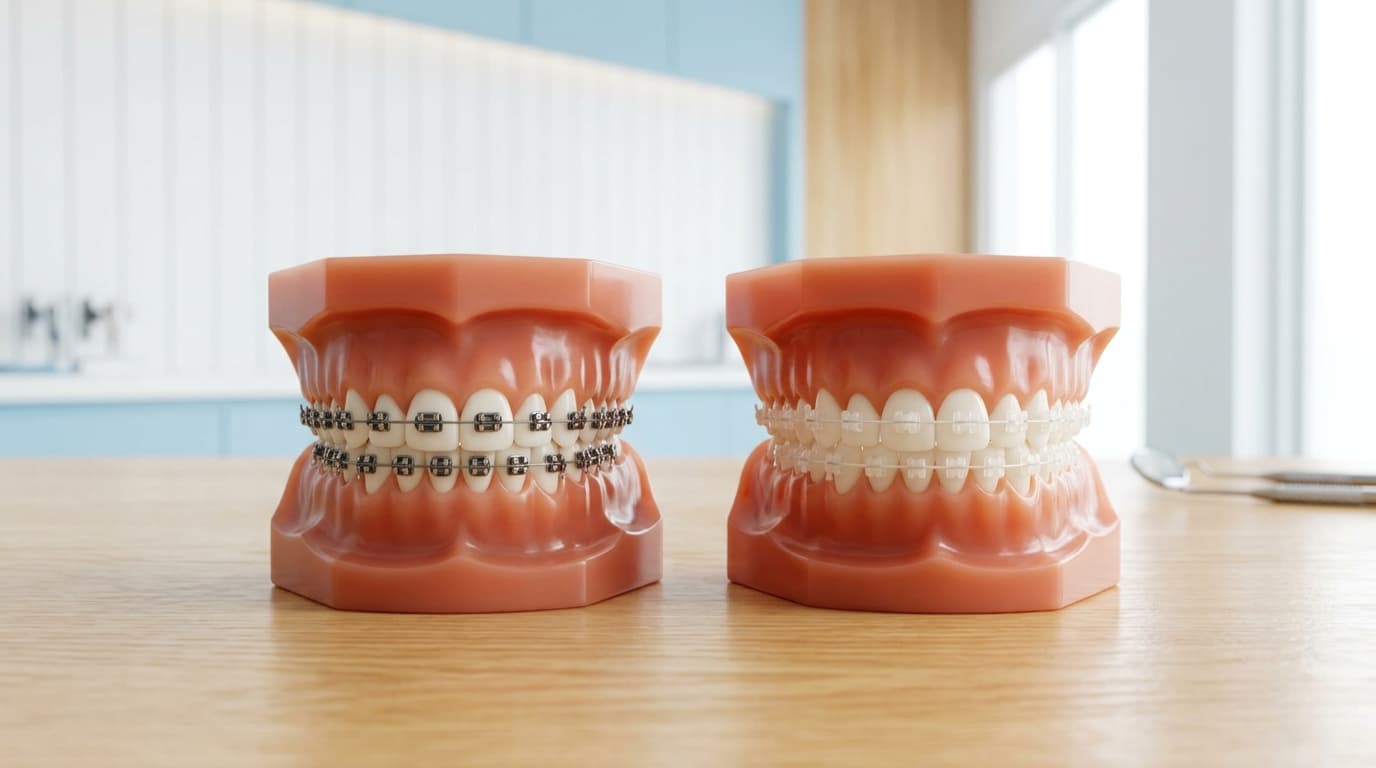
- Metal and ceramic braces correct the same cases in broadly the same window, which is why both sit at 12 to 24 months in our braces in Bangkok treatment plans.
- Self-ligating designs (the family that includes Damon) hold the wire without elastic ties, which can make adjustments a little smoother and sometimes slightly reduce in-chair visits. Helpful for travellers, but not a dramatic time saving.
- Removable clear aligners sometimes finish faster, but only because they tend to be used on milder cases to begin with. For straightforward crowding or spacing, clear aligners in Bangkok can run 6 to 18 months.
The headline to remember: a complex bite will take roughly the same time to fix whichever appliance you wear, so pick the one that suits your comfort, budget, and travel pattern rather than chasing a speed promise. Our guide to braces in Thailand explains the mechanical differences in plain terms, and the Damon braces versus Invisalign comparison walks through how the choice affects day-to-day life.
Adults and teens: does age change the timeline?
Braces work at any age, and the difference between a teenager and an adult is smaller than most people fear:
- Teens sometimes finish a touch quicker for a biological reason: a developing jaw remodels a little faster, so teeth settle into a new position with slightly less resistance.
- Adults have fully formed, denser bone, so the same correction can take a little longer, and your orthodontist may plan for the upper end of the range.
- Adults also more often bring extra factors that need managing first, such as gum recession, old fillings, missing teeth, or a worn bite, and addressing those adds to the overall plan.
None of this changes the quality of the result. Plenty of patients straighten their teeth comfortably in their 30s, 40s, and beyond.
In practice the bigger variable for adults is rarely age itself but consistency. A working adult who keeps every appointment and wears their elastics often finishes ahead of a teenager who forgets both, so the habits below matter more than the birthday on your file.

What speeds braces up, and what slows them down
Two patients with similar starting points can finish months apart. A lot of that gap comes down to factors you can actually influence.
What tends to speed treatment up:
- Keeping every adjustment appointment. Each visit moves treatment forward. Missing or delaying them is the most common reason braces drag on.
- Good oral hygiene. Gum inflammation from trapped plaque slows safe tooth movement. Clean teeth move on schedule.
- Wearing elastics or rubber bands exactly as prescribed. Bite correction often depends on them, and skipping them stalls progress.
- Avoiding broken brackets. A loose bracket from hard or sticky food means a repair visit before movement can continue.
What tends to slow treatment down:
- Case severity. Bigger corrections simply take longer, and no shortcut changes the biology.
- Adult bone density. Adult bone is fully formed and denser than a teenager's, so the same correction can take a little longer. Adults still get excellent results, the timeline is just slightly more patient.
- Skipped retainers later. This does not extend the braces themselves, but failing to wear a retainer afterwards can undo the result and send you back to square one.
A word of caution about "accelerated" gimmicks promising braces in a few months for everyone: real, stable orthodontic movement has limits. Be wary of any clinic that guarantees a dramatic correction far faster than the ranges above.
How international patients manage braces from abroad
Here is the honest part most dental tourism pages skip. Braces are a long treatment with regular check-ins, so it is not realistic to fly in, get straight teeth, and fly home in one trip. That said, plenty of international patients successfully do orthodontics in Bangkok. It just takes a sensible plan.
Two common approaches work well:
- Plan around longer stays or repeat visits. Some patients are based in the region, visit Bangkok frequently for work, or are happy to return every few months. Your orthodontist can schedule adjustments to line up with your trips, spacing them slightly differently from the standard 4 to 6 weeks where the case allows.
- Co-manage with an orthodontist back home. Have the initial assessment, planning, and braces fitting done in Bangkok, then arrange routine adjustments with a local orthodontist near home, returning to Bangkok periodically and for removal and retainer fitting. This works best when agreed up front so everyone shares the same treatment plan.
For milder cases, removable clear aligners can suit travellers better than fixed braces, since trays are changed on a set schedule with fewer in-chair adjustments. If you are still researching the destination overall, our overview of getting braces in Thailand and the bigger picture of dental tourism in Thailand walk through how to combine treatment with a trip sensibly.
Whichever route you choose, be upfront with us at the consultation about where you live and how often you can travel. We would rather build a realistic plan around your life than start something that cannot be finished comfortably.
What the timeline costs in Bangkok
Treatment time and cost are linked, since longer cases involve more adjustment visits. The good news is that orthodontics in Bangkok costs far less than in most Western countries, and our prices are all-inclusive rather than billed per visit.
| Treatment | Typical time | Price in Bangkok |
|---|---|---|
| Metal braces | 12 – 24 months | From ฿35,000 |
| Ceramic (clear) braces | 12 – 24 months | From ฿50,000 |
Those prices cover the consultation, the braces installation, your monthly adjustments, and the retainer at the end, and our guide to braces cost in Thailand breaks down exactly what is included.
Compared with the United States, the United Kingdom, or Australia, where braces are typically advertised at several thousand pounds or dollars, patients typically save 50 to 70 percent. Treatment also comes with a written 1-year warranty against bracket breakage under normal use, so a loose bracket during your treatment is covered.
The retainer phase: why braces are not the finish line
Once your braces come off, your teeth are straight but not yet settled. The bone and ligaments around them need time to stabilise, which is why every patient wears a retainer afterwards. Skip it and teeth can drift back, sometimes enough to need treatment again.
You will usually wear a retainer full-time at first, then gradually move to nights only. There are two common types:
- A removable clear retainer looks like a thin aligner and is taken out to eat and clean.
- A fixed retainer is a thin wire bonded behind your front teeth that you never take out.
Many patients end up with a removable one on top and a fixed wire on the bottom, where lower front teeth are most prone to crowding back. Your orthodontist recommends the combination that best suits your case.
The honest expectation is that retention is not a phase that ends, it simply becomes lighter. Most people wear a removable retainer at night indefinitely, because the tendency for teeth to drift never fully disappears. A few nights a week for years is a small price to protect a result that took more than a year to achieve.
For international patients this is the easiest stage to manage from home, as it needs far fewer clinic visits than active treatment. We fit your retainer before you finish with us and explain exactly how to wear it, clean it, and what to do if it cracks or you lose it.
If a removable retainer is damaged years later, a local dentist near home can usually make a replacement from a fresh impression.
Conclusion
The straight answer to "how long do braces take" is 12 to 24 months for most people, shorter for simple cases and longer for complex ones. The smarter question is how to fit that timeline around your life, especially if you live abroad, and that is exactly what a consultation is for.
Tell us about your case and your travel situation, send us a few photos, and we will give you an honest estimate, a clear plan, and an all-inclusive price. You can explore the full treatment on our braces in Bangkok page first if you want the detail.
Frequently Asked Questions
Can braces work faster than 12 months?
For genuinely mild cases, yes. Minor crowding or a single small gap can finish in 6 to 12 months. What is not realistic is squeezing a complex bite correction into a few months, no matter how the treatment is marketed. Teeth move safely at roughly a millimetre per month, and that biology sets the floor for any honest estimate.
Do braces hurt, and does the discomfort affect how long I wear them?
Most patients feel pressure and tenderness for a few days after fitting and after each adjustment, then it settles. Soft food and over-the-counter pain relief handle it easily. The discomfort does not change your timeline, and it is not a reason to skip appointments, since delaying adjustments is what actually drags treatment out.
How often will I need to visit the clinic?
During active treatment, every 4 to 6 weeks for an adjustment. If you live abroad, those visits are exactly what we plan around at your consultation, either by co-managing routine adjustments with an orthodontist near home or by spacing visits to line up with your trips to Bangkok.
Is wearing braces longer more expensive in Bangkok?
Our prices are all-inclusive rather than billed per visit, so a longer case does not mean a stack of surprise adjustment fees. Metal braces start from ฿35,000 (about $1,030) and ceramic from ฿50,000, with the consultation, fitting, monthly adjustments, and retainer included. Our braces cost in Thailand guide breaks down exactly what is covered.
What happens if I stop treatment partway through?
Stopping with braces still on, or removing them before the plan is complete, usually leaves your teeth in a worse position than where they started, because they have been moved but not finished. This is the real risk of an unrealistic travel plan, which is why we would rather agree a route you can actually complete before fitting anything.
Was this article helpful?