 Written by Dr. Nan
The three-tier choice: conventional denture vs snap-on overdenture vs fixed full-arch
Most people replacing a full arch of teeth are really choosing between three tiers, and the honest way to shop is to see all three side by side.
| Option | Stability | Removable? | Cost per arch |
|---|---|---|---|
| Conventional complete denture | Rests on gum, can slip | Yes | 15,000 THB (~$455) |
| Snap-on implant overdenture (2 to 4 implants) | Clips in place, stable to eat | Yes | ~120,000 to 355,000 THB (~$3,650 to $10,700) |
| Fixed full-arch (All-on-4 / All-on-6) | Fixed, feels closest to teeth | No, dentist removes it | 350,000 to 500,000 THB (~$10,600 to $15,200) |
Tier one is the cheapest and the least stable. Tier three is the most stable and the most expensive. The snap-on overdenture sits in the middle, and for a lot of patients it is the sweet spot: a big jump in stability for a fraction of the fixed-arch price.
If a plain denture is your starting point, read our conventional dentures in Thailand guide and the full denture cost breakdown first, then come back here to see what implants add.
What an implant-supported (snap-on) overdenture actually is, and how it differs from All-on-4
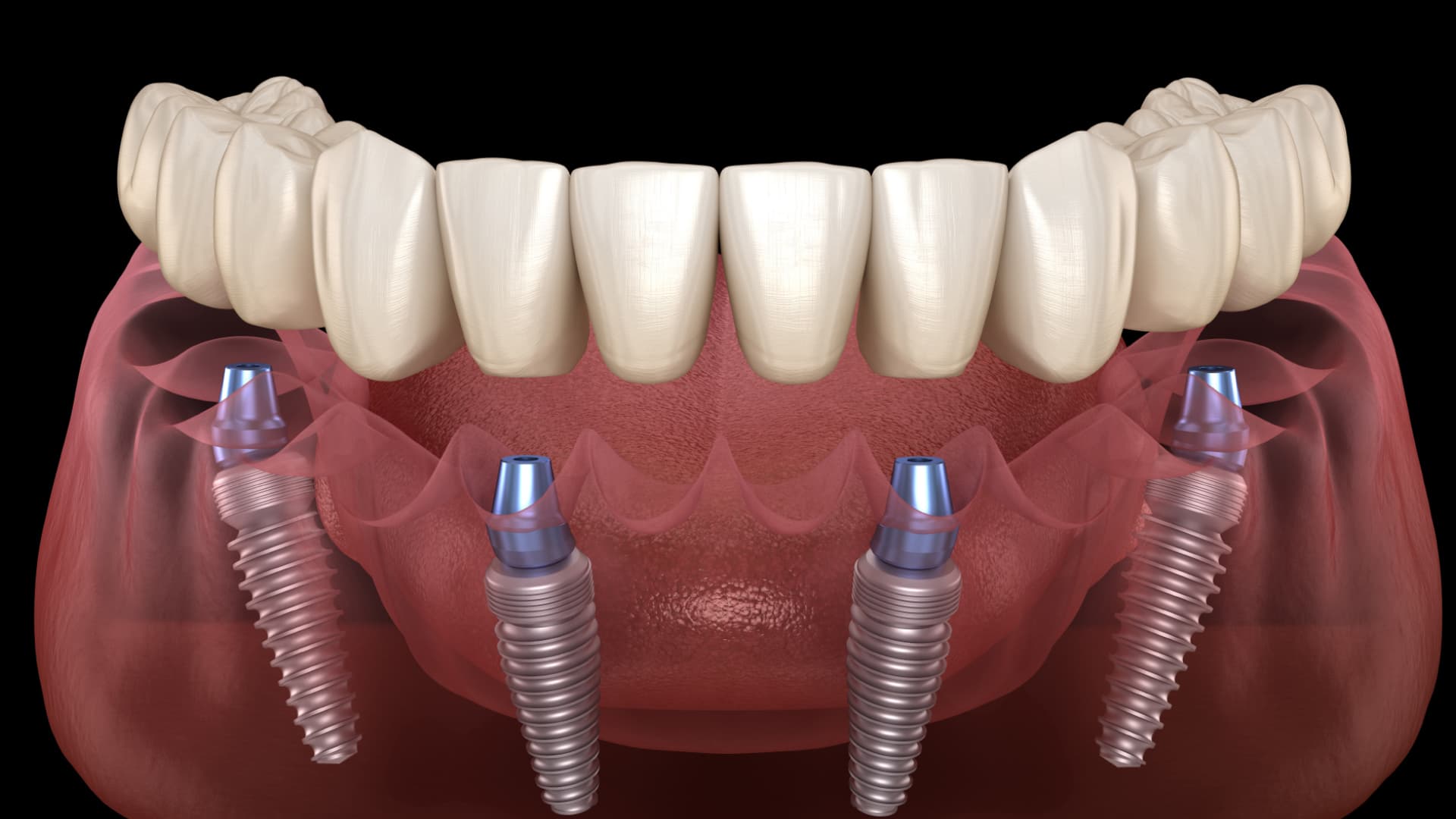
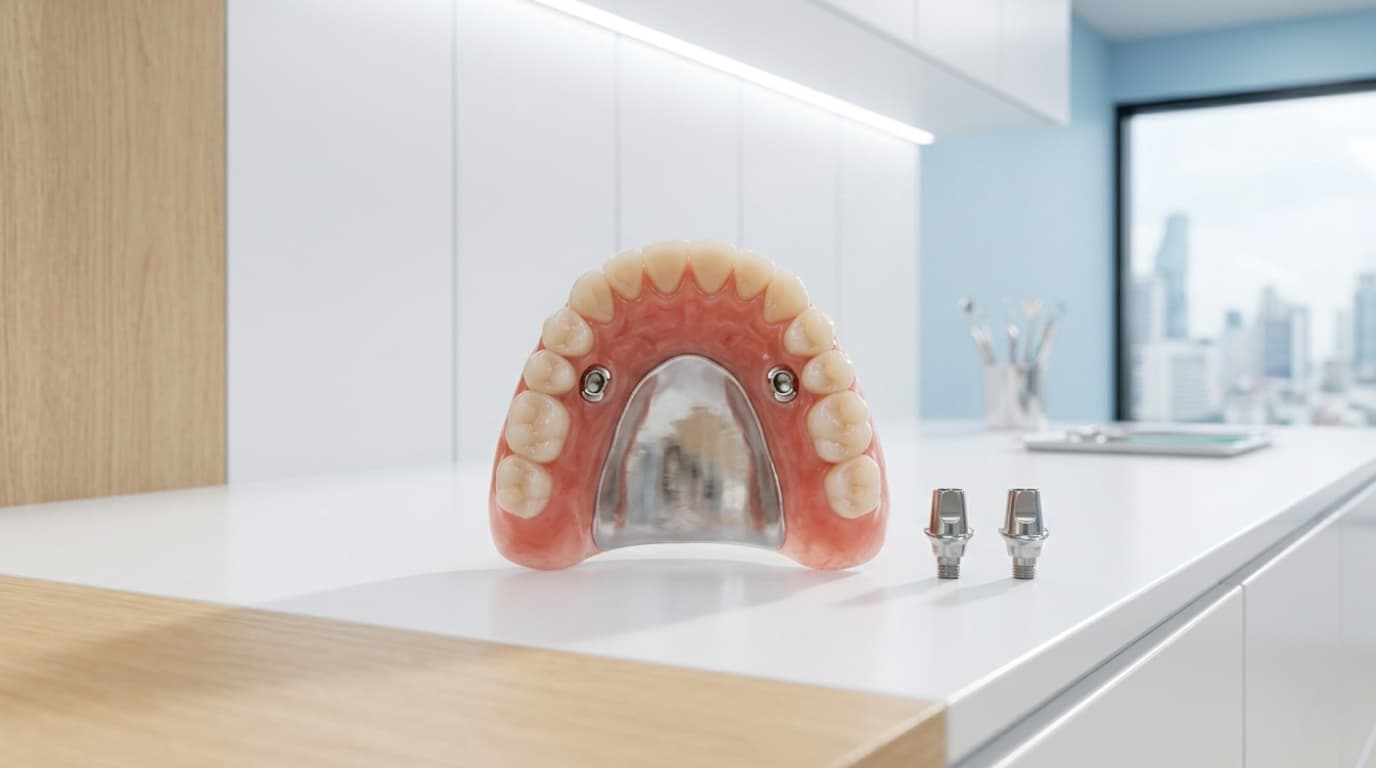
An implant-supported overdenture is a complete denture that snaps onto a small number of implants placed in your jaw. The implants do the holding. Your denture no longer relies on suction and gum grip alone.
The key difference from a fixed full-arch is simple:
- A snap-on overdenture comes out when you decide: you unclip it yourself for cleaning and at night.
- Fixed full-mouth dental implants are screwed onto four, six, or eight implants, and only your dentist can take the bridge off.
Fixed arches use more implants and more lab work, which is why they cost several times more. The overdenture buys most of the day-to-day comfort at a much lower price.
Removable vs fixed: why removability is the whole point here
Removability is not a compromise you tolerate. For many patients it is the feature they want:
- ✅ You lift the denture out to clean it thoroughly under running water, clean the gum and the attachments directly, and give the tissue a rest at night.
- ✅ It is easier to keep genuinely clean than a fixed arch, where you have to thread floss and water-flossers under a bridge you cannot remove.
- ❌ The flip side is honest: a removable prosthesis moves a fraction more than a fixed one, and you have to be willing to take it in and out every day.
If that daily routine sounds like a downside to you, fixed is probably worth the upgrade. If it sounds fine, you save a large sum.
How many implants you need: 2-implant vs 4-implant overdentures (and the upper-jaw caveat)
The lower jaw is the classic case. A lower 2-implant overdenture is the entry point and works well because lower dentures are the ones that float and rock the most, so even two implants transform the experience.
Four implants add more retention and let the denture sit more solidly, at higher cost.
| Configuration | Best for | Retention |
|---|---|---|
| 2 implants (lower) | Budget-focused, lower arch | Good, some rocking possible |
| 4 implants (lower or upper) | More stability, upper arch | Very good, minimal movement |
The upper-jaw caveat matters. The upper jaw has softer bone and the denture covers the palate, so upper overdentures usually want four implants rather than two to feel secure.
Two can be enough on the bottom. On top, plan for more. Our prosthodontists confirm the right number for you from a 3D CT scan, never a guess.
Ball / Locator attachments vs bar attachments: retention, cost, and cleaning tradeoffs
The attachment is the clip system that connects denture to implant. There are two common families.
| Ball / Locator (stud) | Bar attachment | |
|---|---|---|
| How it works | Each implant has its own stud, denture has matching nylon inserts | A metal bar links the implants, denture clips over the bar |
| Cost | Lower | Higher (extra lab bar) |
| Cleaning | Very easy, individual studs | Harder, clean around and under the bar |
| Retention | Good, even with 2 implants | Stronger, splints implants together |
| Maintenance | Replace worn nylon inserts periodically | Fewer insert changes, more complex if adjusted |
Ball or Locator studs are the popular, cost-friendly default, especially for 2-implant cases. Bar attachments cost more because of the custom bar, but they splint the implants together for stronger, more even retention, which suits some four-implant cases.
Neither is "better" in the abstract. It depends on your bone, your budget, and how much retention you want.
What it costs in Bangkok: THB and USD cost math built from real implant and denture prices
Here is the math built from our real prices, not marketing rounding. A single implant starts from 45,000 THB, and a complete denture is 15,000 THB per arch. Attachment components add a modest amount per implant.
| Build | Implants | Denture | Approx total (THB) | Approx (USD) |
|---|---|---|---|---|
| Lower 2-implant, Locator | 2 x from 45,000 | 15,000 | ~120,000 to 200,000 | ~$3,650 to $6,100 |
| 4-implant, Locator | 4 x from 45,000 | 15,000 | ~220,000 to 355,000 | ~$6,700 to $10,700 |
Compare that with 350,000 to 500,000 THB per arch for a fixed All-on-4. The snap-on overdenture is dramatically cheaper.
Implant totals rise if you choose premium brands, since our single implants range from Neobiotech at the entry level up toward Straumann at the top. For a single-tooth reference point, see the single implant cost in Thailand breakdown.
Your exact quote depends on brand, attachment type, and whether you need any grafting, all confirmed after your CT scan.
How the treatment works: 3D CT planning, healing time, and immediate vs delayed loading
Every case starts with a 3D CT scan so we can see bone height and width and plan implant positions precisely. On surgery day the implants are placed. Then the jaw needs time for osseointegration, the process where bone fuses to the implant, which typically takes two to six months.
There are two loading approaches:
- Delayed loading. You wear a conventional or softened denture while the implants heal, and the attachments are connected once healing is done.
- Immediate loading. In selected cases with strong bone, the attachments can be engaged sooner.
We only recommend immediate loading when the bone supports it, because rushing this stage risks the implants. Honesty here protects your result.
How many trips to Bangkok and how long the full timeline takes
Because healing sits in the middle, implant treatment usually runs across two trips over three to six months, the same pattern as our other implant work.
| Trip | What happens | Time in Bangkok |
|---|---|---|
| Trip 1 | CT scan, implant placement, temporary denture fitted | Several days |
| Healing at home | Osseointegration, 2 to 6 months | None |
| Trip 2 | Attachments connected, final overdenture fitted and adjusted | Several days |
You heal at home between trips, so you are not stuck in Thailand for months.
Do snap-on dentures stop bone loss? What implants actually preserve
Here is the honest version. When you lose teeth, the jaw bone that held them starts to shrink, and a plain denture sitting on top does not stop that. It can even speed up ridge shrinkage over years.
Implants change the picture, with an honest nuance:
- Around each implant, chewing force is transmitted into the bone and keeps it stimulated, which preserves bone in that zone.
- Between and behind the implants, the denture-bearing areas still change slowly, which is one reason relines are part of long-term care.
- More implants, more preserved bone. Two implants protect two zones. They do not freeze the entire ridge in place forever.
It is a real benefit, just not a magic seal.
Living with it: sleeping, cleaning, nylon insert wear, and attachment maintenance
Day to day, a snap-on overdenture is easy to live with. You press it down until it clicks in each morning, and you eat with confidence in foods that a plain lower denture struggles with.
Cleaning and upkeep come down to a short routine:
- Take it out, brush and rinse it, then clean the studs or bar in your mouth
- Take it out at night to rest the gums and reduce infection risk, unless your dentist advises otherwise
- Replace the nylon inserts when they lose grip, quick and inexpensive upkeep rather than a repair
- Have the denture relined occasionally to keep the fit snug as your gums settle
Those little clips wear down with the daily click in and click out, so insert changes are simply expected maintenance, not a sign anything has gone wrong.

The honest downsides: some movement, clip replacement, and when fixed is worth the upgrade
No overclaiming here. A snap-on overdenture has real tradeoffs:
- It moves a little more than a fixed arch, especially a 2-implant lower one
- On the upper jaw it covers more of your palate than a fixed bridge does
- You must take it out to clean it properly
- The nylon inserts wear out and need periodic replacement
- Upper-jaw stability is genuinely harder and usually needs four implants
If you want the closest thing to natural teeth, do not want your palate covered, and do not want to take anything out, then fixed is worth the extra money. Compare the fixed routes in our All-on-4 vs All-on-6, All-on-6 in Thailand, and All-on-8 full-arch implants guides.
The overdenture is the right answer when budget matters and removable is acceptable, not when you want maximum everything.
Are you a candidate? Bone volume, budget, and converting an existing denture
Good candidates are fully edentulous patients (or those about to lose a full arch) who:
- have enough bone volume for two to four implants
- want more stability than a plain denture, without the fixed-arch price
Thin bone may need grafting, which the CT scan reveals. If you are still weighing a single gap instead, the implant vs bridge comparison is a better starting point, and for partial cases see full vs partial dentures and flexible partial dentures.
One common question: can you convert an existing denture? Often yes. A well-made, well-fitting denture can sometimes be retrofitted with attachment housings to snap onto new implants, saving the cost of a new denture. Whether yours is suitable depends on its condition and fit, which we assess in person.
Why patients choose our Bangkok clinic: named prosthodontists, on-site lab, 1-year warranty
Your overdenture is planned and delivered by named prosthodontists, not anonymous staff:
- Board-certified specialists: Dr. Nan (Thai Board of Prosthodontics and Orthodontics) and Dr. Ple, a prosthodontist focused on implants, crowns and bridges
- 3D CT planning on every case, so implant positions are mapped to your real anatomy
- On-site dental lab that fabricates and adjusts your denture in house, so fit issues are solved fast
- 1-year written warranty on every case
You can explore the full range of dental implants in Bangkok on our main implant page.
Conclusion
A snap-on overdenture is the honest middle tier: most of the day-to-day stability implants can give you, at a fraction of the fixed-arch price, in exchange for a little movement and a daily click-in, click-out routine. Two implants transform a floating lower denture, and the upper jaw usually asks for four.
If removable suits your life, it is one of the best value-for-money upgrades in dentistry. If you want maximum everything, put the difference toward a fixed arch instead. Either way, the decision starts with your bone, on a CT scan, not with a package name.
You do not need to fly here to find out where you stand. Send us a few photos of your teeth, tell us what you are after, and we reply within 24 hours with whether a snap-on overdenture or a fixed arch suits your bone and budget, a realistic cost range, and whether anything should be handled first.
Frequently Asked Questions
What is the difference between implant-supported dentures and All-on-4?
An implant-supported overdenture is removable and clips onto two to four implants. All-on-4 is a fixed bridge screwed onto four implants that only your dentist removes. The overdenture is cheaper, All-on-4 is more stable.
Are implant-supported dentures removable?
Yes. You take them out daily to clean, which is the main reason people choose them over a fixed arch.
How many implants do you need for a snap-on denture?
Two to four. Two is common on the lower jaw. The upper jaw usually needs four for good stability.
How much do implant-supported dentures cost in Thailand?
A lower 2-implant snap-on runs roughly 120,000 to 200,000 THB (~$3,650 to $6,100) in Bangkok. Four implants cost more.
Are snap-in dentures cheaper than All-on-4?
Yes, substantially. A snap-on overdenture is a fraction of the 350,000 to 500,000 THB per arch cost of a fixed All-on-4.
What is the difference between ball and bar attachments?
Ball or Locator studs are individual, cheaper, and easy to clean. A bar links the implants for stronger retention but costs more and is harder to clean around.
How long do implant overdentures last?
The implants can last many years with good care. The nylon inserts wear out and are replaced periodically, and relines keep the fit snug.
Do snap-on dentures stop bone loss?
They help preserve bone around each implant, but they do not freeze the whole ridge. More implants preserve more bone.
Can you sleep with snap-in dentures in?
Most patients remove them at night to rest the gums, though your dentist tailors the routine to you.
How do you clean implant-supported dentures?
Take the denture out, brush and rinse it, and clean the studs or bar in your mouth. It is easier to clean than a fixed bridge.
Are implant overdentures painful?
Implant placement is done under anesthetic with manageable post-op soreness, similar to any implant surgery.
Can I convert my existing denture to snap onto implants?
Often yes, if it fits well and is in good condition. We assess this in person.
How many trips to Thailand do implant dentures take?
Usually two trips over three to six months, with healing done at home between them.
Do implant-supported dentures feel like real teeth?
They feel far more stable than a plain denture. A fixed arch feels closer to natural teeth, which is the tradeoff.
Is 2 implants enough for a lower overdenture?
Often yes. The lower jaw responds well to two implants. The upper jaw usually needs four.
Was this article helpful?