 Written by Dr. Nan
There is no single "best" answer that fits everyone, which is why this page is a neutral hub rather than a sales pitch. Below you will find an honest three-way comparison, a decision framework, and something almost no other guide gives you: exactly how many trips to Bangkok each option takes.
Why replacing a missing tooth matters (drift, bite changes, and bone loss)
A gap is rarely "just cosmetic." When you lose a tooth:
- Neighboring teeth slowly tilt and drift into the empty space.
- The opposing tooth can over-erupt because nothing is meeting it anymore.
- Your bite changes over months and years, cleaning gets harder, and your jaw joint can take strain.
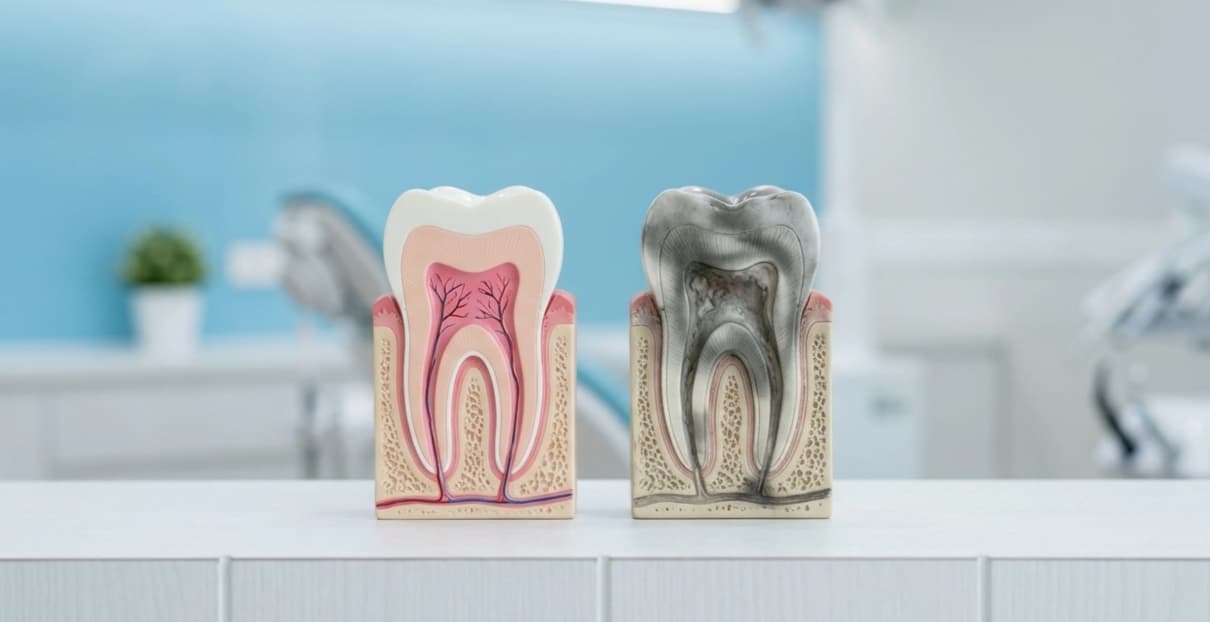
The quieter problem is bone. The root of a tooth stimulates the jawbone every time you chew. Remove the root and that section of bone starts to resorb, meaning it shrinks. This is why people who have worn dentures for a long time can develop a sunken look around the mouth.
Only an implant replaces the root and preserves bone directly. Bridges and dentures replace what you see above the gum but do not stop the bone underneath from receding.
So the honest reason to act is not vanity. It is protecting the teeth and bone you still have.
Your three real options at a glance
Here is the whole decision in one table. Prices are real clinic figures in Thai baht with a rough US dollar equivalent.
| Option | Typical cost | Longevity | Other teeth affected? | Healing / stability | Comfort |
|---|---|---|---|---|---|
| Implant | From 45,000 THB (~$1,320) single, up to ~$2,500 for premium brands | ~20 to 25 years, often longer | No, it stands alone | 3 to 6 months to fuse to bone | Feels closest to a natural tooth |
| Bridge | E-max 16,000 THB/unit, zirconia 17,500 THB/unit; 3-unit zirconia ~52,500 THB (~$1,590) | ~8 to 15 years | Yes, the two neighbors are ground down | Fixed and solid in 7 to 10 days | Fixed, feels stable to chew on |
| Denture | Acrylic partial 3,000, metal partial 8,000, complete 15,000 THB/arch (~$455) | ~5 to 10 years, relined as gums change | No grinding, clasps rest on them | Wearable in 2 to 4 weeks | Removable, least stable when chewing |
Read past this table and the differences get more personal. Let us go one by one.

Dental implants: the standalone, longest-lasting option
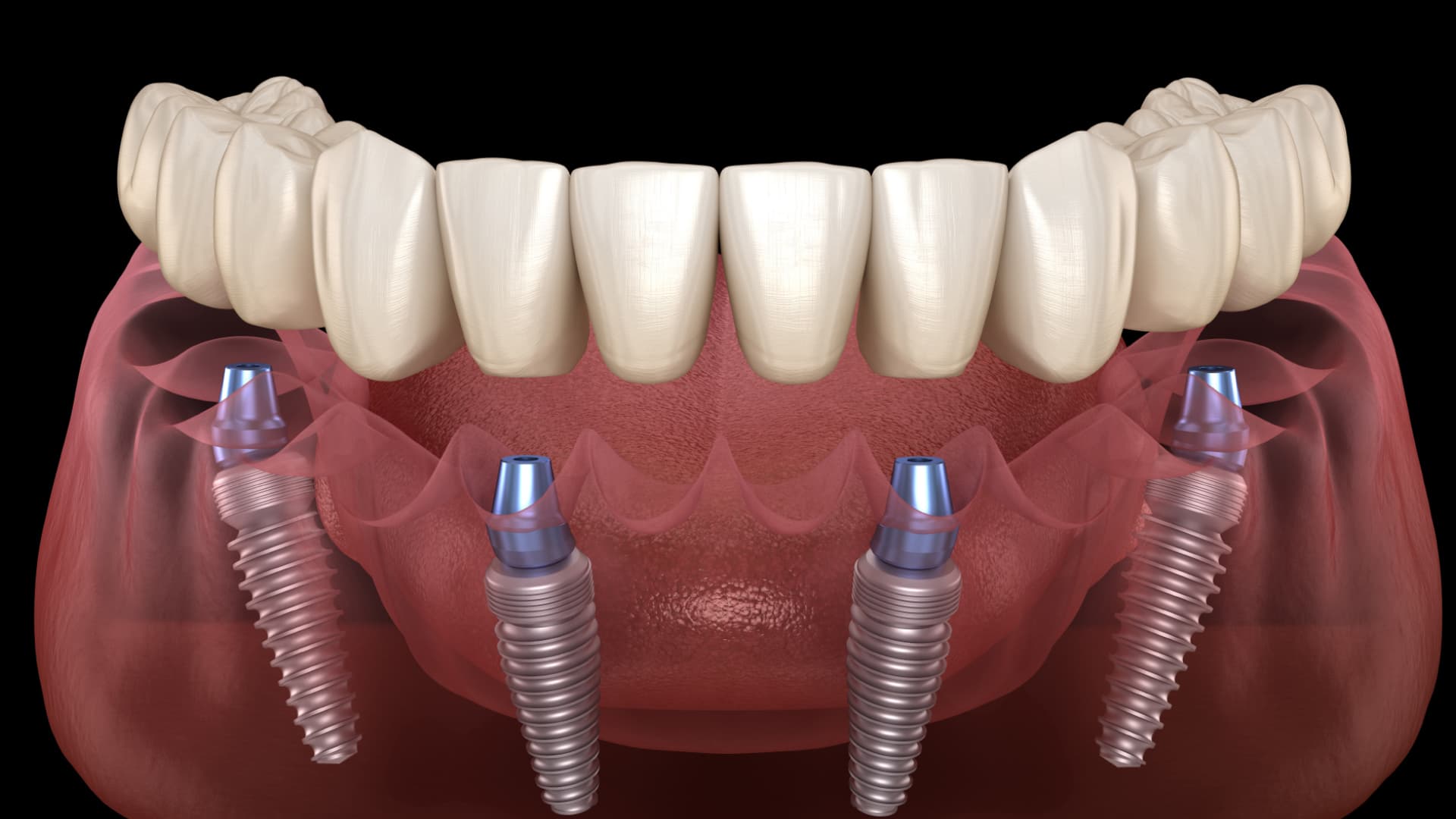
A dental implant is a small titanium post placed into the jawbone to act as a new root. Once it has fused to the bone, a process called osseointegration, an abutment and a crown are attached on top.
The result looks and functions like a natural tooth, and because it stands on its own, your neighboring teeth are never touched.
Implants are the gold standard for good reasons:
- They last the longest, often 20 to 25 years or more.
- They preserve bone, because the new root keeps stimulating the jaw.
- They are the easiest to clean: you floss around them like a normal tooth.
At our clinic single implants start from 45,000 THB (~$1,320) using Neobiotech and rise to around $2,500 for premium Straumann fixtures. For anyone replacing several teeth or a whole arch, an implant-supported bridge or an All-on-4 spreads a fixed arch across just four implants.
The honest trade-off is cost and time. Implants are the most expensive per tooth, and osseointegration cannot be rushed, so you are looking at 3 to 6 months from placement to final crown.
If that timeline works for you, this is usually the option we recommend. You can read the full implant cost breakdown or the details on dental implants in Bangkok for specifics.
Dental bridges: fixed and fast, but they lean on neighboring teeth
A traditional bridge fills a gap by anchoring a false tooth, called a pontic, to crowns on the two teeth on either side. It is cemented in place, so it is fixed, stable, and feels solid when you bite.
Best of all for a traveler, it can be completed in a single trip of 7 to 10 days.
The catch is right there in how it works. To place crowns on the neighboring teeth, the dentist has to grind those healthy teeth down:
- ✅ If they already needed crowns, no loss.
- ❌ If they were perfectly healthy, that is a real cost you are paying with tooth structure you cannot get back.
There are more conservative designs too. A Maryland or resin-bonded bridge uses a thin wing instead of full crowns, and a cantilever bridge anchors to just one side, though both are less durable and suit specific situations.
Bridges typically last 8 to 15 years. For the finer points see how long bridges last, the different types of dental bridges, the bridge cost breakdown, or dental bridges in Bangkok.
Dentures: the most affordable and flexible route
Dentures are the budget-friendly and most flexible path:
- A removable partial denture (acrylic, or a slimmer metal frame) clips onto your remaining teeth to fill one or several gaps.
- A complete denture replaces a full arch.
- A flexible denture uses a softer, gum-colored material with no metal clasps.
- A dental flipper is a lightweight temporary you can use while something more permanent is planned.
The appeal is obvious: an acrylic partial starts at just 3,000 THB, a metal partial at 8,000 THB, and a complete denture at 15,000 THB per arch (~$455). Nothing gets ground down, and everything can be adjusted, relined (2,000 THB) or repaired (1,500 THB) as your gums change shape.
The honest trade-off is stability. Because dentures rest on the gums rather than anchoring into bone, they move more when you chew or speak, and some people find they dull the taste and feel of food, especially with an upper full denture that covers the palate.
They also do not stop the bone loss underneath. For more, compare full vs partial dentures, see the denture cost breakdown, or read about dentures in Bangkok.
How to decide: a simple framework by number of teeth, position, budget, and bone health
Instead of a "best," think in terms of four questions. Answer them honestly and one option usually rises to the top.
How many teeth
- A single tooth: the cleanest fight is implant vs bridge, and we hand that two-way decision to our dedicated implant vs bridge deep dive.
- A few teeth in a row: a bridge or a partial denture both work, while implants can replace each one individually.
- A full arch or all your teeth: the conversation shifts to full dentures versus an implant-supported All-on-4, which we cover in replacing a full arch or all your teeth.
Front tooth or back
- A front tooth is about appearance and a natural gum line, where an implant or a well-made bridge shines.
- A back molar takes heavy chewing force, so durability matters most, and an implant or a fixed bridge tends to beat a removable denture there.
- If cost rules out a fixed option for a back tooth, a partial denture still restores function.
Budget and bone
- Limited bone density or gum health: an implant may need grafting first, or may not be the right call at all, which pushes you toward a bridge or denture.
- Budget as the hard limit: a denture is the answer, then a bridge, then an implant.
- Want to avoid surgery entirely? Our sibling guide on non-implant alternatives lays out every route that skips the drill.
Honest trade-offs: what each option costs you (not just in money)
Every option asks for something in return:
- Implant: the most money and the most patience, in exchange for the longest life and untouched neighbors.
- Bridge: two healthy teeth ground down, in exchange for speed and a fixed result in one trip.
- Denture: a removable appliance that is less stable and does not preserve bone, in exchange for the lowest cost.
There is no free choice here, only the trade-off that fits your priorities. A good dentist will tell you what you are giving up, not just what you are getting.
Doing it in Bangkok: how many trips and how long each option takes
This is the part most guides skip entirely, and for an international patient it is the whole decision. Here is what each path actually requires.
| Option | Trips to Bangkok | Total time | Why |
|---|---|---|---|
| Implant | Usually 2 trips | 3 to 6 months | The post must fuse to bone before the final crown |
| Bridge | 1 trip | 7 to 10 days | Teeth prepped, bridge made in our on-site lab, cemented |
| Denture | 1 trip | 2 to 4 weeks | Impressions, fitting, and adjustments over a few visits |
If you can only fly once, a bridge or denture may win on feasibility alone, even where an implant would be the textbook choice. If you can split the treatment across two visits over several months, the implant is on the table.
This is exactly the kind of thing to raise in your consultation so we can plan around your travel.

Cost snapshot: real prices for all three paths side by side
To bring the money into one place:
| Path | Price |
|---|---|
| Single implant (Neobiotech) | From 45,000 THB (~$1,320) |
| Single implant (premium/Straumann) | Up to ~$2,500 |
| E-max bridge | 16,000 THB/unit |
| Zirconia bridge (3-unit) | ~52,500 THB (~$1,590) |
| Acrylic partial denture | 3,000 THB |
| Metal partial denture | 8,000 THB |
| Complete denture (per arch) | 15,000 THB (~$455) |
Conclusion
There is no universal best here, only three honest trade-offs. An implant buys the longest life and untouched neighbors with the most money and patience. A bridge buys speed and a fixed result in one trip at the price of two ground-down teeth. A denture buys the lowest cost at the price of stability.
Match the option to how many teeth you are replacing, where they sit, your bone, and the number of trips you can make, and the decision usually makes itself. Whichever route you choose, our work comes with a 1-year written warranty and everything is made in our on-site dental lab.
You do not need to book a flight to find out where you stand. Send us a few photos of your teeth, tell us how many you are replacing and how long you can stay, and Dr. Nan's team replies within 24 hours with the option that fits, a realistic cost range, and how many trips it would take.
Frequently Asked Questions
What is the best way to replace a missing tooth?
For most people with healthy bone, a dental implant, because it lasts longest and leaves neighboring teeth untouched. The "best" for you depends on budget, position, and how many trips you can make.
How much does it cost to replace a missing tooth?
In Bangkok, from 3,000 THB for a partial denture, from about 16,000 THB per unit for a bridge, and from 45,000 THB (~$1,320) for a single implant.
What is the cheapest way to replace a missing tooth?
A removable partial denture, starting at 3,000 THB for acrylic.
Can you replace a missing tooth without an implant?
Yes. A bridge or a denture both replace teeth without surgery. See our guide on non-implant alternatives.
What happens if you don't replace a missing tooth?
Neighboring teeth drift, the opposing tooth over-erupts, your bite changes, and the jawbone in that spot slowly resorbs.
Is a dental implant or a bridge better?
It depends on whether you value longevity and preserving neighboring teeth (implant) or speed in one trip (bridge). See our implant vs bridge deep dive.
Which is better, dentures or implants?
Implants are more stable and preserve bone; dentures are far cheaper and need no surgery. Many people choose based on budget and bone health.
How long does it take to replace a missing tooth?
A bridge in 7 to 10 days, a denture in 2 to 4 weeks, an implant in 3 to 6 months.
Can a missing tooth be replaced in one trip abroad?
Yes, with a bridge or a denture. An implant usually needs 2 trips.
Which tooth replacement lasts the longest?
The implant, often 20 to 25 years or more.
How many teeth can a bridge or denture replace?
A bridge typically spans a few consecutive teeth; a denture can replace a few teeth or a full arch.
Does replacing a missing tooth hurt?
Bridges and dentures are not surgical. Implant placement is done under local anesthetic, with mild soreness for a few days afterward.
Was this article helpful?